

Waves from the Tonga tsunami are still being felt in Australia – and even a 50cm surge could knock you off your feet
- Written by Hannah Power, Associate Professor in Coastal and Marine Science, University of Newcastle
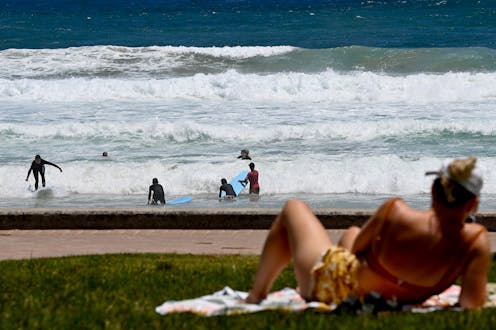
The eruption of the underwater volcano Hunga Tonga–Hunga Ha'apai created a tsunami felt across the Pacific Ocean. This includes Australia, where small but measurable tsunami waves were still being recorded as late as Monday afternoon. These may even persist into Tuesday morning.
The sea level gauge at Nuku’alofa, Tonga, recorded a tsunami wave of 1.19 metres before it stopped reporting. The waves that subsequently arrived at the Australian coast were comparable to some of the biggest tsunami waves recorded here, including those generated by the southern Chile earthquake in 1960 – one of the largest on record.
The Tongan volcanic eruption generated waves of 82cm at the Gold Coast. In southern coastal New South Wales, the tsunami waves reached 65cm at Port Kembla and 77cm at Eden’s Twofold Bay.
Australians tend to be fairly relaxed about tsunami risk. But this latest event demonstrates Australia is vulnerable to tsunamis, and that warnings from authorities to stay away from foreshore areas should not be ignored.
Why are tsunami waves different?
Where everyday ocean waves are caused by wind, tsunamis are caused by the large-scale vertical displacement of the water column.
The biggest cause of tsunamis is underwater earthquakes. Underwater volcanoes are a far less common cause, as the graph below shows.
A tsunami wave of, say, 50cm might not sound that big. But it’s entirely different to the normal waves arriving at our coastline everyday. Those normal waves might take 5-15 seconds to come onshore and flow back out. A single tsunami wave can last minutes or more than an hour.
Let’s look at data from tide levels in Sydney on Saturday night. The tsunami off Tonga occurred at 3.10pm AEDT, and waves first arrived in Sydney just after 6pm.
Between 8.17pm and 9.08pm, two peaks in the tsunami waves were recorded. Each wave lasted almost 30 minutes – 15 minutes while the water went onshore, and 15 minutes while it went offshore.
And as late as Monday afternoon, hour-long tsunami waves were being recorded at Batemans Bay in NSW.
At some places along the Australian coast, these waves were 50cm high and the water was pushing onshore for 15 to 30 minutes. That is really different to a normal 50cm wave.
If you were standing on the beach in Australia observing the tsunami, it would look like the tide was coming in really fast. Half a metre of tidal change would normally take 90 minutes or more – here we’re talking about that happening six times faster.
The below controlled experiment conducted in Japan shows how a human can struggle to stand in a strong, rapid flow of knee high water, similar to that which would occur during a tsunami:
Read more: Making waves: the tsunami risk in Australia
Tsunami waves are unpredictable
Tide gauges up and down the coast, which usually measure everyday water levels, can also be used to determine the size of tsunami waves. These days, tide gauges usually operate using acoustic or pressure sensors.
To measure a tsunami wave, we take out the tide level and the short oscillations which represent normal waves so we’re only left with the waves from the tsunami.
Tsunami waves typically arrive in a series which lasts for 12 to 24 hours, and the first wave is not always the biggest.
I’m on holidays at the beach at the moment. I spoke to a few people on Sunday who had been for a morning swim because they thought the tsunami had passed – but it hadn’t. In some places in Australia, the biggest tsunami waves were observed after 10am on Sunday – more than 12 hours after the first recorded impacts.
A tsunami wave does not behave in a linear fashion. It radiates out across the ocean and interacts with the continents and coastlines, as well as the features of the seabed such as sea mounts and underwater ridges. Tsunami waves also travel faster in deep water than shallow water. All these factors interact to cause the waves to bounce around in complex ways.
Before communications to Tonga were lost, video reports showed significant tsunami wave flooding and inundation which damaged roads, buildings, and infrastructure such as seawalls.
As well as affecting Australia, tsunami waves also travelled across the whole Pacific Ocean to Fiji, the Cook Islands, New Caledonia, New Zealand, along both the North and South American coastlines and to Japan. Some of these places reported flooding and localised inundation.
Fortunately, Australia didn’t experience significant inundation due to this tsunami. The effect was most visible in estuaries, which don’t feature swell or wind waves that to bystanders can mask the signal of the tsunami.
Tsunamis can cause cause significant erosion, especially in estuaries when water is flowing in and out very quickly. Following the 1960 Chile earthquake, for example, the Sydney suburb of Clontarf experienced significant erosion.
Read more: Yes, a tsunami could hit Sydney – causing flooding and dangerous currents
Don’t ignore the risks
Australians tend to be fairly complacent about tsunamis because we don’t have a large localised risk. In contrast, places like New Zealand are more highly attuned to the dangers because the country is close to plate tectonic boundaries – part of the outer rocky crust of the Earth that could generate the large earthquakes that cause most tsunamnis.
But given the potential for further volcanic activity off Tonga, further tsunamis could be generated, and they may again reach Australia.
Australia is better prepared for tsunamis following the devastating 2004 Boxing Day tsunami. This includes the joint Australian Tsunami Warning System run by the Bureau of Meteorology and Geoscience Australia.
In the event of a tsunami warning, keep a close eye on emergency alert services and follow guidance from emergency services. Certainly, during a tsunami warning is no time to go swimming or surfing.
Read more: The Tonga volcanic eruption has revealed the vulnerabilities in our global telecommunication system
Authors: Hannah Power, Associate Professor in Coastal and Marine Science, University of Newcastle

















