

Some endangered species can no longer survive in the wild. So should we alter their genes?
- Written by Tiffany Kosch, Research Fellow, The University of Melbourne
Around the world, populations of many beloved species are declining at increasing rates. According to one grim projection, as many as 40% of the world’s species may be extinct by 2050. Alarmingly, many of these declines are caused by threats for which few solutions exist.
Numerous species now depend on conservation breeding programs for their survival. But these programs typically do not encourage species to adapt and survive in the wild alongside intractable threats such as climate change and disease.
This means some species can no longer exist in the wild, which causes major downstream effects on the ecosystem. Consider, for example, how a coral reef would struggle to function without corals.
What if there was another way? My colleagues and I have developed an intervention method that aims to give endangered species the genetic features they need to survive in the wild.
Bringing theory into practice
Over generations, natural selection enables species to adapt to threats. But in many instances today, the speed at which threats are developing is outpacing species’ ability to adapt.
This problem is especially apparent in wildlife threatened by newly emerging infectious diseases such as chytridiomycosis in amphibians, and in climate-affected species such as corals.
The toolkit my colleagues and I developed is called “targeted genetic intervention” or TGI. It works by increasing the occurrence or frequency of genetic features that impact an organism’s fitness in the presence of the threat. We outline the method in a recent research paper.
The toolkit involves artificial selection and synthetic biology. These tools are well established in agriculture and medicine but relatively untested as conservation tools. We explain them in more detail below.
Many tools in our TGI toolkit have been discussed in theory in conservation literature in recent decades. But rapid developments in genome sequencing and synthetic biology mean some are now possible in practice.
The developments have made it easier to understand the genetic basis of features which enable a species to adapt, and to manipulate them.
Read more: We name the 26 Australian frogs at greatest risk of extinction by 2040 — and how to save them
What is artificial selection?
Humans have long used artificial (or phenotypic) selection to promote desirable characteristics in animals and plants raised for companionship or food. This genetic alteration has led to organisms, such as domestic dogs and maize, that are dramatically different from their wild progenitors.
Traditional artificial selection can lead to outcomes, such as high inbreeding rates, that affect the health and resilience of the organism and are undesirable for conservation. If you’ve ever owned a purebred dog, you might be aware of some of these genetic disorders.
And when it comes to conservation, determining which individuals from a species are resistant to, say, a deadly pathogen would involve exposing the animal to the threat – clearly not in the interests of species preservation.
Scientists in the livestock industry have developed a new approach to circumvent these problems. Called genomic selection, it combines data from laboratory work (such as a disease trial) with the genetic information of the animals to predict which individuals bear genetic features conducive to adaptation.
These individuals are then chosen for breeding. Over subsequent generations, a population’s ability to survive alongside pervasive threats increases.
Genomic selection has led to disease-resistant salmon and livestock that produce more milk and better tolerate heat. But it is yet to be tested in conservation.
What is synthetic biology?
Synthetic biology is a toolkit for promoting change in organisms. It includes methods such as transgenesis and gene editing, which can be used to introduce lost or novel genes or tweak specific genetic features.
Recent synthetic biology tools such as CRISPR-Cas9 have created a buzz in the medical world, and are also starting to gain the attention of conservation biologists.
Such tools can accurately tweak targeted genetic features in an individual organism – making it more able to adapt – while leaving the rest of the genome untouched. The genetic modifications are then passed on to subsequent generations.
The method reduces the likelihood of unintended genetic changes that can occur with artificial selection.
Synthetic biology methods are currently being trialled for conservation in multiple species around the world. These include the chestnut tree and black-footed ferrets in the United States, and corals in Australia.
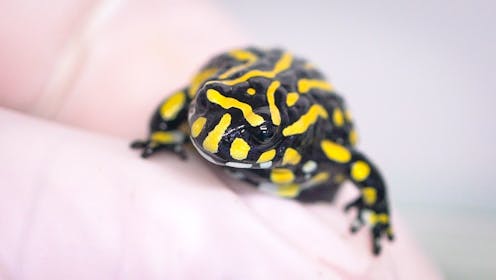
I am working with researchers at the University of Melbourne to develop TGI approaches in Australian frogs. We are trialling these approaches in the iconic southern corroboree frog, and plan to extend them to other species if they prove effective.
Worldwide, the disease chytridiomycosis is devastating frog populations. Caused by the fungal pathogen Batrachochytrium dendrobatidis, it has led to the extinction of about 90 frog species and declines in as many as 500 others.
Many frog species now rely on conservation breeding for their continued survival. No effective solution for restoring chytrid-susceptible frogs to the wild exists, because the fungus cannot be eradicated.
Looking ahead
As with many conservation approaches, targeted genetic intervention is likely to involve trade-offs. For example, genetic features that make a species resistant to one disease may make it more susceptible to another.
But the rapid rate of species declines means we should trial such potential solutions before it’s too late. The longer species are absent from an ecosystem, the greater the chance of irreversible environmental changes.
Any genetic intervention of this type should involve all stakeholders, including Indigenous peoples and local communities. And caution should be taken to ensure species are fit for release and pose no risk to the environment.
By bringing the concept of TGI to the attention of the public, government, and other scientists, we hope we will spur discussion and encourage research on its risks and benefits.
Read more: 5 major heatwaves in 30 years have turned the Great Barrier Reef into a bleached checkerboard
Authors: Tiffany Kosch, Research Fellow, The University of Melbourne

















