

Have you stopped wearing reusable fabric masks? Here's how to cut down waste without compromising your health
- Written by Aleasha McCallion, Strategic Projects Manager, Monash Sustainable Development Institute, Monash University

At the beginning of the pandemic, many of us opted to buy reusable fabric masks to help fight the spread of COVID – they’re better for the environment than disposables, can be locally made, and come in a range of creative designs.
But since the highly infectious Omicron variant emerged, we’ve been urged to wear well-fitted respirator mask as a first choice (N95, KN95, or P mask). These, however, have a short shelf-life, and it may be jarring to switch back to a more wasteful product for many environmentally-minded Aussies.
While it’s too soon to say exactly how many disposable masks go to landfill in Australia, we do know textile waste is already a massive issue. Every year, each Australian throws away around 23 kilograms of clothes on average, with more than 780,000 tonnes of leather, rubber and other textile waste generated Australia-wide.
As waste generation is likely to increase as we protect ourselves against Omicron, are there ways we can minimise our waste without compromising our health?
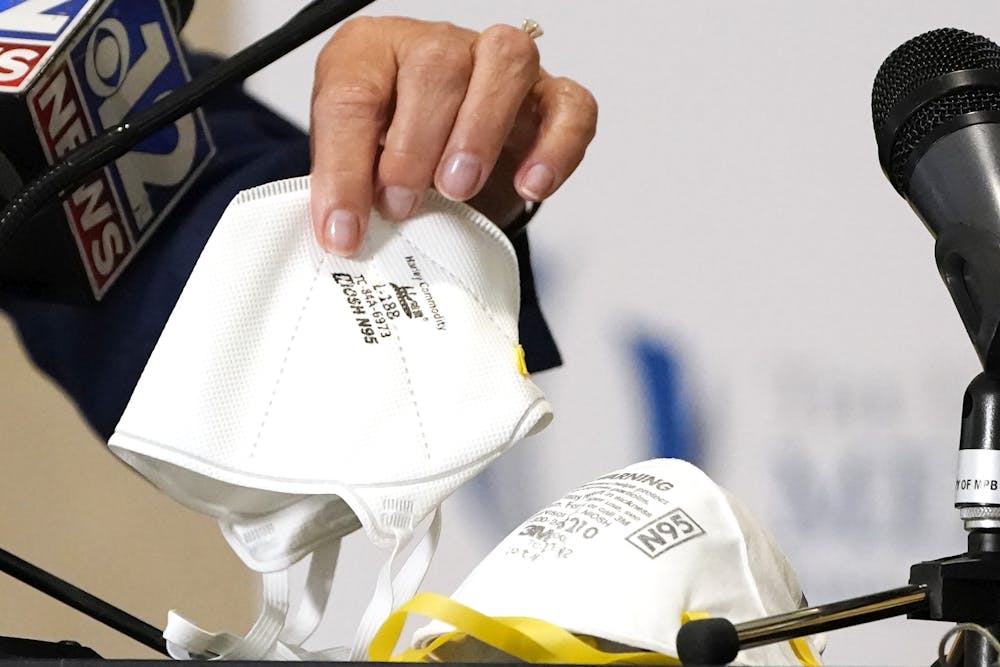
Making the most out of masks
Australians have been advised since mid-2020 that N95 masks offer the best protection against coronavirus. They typically offer a tighter fit to the face and a higher level of filtration than fabric masks, protecting the wearer from aerosols and droplets.
But supply chain issues, concerns of shortages, and lower transmission rates of earlier variants meant the comparatively less effective fabric and surgical masks were fit-for-purpose in lower-risk settings. This is no longer the case under the Omicron variant.
An easy way to minimise waste if you own N95 masks is to safely extend their life. In hospital settings, it’s advised to avoid use beyond one day and to dispose if they become soiled or moist.
This, however, is not realistic for the general public, such as when supply is low. There are a range of methods to reuse N95 masks safely, which are supported by the mask’s inventor. There are also re-usable options such as elastometric respirators.
Read more: Time to upgrade from cloth and surgical masks to respirators? Your questions answered
For disposable respirators, the most straightforward reuse method in non-medical settings is to rotate your mask every three or four days, storing it in a clean paper bag when not in use. Wash your hands thoroughly before and after you touch your mask, and keep your mask dry – if your mask gets wet, stop using it. Consider numbering your masks so you don’t mix them up.
The US Centre for Disease Control and Prevention (CDC) recommends using N95s up to five times before throwing it away (if they’ve been kept clean and aren’t damaged). But it’s important to note the long-term effects of cleaning and reuse are still unknown.
How to safely reuse your N95.There’s no need to throw away fabric masks. Having your favourite fabric masks on hand as backup in your car, bag or pockets is important because any mask is better than no mask in low-risk and fleeting contact settings, such as outside.
Double masking – placing your fabric mask over a disposable surgical mask – offers increased protection compared to a single fabric or surgical mask. And fabric masks will also offer protection against other droplet-based diseases, like the flu.
Sustainability in healthcare
The surge in disposable mask waste points to a broader issue that’s getting increasingly recognised: hospital waste.
Take single use plastic hospital gowns, for example. An estimated 1 million gowns have been used each year of the pandemic at just one (of six) acute public hospitals in Victoria, according to an ongoing investigation undertaken by co-author Forbes McGain.
This number is a conservative estimate, and only captures public hospitals when we know disposal gowns are used in many other settings. This includes in private hospitals, aged care, residential and home care, allied health services and testing and vaccination centres.
 Disposable hospital gowns generate enormous amounts of waste.
AAP Image/Joel Carrett
Disposable hospital gowns generate enormous amounts of waste.
AAP Image/Joel Carrett
Environmentally sustainable healthcare is an emerging field aimed at finding alternative solutions to the waste generated in healthcare, its impacts on the environment, and how we educate health professionals on sustainable practices.
For example, research shows there’s potential to expand the “tiered approach”, which offers further choice of protection depending on low or high risk settings. For example, integrating reusable gowns when appropriate could help keep people safe, put less strain on supply systems, and help reduce waste.
Read more: Health care has a huge environmental footprint, which then harms health. This is a matter of ethics
Spearheading this effort is textile scientist Meriel Chamberlin, who is collaborating with clinicians to develop compliant, safe and reusable textile gowns that offer protection and comfort with a lower environmental impact than disposables.
When it comes to masks, more sustainable options are also being developed. This includes masks and filters made from biodegradable agricultural crop waste.
Research is also underway to identify processes for re-purposing discarded single-use face masks into road pavements materials.
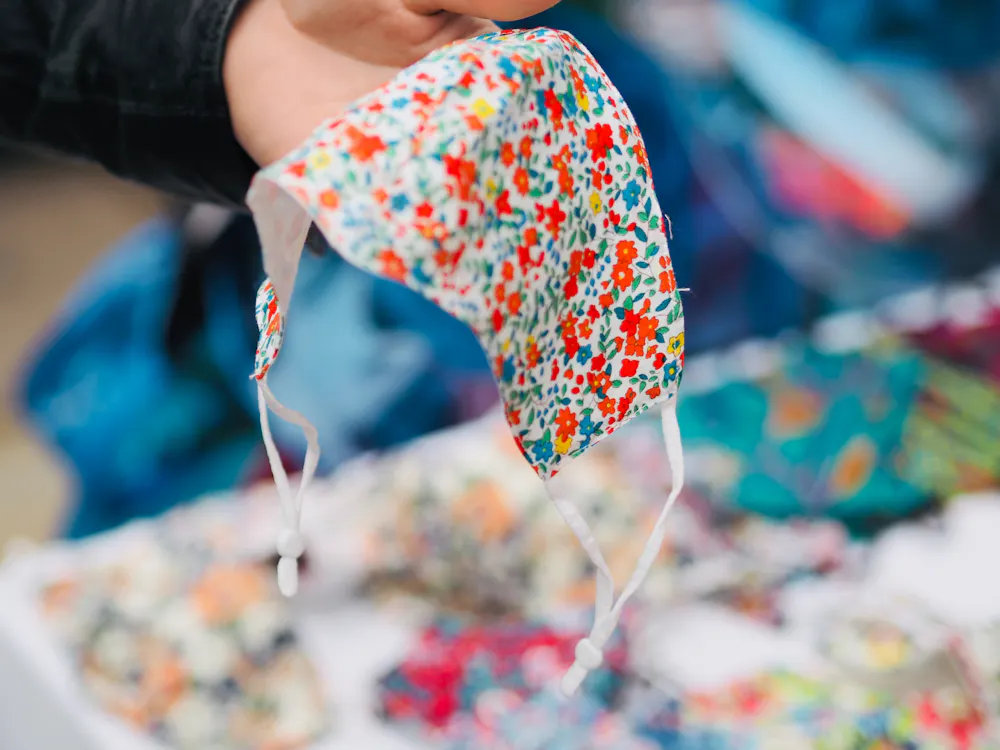 Wearing reusable cloth masks to protect against COVID is no longer advised, but it’s worth holding onto them as a back up.
Liza pooor/Unsplash, CC BY
Wearing reusable cloth masks to protect against COVID is no longer advised, but it’s worth holding onto them as a back up.
Liza pooor/Unsplash, CC BY
Six ways to offset our daily waste
Even during a pandemic, people don’t want to be wasteful. Tellingly, “Plastic Free July” saw a huge global increase in participation from 250 million participants in 2019, to 326 million in 2020.
There are many ways to reduce waste without compromising your health. The key is to focus on behaviours within your control, such as minimising single-use plastics. To help offset your daily waste from disposable masks, consider:
making the switch to refillable cleaning products to cut down on single-use packaging (there are even delivery options)
if you’ve shifted to online grocery delivery, choose paper over plastic bags and either reuse them at home or compost them after use
when dining at home, repurpose your leftovers, prioritise older food, and avoid over-buying to cut down on food waste
if you’re shopping online more, find second-hand retailers and peer-to-peer platforms to give pre-loved items a new life (there are delivery options for this too)
before throwing away household items (clothing, furniture), try selling or giving them away online - you’d be surprised what other people find useful
if your household items are damaged, get them repaired, or use them for a different purpose, such as using well-worn clothes as cleaning rags.
Just because we’re in a period of significant social change, doesn’t mean we have to lose momentum on sustainability.
Authors: Aleasha McCallion, Strategic Projects Manager, Monash Sustainable Development Institute, Monash University

















