

Modern Australian
The Times

Who'll teach all the students promised extra TAFE places? 4 steps to end staff shortages

  • Written by Darryl Dymock, Adjunct Senior Research Fellow in Education, Griffith University
Who'll teach all the students promised extra TAFE places? 4 steps to end staff shortages

Under Labor’s proposed Future Made in Australia Skills Plan, Australians studying in an industry with a skills shortage will be supported through the provision of free TAFE places. This will include 45,000 new places. If Labor does that without expanding the present depleted teaching workforce, we’re likely to see more current teachers bailing out and corners cut in teaching practices.

Our 2021 research for the National Centre for Vocational Education Research (NCVER) found the shortages of VET teachers and trainers extend to virtually every industry. If these shortages are not overcome, the result will be an inadequately trained vocational workforce. This in turn will have an impact on the country’s skill levels and productivity.

Not that the present federal government has much to be proud of in this regard. Although Vocational Education and Training (VET) significantly underpins the nation’s workforce development, it has limped along under recent national governments.

TAFE, the public provider, has remained a poor relation. Workforce shortages have continued, made worse by retirements from the ageing VET workforce and by the need to expand training to cater for new and emerging industries.

For our research we talked with key members of almost 30 registered training organisations (RTOs) across Australia about the shortage of trainers. We also surveyed over 300 practising teachers and trainers (VET practitioners) about their experiences of moving into VET.

The challenge in overcoming the shortage of VET practitioners is to encourage experienced workers from trades and the professions to move into VET.

What are the key issues?

The difference in salaries between industry and VET is a significant issue. It’s too simplistic an explanation for the lack of applicants, however.

For example, one disincentive is the nature of employment in the sector. Just over half of VET practitioners are employed in ongoing full-time roles. As one said:

“People at the top of their industry don’t leave for a temporary contract.”

Private training organisations reported they sometimes provide permanent employment for trainers simply to keep them “on the books”. One RTO principal told us:

“I can’t afford to put them off because we’ll never get them back.”

A further stumbling block is the inflexibility of the basic educational qualification as a point of entry. Trainers generally need to complete a Certificate IV in Training and Assessment (Cert IV TAE) before they can teach. There is only minimum provision for supervised practice without it.

Training organisations reported prospective trainers are reluctant to acquire the full qualification before they’re allowed to teach. Tradespeople with significant practical experience but no formal education since their apprenticeship were also anxious about “returning to study”.

Paradoxically, there was pushback from university-educated professionals in senior positions against the need for a vocational qualification.

The value of the certificate itself as a training qualification has been an ongoing contentious issue. One ex-tradie wrote:

“They want teachers to have ten years of industry experience […] but expect a six-day course to be enough to be a good teacher.”

It’s understood changes to the qualification are in the wind. Let’s hope these include ones that will make entry to VET teaching more flexible.

Training organisations and trainers alike argued for better recognition of prior learning among those who already have a training or mentoring role.

Even after they make the transition, new practitioners sometimes leave VET because their expectations don’t meet the reality. This is especially true if their employer doesn’t provide appropriate orientation and support. One trainer said:

“Day one I was given a USB with PowerPoint presentations on it and told to go into the classroom and deliver it.”

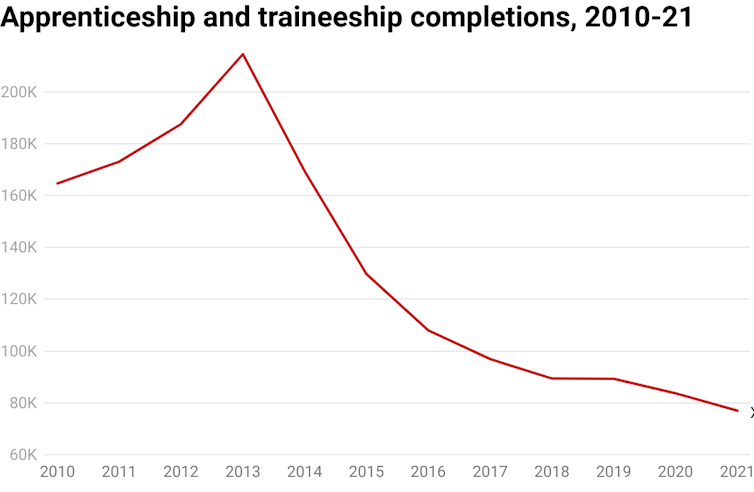
Chart showing decline in apprenticeship and traineeship completions in Australia, 2010 to 2021
Data: NCVER, CC BY What can be done to end the shortages? We identified several strategies to attract more VET practitioners. 1. Exploit career points and individual passion for teaching and training. A national media campaign could target prospective VET professionals at potential “turning points” in their careers. That might be, for example, when they are looking to move into something different from their everyday job, when family or financial responsibilities have eased, or when they are seeking an alternative work-life balance. Sell these as benefits beyond salary. 2. Smooth the entry path. Provide more options to “try before you buy”. These might include “bite-size” opportunities to experience teaching in VET before making a commitment. Industry specialists could be allowed to teach short-term with a particular training skill set, rather than the full qualification. It’s also essential to ensure prospective practitioners understand in advance how expectations in VET are different from those in their former workplaces. When they get there, give them a soft landing, especially those new to training. Show them they’re valued. 3. Involve industry more. Encourage and enable movement in and out of VET – so-called “boundary crossing”. This will enable practitioners to maintain their links and their industry currency. There is also scope and reason for industry to be more directly involved in promoting and fostering the VET practitioner career. 4. Enhance the status of VET. This can be done by promoting the uniqueness of the “dual practitioner”. Arguably even more than at university level, VET employs tradespeople and professionals who have developed expertise in one career and channels them into a second career. As a VET teacher or trainer, their initial expertise is highly valued. Our research showed many people in VET are passionate about its potential but some despair about its future. Whichever party is in power, expanding and equipping the VET workforce is a vital step forward.

Authors: Darryl Dymock, Adjunct Senior Research Fellow in Education, Griffith University

Read more https://theconversation.com/wholl-teach-all-the-students-promised-extra-tafe-places-4-steps-to-end-staff-shortages-175523

What Every Homeowner Should Know About Roof and Drainage Maintenance

A home's roof and drainage system work together every day to protect the property from water damage. While many homeowners focus on visible areas such...

From Plans to Priced Quote: The Estimating Workflow Most Builders Skip

For a small one-off job, an experienced builder can size up the materials in their head. The problem is that most jobs are not small one-off jobs, and...

Organisational Experts Share Their Tips for Achieving a Clutter-Free Kitchen

They say the kitchen is the heart of a house which means a clutter-free kitchen not only makes your home in general look nicer, it also makes cookin...

10 Creative Ways AI Image Extenders Are Transforming Digital Content Creation in 2026

Introduction Artificial intelligence continues to reshape the digital landscape, and one of the most exciting innovations in 2026 is the rise of AI i...

What to Do When You're Arrested in Victoria

Most people have thought about this in the abstract. A knock at the door, a hand on the shoulder, a car pulled over on the Hume. In the abstract, th...

Common Financial Disputes During Separation

Separation hits on many levels, not just emotionally. When a partnership ends, untangling the financial side — assets, debts, and everything built t...

Why Posting More Content is Killing Your Brand

More content. More often. More platforms.Most brands have been running this playbook for three years. Most brands have nothing to show for it.Not be...

Garden Clean-Up vs. Regular Maintenance: Which Do You Really Need?

Most people ring a gardener and ask for a "tidy up." What they mean by that, and what the garden actually needs, are often two completely different ...

Solar Panel Maintenance Tips for Melbourne Homes

Three years in and the panels are still on the roof. The inverter is still blinking. The electricity bills are still lower than they used to be, rou...

Cost Effective Kitchen Renovations – From the Ground Up

Even in times of uncertainty, it seems renovations continue to be on the to-do list for many Australian property owners. As a result, demand on materi...

Why Bathroom Product Selection Matters More Than Most Homeowners Realise

Most homeowners think wrong when it comes to a bathroom renovation. They think hard about the layout. Spend hours choosing tiles. Agonise over pain...

How An Asbestos Removalist Ensures Safe And Compliant Property Environments in Melbourne

Maintaining a safe environment within residential and commercial properties requires careful management of hazardous materials, which is why engaging ...

Why Protein Bars Are A Convenient Option For Daily Nutrition And Energy

Maintaining balanced nutrition throughout the day can be challenging, especially for individuals with busy schedules, which is why protein bars hav...

Property Settlements After Separation: Key Considerations

Dividing assets after a separation is one of the more complex and emotionally charged aspects of the process. Understanding how property settlements...

Why Dust Control Matters During Bathroom Demolition

People usually expect bathroom demolition to be noisy.  No one thinks of dust — but it turns up everywhere. Inside cupboards. On couches. Along...

Why Roller Shutters And Outdoor Blinds Are Popular For Modern Properties

Many homeowners and businesses now install roller shutters to improve security, privacy, insulation, and weather protection across residential and ...

Slushie Machine Hire for Events: What to Check Before Booking

There's a moment at every great event when guests stop what they're doing and just enjoy something. A slushie machine is often that moment. It draws p...

Why AS/NZS Certified Sunglasses Are Essential for Australian Kids

Australia has some of the highest UV radiation levels in the world. That's not a warning label exaggeration; it's a measurable, documented fact that s...
















