

Google AI


Modern Australian

Who'll teach all the students promised extra TAFE places? 4 steps to end staff shortages

  • Written by: Darryl Dymock, Adjunct Senior Research Fellow in Education, Griffith University
Who'll teach all the students promised extra TAFE places? 4 steps to end staff shortages

Under Labor’s proposed Future Made in Australia Skills Plan, Australians studying in an industry with a skills shortage will be supported through the provision of free TAFE places. This will include 45,000 new places. If Labor does that without expanding the present depleted teaching workforce, we’re likely to see more current teachers bailing out and corners cut in teaching practices.

Our 2021 research for the National Centre for Vocational Education Research (NCVER) found the shortages of VET teachers and trainers extend to virtually every industry. If these shortages are not overcome, the result will be an inadequately trained vocational workforce. This in turn will have an impact on the country’s skill levels and productivity.

Not that the present federal government has much to be proud of in this regard. Although Vocational Education and Training (VET) significantly underpins the nation’s workforce development, it has limped along under recent national governments.

TAFE, the public provider, has remained a poor relation. Workforce shortages have continued, made worse by retirements from the ageing VET workforce and by the need to expand training to cater for new and emerging industries.

For our research we talked with key members of almost 30 registered training organisations (RTOs) across Australia about the shortage of trainers. We also surveyed over 300 practising teachers and trainers (VET practitioners) about their experiences of moving into VET.

The challenge in overcoming the shortage of VET practitioners is to encourage experienced workers from trades and the professions to move into VET.

What are the key issues?

The difference in salaries between industry and VET is a significant issue. It’s too simplistic an explanation for the lack of applicants, however.

For example, one disincentive is the nature of employment in the sector. Just over half of VET practitioners are employed in ongoing full-time roles. As one said:

“People at the top of their industry don’t leave for a temporary contract.”

Private training organisations reported they sometimes provide permanent employment for trainers simply to keep them “on the books”. One RTO principal told us:

“I can’t afford to put them off because we’ll never get them back.”

A further stumbling block is the inflexibility of the basic educational qualification as a point of entry. Trainers generally need to complete a Certificate IV in Training and Assessment (Cert IV TAE) before they can teach. There is only minimum provision for supervised practice without it.

Training organisations reported prospective trainers are reluctant to acquire the full qualification before they’re allowed to teach. Tradespeople with significant practical experience but no formal education since their apprenticeship were also anxious about “returning to study”.

Paradoxically, there was pushback from university-educated professionals in senior positions against the need for a vocational qualification.

The value of the certificate itself as a training qualification has been an ongoing contentious issue. One ex-tradie wrote:

“They want teachers to have ten years of industry experience […] but expect a six-day course to be enough to be a good teacher.”

It’s understood changes to the qualification are in the wind. Let’s hope these include ones that will make entry to VET teaching more flexible.

Training organisations and trainers alike argued for better recognition of prior learning among those who already have a training or mentoring role.

Even after they make the transition, new practitioners sometimes leave VET because their expectations don’t meet the reality. This is especially true if their employer doesn’t provide appropriate orientation and support. One trainer said:

“Day one I was given a USB with PowerPoint presentations on it and told to go into the classroom and deliver it.”

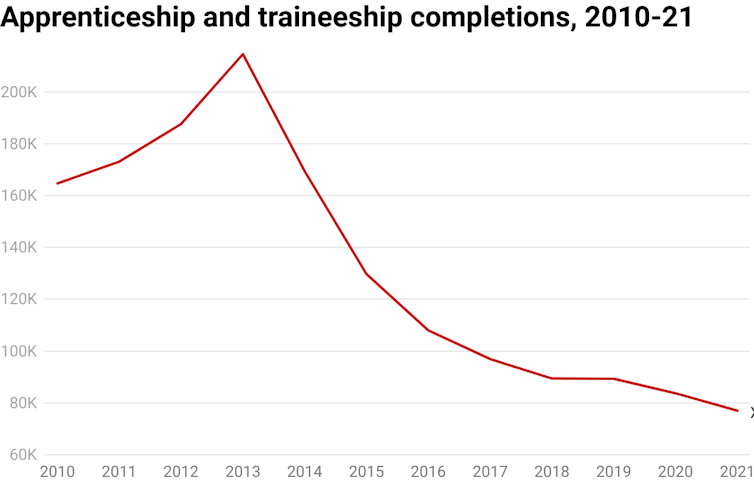
Chart showing decline in apprenticeship and traineeship completions in Australia, 2010 to 2021
Data: NCVER, CC BY What can be done to end the shortages? We identified several strategies to attract more VET practitioners. 1. Exploit career points and individual passion for teaching and training. A national media campaign could target prospective VET professionals at potential “turning points” in their careers. That might be, for example, when they are looking to move into something different from their everyday job, when family or financial responsibilities have eased, or when they are seeking an alternative work-life balance. Sell these as benefits beyond salary. 2. Smooth the entry path. Provide more options to “try before you buy”. These might include “bite-size” opportunities to experience teaching in VET before making a commitment. Industry specialists could be allowed to teach short-term with a particular training skill set, rather than the full qualification. It’s also essential to ensure prospective practitioners understand in advance how expectations in VET are different from those in their former workplaces. When they get there, give them a soft landing, especially those new to training. Show them they’re valued. 3. Involve industry more. Encourage and enable movement in and out of VET – so-called “boundary crossing”. This will enable practitioners to maintain their links and their industry currency. There is also scope and reason for industry to be more directly involved in promoting and fostering the VET practitioner career. 4. Enhance the status of VET. This can be done by promoting the uniqueness of the “dual practitioner”. Arguably even more than at university level, VET employs tradespeople and professionals who have developed expertise in one career and channels them into a second career. As a VET teacher or trainer, their initial expertise is highly valued. Our research showed many people in VET are passionate about its potential but some despair about its future. Whichever party is in power, expanding and equipping the VET workforce is a vital step forward.

Authors: Darryl Dymock, Adjunct Senior Research Fellow in Education, Griffith University

Read more https://theconversation.com/wholl-teach-all-the-students-promised-extra-tafe-places-4-steps-to-end-staff-shortages-175523

Understanding a dental implant Melbourne Treatment Plan

A dental implant Melbourne patients may consider is one option for replacing a missing tooth, but suitability depends on oral health, bone support a...

How 3PL Logistics Australia Supports Faster and More Efficient Supply Chains

Why Has 3PL Logistics Become Important for Growing Businesses?  Gone are the days when supply chains were simpler and in minimal quantity. Now, the...

Common Skin Concerns and Treatment Options Available in Melbourne

Skin concerns can develop gradually or become noticeable following changes in age, lifestyle, sun exposure or hormonal factors. Pigmentation, rednes...

Why a Code-Compliant Home Can Still Feel Uncomfortable

When people build or renovate a home, they usually expect that meeting current building requirements will also produce a comfortable place to live. ...

Breach of Contract in Business: What Are Your Options?

Contracts are essential to business relationships. They establish expectations, allocate responsibilities and provide a framework for delivering goods...

How Pest Control Companies Can Rank for the Problems Customers Search First

Introduction SEO for Pest Control needs to start with the customer’s problem. Most people do not search for pest services in a neat or technical wa...

What Are the Benefits of Renovating an Older Home in Sydney?

Sydney has plenty of character homes, from Federation cottages to mid-century brick homes. Renovating rather than rebuilding can preserve what makes t...

Pool and Deck Design: How to Plan the Perfect Outdoor Living Space for Your Sydney Home

For many Australians, the backyard is where life happens. Summer barbecues, weekend swims and long evenings outdoors are all part of the lifestyle, ...

Is Solar Pool Heating Worth It? What Sydney Homeowners Should Know

There's nothing quite like a backyard pool on a hot Sydney day. But once autumn rolls in, many pools sit unused for months because the water is simp...

Planning a Luxury House Move: A Week-by-Week Timeline for Prestige Sydney Homes

Selling or buying a prestige home is a major milestone. Whether it's a waterfront residence in Birchgrove, a grand Federation home in Haberfield or ...

Downsizing or Upgrading Your Caravan? Here's How to Sell It Without the Hassle

Selling a caravan can feel like a major task, especially when you are unsure about its value, paperwork, or how to find a buyer. Whether you are dow...

The Best Overseas Adventure Holidays for Australians Who Love the Outdoors

Australia offers no shortage of incredible outdoor experiences, but sometimes the best way to satisfy your sense of adventure is to head overseas. A...

Cape Town Wine Shuttle: Winelands Tasting & Tours

Embark on an unforgettable journey through the picturesque Cape Winelands, where world-class wines and breathtaking scenery await. Our Cape Town Win...

Metal Fabrication: Choosing Metal Fabrication Melbourne Services for Custom Projects

What Modern Metal Fabrication Involves From individual components to complete structures, metal fabrication brings together processes such as desig...

Why Giant Rats Tail Grass Keeps Coming Back After Spraying

Giant Rats Tail Grass (GRT) is one of the most frustrating pasture weeds for farmers and lifestyle property owners. You spray an infested area, see th...

When Custom Cardboard Boxes Make Sense for Your Business

Custom cardboard boxes can be useful when a standard carton does not fit a product, packing method or presentation requirement particularly well. A ...

Full-Height vs. Pop-Top Caravan: Which Is Better for Family Travel across WA?

A pop-top caravan is an excellent choice for travellers who want the comfort of a caravan without committing to a larger, bulkier setup. With a lowe...

Bottle Label Printing: Key Factors for a Professional Finish

Why the Printing Method Matters When businesses need packaging or printed containers developed for a particular application, the right supplier can m...

















