

Staff and children in preschool and childcare aren't being protected like in schools. We need a national plan
- Written by Thea van de Mortel, Professor, Nursing and Deputy Head (Learning & Teaching), School of Nursing and Midwifery, Griffith University
By late January, more than 400 early learning centres were closed across the country due to the Omicron wave, and many more were running at reduced capacity.
Anxiety about kids’ safety is leading many parents not to send their child to preschool or childcare. Absence rates in some large providers of early childhood education and care were reportedly as high as 43% by late January compared to about 10% in November and December.
Most kids across the country went back to school this week with various plans in place in different states to monitor and contain COVID infections. Together with mitigation measures such as masks and effective ventilation, schools in New South Wales, Victoria and the ACT, for instance, are providing free rapid antigen tests to families so students and staff can be tested several times a week to monitor any infections.
While provision of RATs for preschool and childcare staff and similar testing plans are in place in NSW, Victoria and South Australia, this is not the case for the children in their care. This may be because RATs aren’t as effective in detecting infections in children as in adults. A study of the sensitivity of RATs in children found the tests failed to accurately detect infection in 36% of infected children. If the child was infected but had no symptoms, RATs failed to detect this in 44% of cases.
Other states’ decisions not to require regular RATs for staff may be due to lower case numbers. For instance, on February 1, NSW had over 12,000 new cases while Western Australia had 24.
Other mitigation measures in place at schools are more difficult to implement in early learning settings. No vaccine is available for preschool and childcare-aged children and masks are not recommended for children under two years old.
There is a national framework for managing COVID in schools and childcare settings. Early childhood services and schools must respond on the basis of public health advice and with support from public health authorities where required.
However, at the moment plans to prevent transmission in childcare settings are being left to states and territories, and the approaches are at times fragmented. A national set of strategies supported by evidence is required to ensure the best outcomes for children, childcare workers and families.
What are the risks of childcare?
COVID remains a mild disease for most infants and children. The majority of positive COVID cases still occur in older age groups.
Despite this, because of the sheer number of overall Omicron infections, some areas in the northern hemisphere have had an almost eight-fold increase in hospitalisations of children aged 0-4. This is higher than the population generally, probably because small children are unvaccinated.
It is also winter there, which increases transmission risk for everyone because viral particles stay viable for longer in the cold, and transmission occurs much more frequently indoors.
Australian infants and children have a very low risk of dying from COVID. Only four deaths associated with COVID have been recorded in Australian children under the age of 10 since the first case of COVID was reported. This is compared to 12 in the 20-29 group, 41 for 30-39 and 353 for those aged 60-69.
However, having a chronic condition may increase your child’s risk of serious outcomes from COVID. You may wish to seek medical advice on whether to send them to childcare or keep them at home.
What about the risks to teachers?
A Scottish study found school teachers were not at a higher risk of contracting COVID-19 than the general population.
There is very little published on the risk to teachers in childcare. However, data collected in childcare in the middle of 2021, during the Delta outbreak in NSW, showed that of the secondary cases (someone being infected by a primary case) most SARS-CoV-2 (the virus that causes COVID) transmission in childcare occurred between staff (16.9%), or staff infected children (8.1%), rather than the other way around.
Read more: COVID chaos has shed light on many issues in the Australian childcare sector. Here are 4 of them
Omicron is much more transmissable than Delta, but given the very high volume of cases in the commmunity, teachers are likely at no greater risk of contracting COVID at work than they are anywhere else.
States and territories doing different things
All states and territories require preschool and childcare staff to be vaccinated. But there are slight variations when it comes to other migitation measures.
For instance, in Queensland, staff are required to wear masks while standing or moving about indoors, but may remove their mask when seated or if able to maintain a 1.5 metre distance from others while teaching or interacting with children. But in NSW, all staff and visitors in early childhood and education services are required to wear masks while indoors with no exceptions.
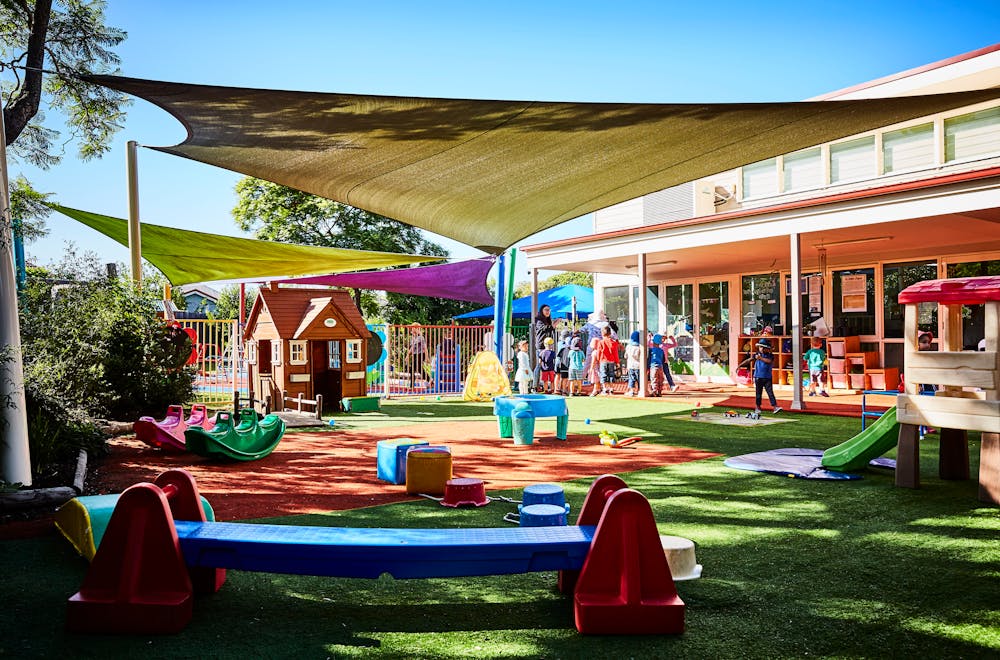 Kids should be kept outside as much as possible.
Shutterstock
Kids should be kept outside as much as possible.
Shutterstock
States and territories advise childcare centres to keep indoor areas well ventilated by opening doors and windows and using outdoor spaces as much as possible.
While most states are deploying air purifiers to schools, there is no such policy for early education and care settings. It is less simple for the government to send free purifiers to childcare centres due to their different ownership arrangements and the sheer number of them.
But air purifiers are an important way to ensure children and staff in early childhood and care settings are protected, especially considering other mitigation measures employed by schools are not in place. A national plan needs to address how to ensure each centre has one.
What steps can be taken to reduce the risk?
Parents
If your child or household member has COVID symptoms, get them tested and keep them home for the period required in your state. Check the rules for your state or territory here
wear a mask (or respirator: P2, N95 or KN95), and practise physical distancing during drop-offs and pick-ups
children aged 2 and older can wear a mask but parents can decide based on their particular child
sanitise your hands regularly
ensure eligible household members are fully vaccinated (including a booster) to lower the risk.
Childcare providers
providers should do a risk assessment of their facility and draw up a COVID-safe plan to minimise risk
staff should be fully vaccinated and wear a mask or respirator indoors in line with requirements.
staggered drop-off and pick-up times can reduce the density of people in the building
regular cleaning of surfaces, and particularly of objects infants and small children put in their mouths, may help reduce transmission
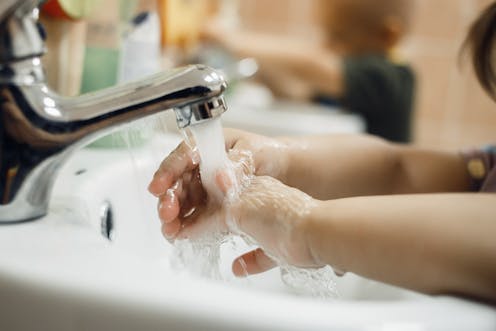
children should be encouraged to regularly wash hands, particularly before touching food.
One of the most important strategies to reduce transmission is good ventilation, as infectious particles build up in the air when infected people are indoors, so:
where possible children should be outdoors
if indoors, open doors and windows to create a cross breeze.
Ultimately though, we need a national approach to developing coherent and easy-to-follow guidelines for parents and childcare providers.
Read more: Schools have moved outdoors in past disease outbreaks. Here are 7 reasons to do it again
Authors: Thea van de Mortel, Professor, Nursing and Deputy Head (Learning & Teaching), School of Nursing and Midwifery, Griffith University

















