

Native birds have vanished across the continent since colonisation. Now we know just how much we’ve lost
- Written by Michelle Ward, PhD Candidate, The University of Queensland
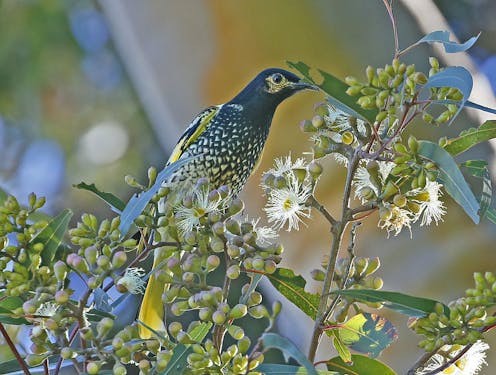
In the 250 years since Europeans colonised Australia, native birdlife has disappeared across the continent. Our new research has, for the first time, registered just how much Australia has actually lost – and our findings are astonishingly sad.
We focused on 72 species of birds faced with extinction today, including the Kangaroo Island glossy black cockatoo, regent honeyeater, and night parrot. We found 530 million hectares, or 69%, of Australia, has lost at least one bird species. In some parts of the country, we’ve lost up to 17 birds.
Land clearing, along with threats such as cat predation, have driven ten birds to disappear from over 99% of their historical habitat. Indeed, we show the last 250 years has seen more than 100 million hectares of now-threatened bird habitat cleared on mainland Australia – that’s 15% of Australia’s landmass.
For many of the species we examined, their remaining habitats occur in patches surrounded by farmland, towns and cities. To give birds and other animals a chance at survival, we need effective national leadership not only to protect existing habitats, but also to restore lost habitat and manage future habitat under climate change.
Lost, but not forgotten
In the last 250 years, 22 native birds have gone extinct. We found two more currently listed as threatened under Australia’s environmental legislation may also be now extinct.
One is the eastern star finch. This bird was once found from northern New South Wales to Queensland’s Burdekin River. A victim of overgrazing, it has not been seen since 1995. Surprisingly, this bird is only listed as “endangered” rather than “critically endangered” under [Australian law]
The other is the Tiwi Islands hooded robin, which has not been seen for 27 years. Changed fire patterns from European colonisation and invasive species such as cats and weeds have likely driven it to extinction.
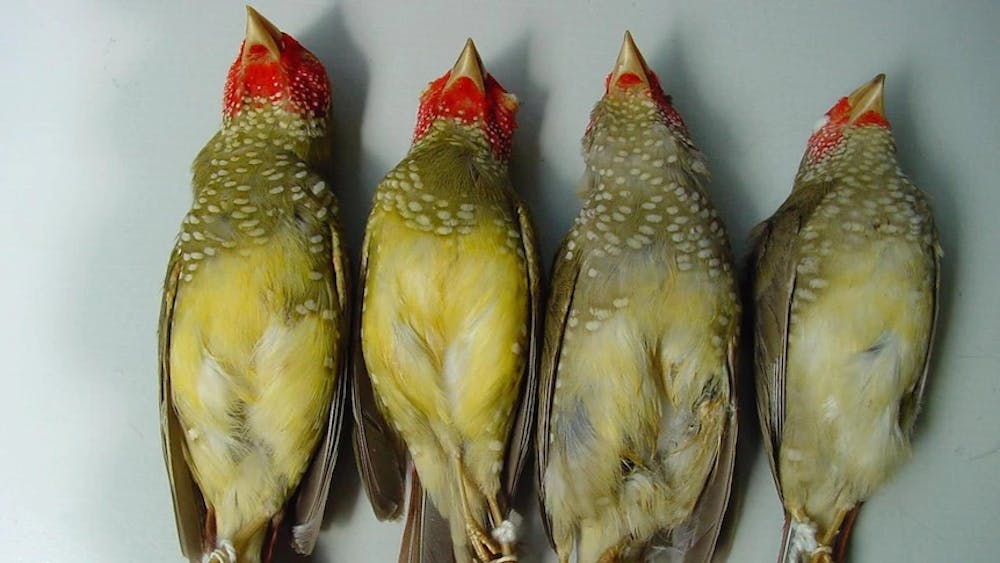
Other species are on their last legs. The western ground parrot, for example, once swept across large parts of Western Australia, but are now in just two locations: Cape Arid National Park and Nuytsland Nature Reserve.
They’ve become locally extinct across more than 99% of their historical habitat because of habitat destruction, invasive species, and changed fire patterns. They’re at significant risk from isolated catastrophic events such as major bushfires. For example, the 2019-2020 fires alone destroyed 40% of the bird’s last remaining habitat.
The plight of the regent honeyeater is another tragic story of decline. Flocks of thousands once occurred from Adelaide to north of Brisbane, with the naturalist John Gould writing in 1865:
I met with it in great abundance among the brushes of New South Wales […] I have occasionally seen flocks of from fifty to a hundred in numbers, passing from tree to tree as if engaged in a partial migration from one part of the country to another, or in search of a more abundant supply of food.
Today, only 100 breeding pairs are left, and almost all breed in just three sites in NSW. The species has lost more than 86% of its historical habitat, with land clearing the main driver of decline. So few remain that young birds cannot learn to sing properly, so have trouble attracting a mate.
The extinction wave
Our research used a combination of historical field guides, reference books, research papers, government records, spatial data, and expert elicitation to create maps of past habitats, and compared those to current habitats.
We found certain areas across continental mainland Australia to be in worse shape than others.
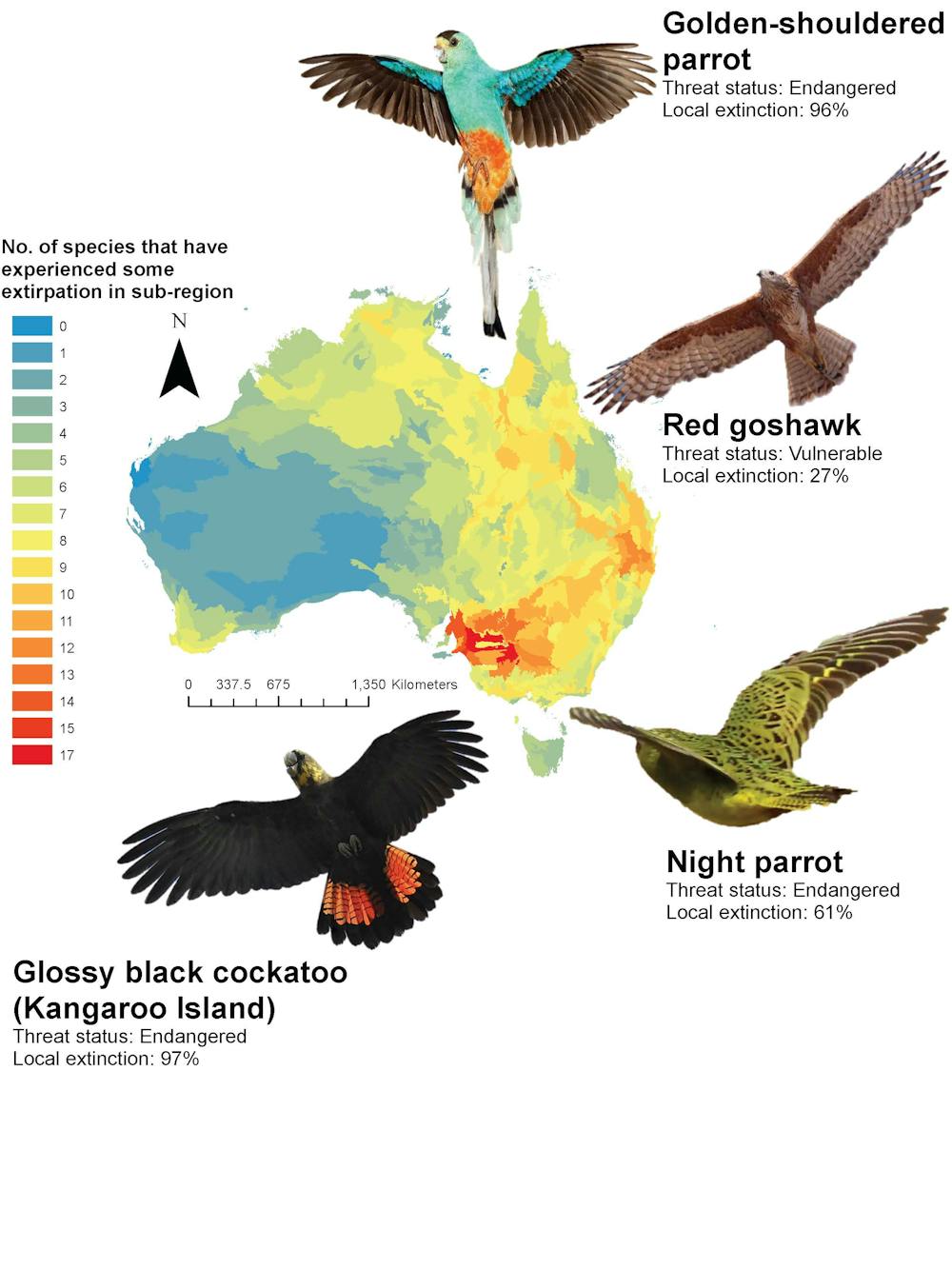 Number of threatened species that have experienced local extinction per subregion (Ward et al. 2022).
Clockwise from top left: golden- shouldered parrot (source: Jan Wegener); red goshawk (source: James Watson), night parrot (source: Bruce Greatwich), and Kangaroo Island glossy black-cockatoo (source: Maureen Goninan).
Number of threatened species that have experienced local extinction per subregion (Ward et al. 2022).
Clockwise from top left: golden- shouldered parrot (source: Jan Wegener); red goshawk (source: James Watson), night parrot (source: Bruce Greatwich), and Kangaroo Island glossy black-cockatoo (source: Maureen Goninan).
For example, we revealed extinction hotspots in areas between Swan Hill in Victoria and Marmon Jabuk range in South Australia. In this region, up to 17 birds have gone extinct (red areas in map), such as the black-eared miner.
Likewise, over the last century, almost 10% of all known breeding land-based birds have vanished in SA’s Mount Lofty ranges. This includes the rufous fieldwren, bush stone-curlew, ground parrot, king quail, azure kingfisher, barking owl, regent honeyeater, and swift parrot.
The story of decline is not limited to only threatened species, with more common birds such as willie wagtails, brolgas, boobook owls, and even magpies now disappearing from many places they were once common.
Indeed, the loss of so many species is the canary in the coal mine of total ecosystem collapse. And total ecosystem collapse poses an existential threat to food systems, water quality and climate stability.
If we don’t make fundamental changes in the way we manage and use landscapes, the extinction wave will continue to inundate Australia.
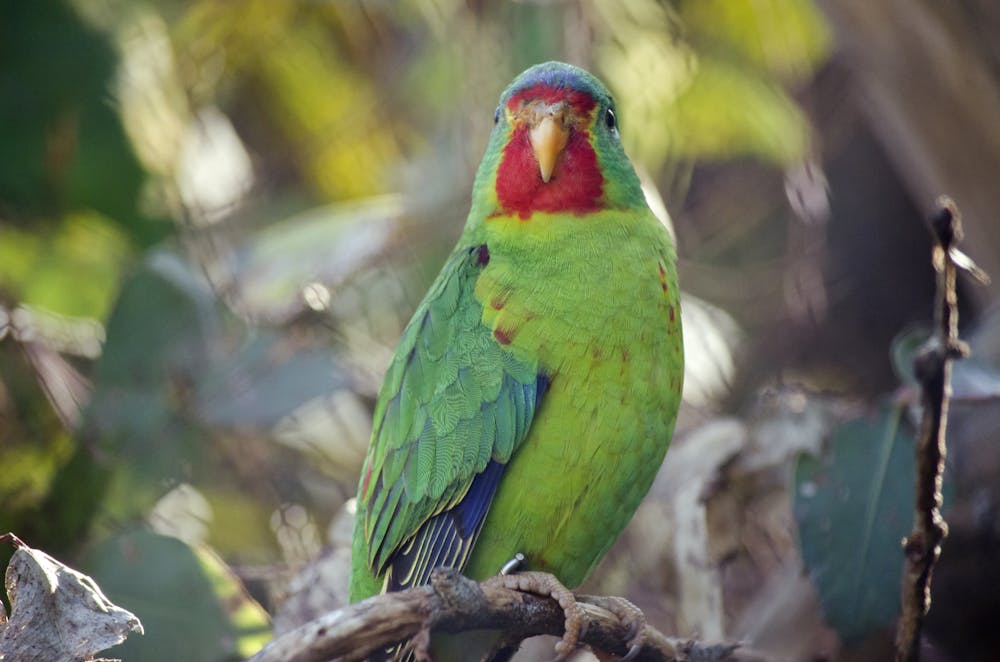 Swift parrots have vanished from the Mount Lofty ranges.
Shutterstock
Swift parrots have vanished from the Mount Lofty ranges.
Shutterstock
What can we do about it?
We need federal leadership to curb the extinction crisis, and an important start is to implement promises we’ve already signed up to in, for example, the UN’s Aichi biodiversity targets.
At the ongoing international biodiversity conference – COP15 – a key ask is for countries to halt human-induced species extinctions from now onwards, to bring the overall risk of species extinctions to zero, and to bring population abundance of native species back to 1970s levels by 2050. This is a basic commitment to Australia’s heritage and culture.
Crucially, we need fundamental reform of Australia’s key environment legislation: the Environment Protection and Biodiversity Conservation (EPBC) Act.
A major, independent review last year revealed that the EPBC Act has failed native wildlife. One of its key recommendations was to implement strong national environmental standards, such as not allowing any degradation of critical habitat.
These standards must be put in place as a matter of urgency. They must be legally enforceable, concise, specific, and focused on the conservation outcomes to properly protect Australian biodiversity and reverse the decline of our iconic places.
A huge thank you to all my wonderful co-authors, without which, this research would not be possible: James E.M. Watson, Hugh P. Possingham, Stephen T. Garnett, Martine Maron, Jonathan R. Rhodes, Chris MacColl, Richard Seaton, Nigel Jackett, April E. Reside, Patrick Webster, Jeremy S. Simmonds.
Authors: Michelle Ward, PhD Candidate, The University of Queensland

















