

150 years ago, Charles Darwin wrote about how expressions evolved – pre-empting modern psychology by a century
- Written by Ben Bradley, Professor Emeritus (Psychology), Charles Sturt University
Was Charles Darwin a one-hit wonder? According to scientists who take a gene’s-eye view of evolution, the 19th-century English naturalist contributed one crucial idea to understanding how species change: natural selection, or “design without a designer”.
However, a book of Darwin’s that is little read by modern evolutionists – The Expression of the Emotions in Man and Animals – turns out to contain valuable lessons for scientists seeking to understand how and why humans do what we do.
Published 150 years ago, the book has long bemused scientific readers because it hardly mentions natural selection. Instead, it puts how organisms behave at the heart of evolutionary adaptation – an idea that is becoming commonplace in 21st-century biology.
Read more: Curious Kids: how do scientists know evolution is real?
Putting agency into evolution
Since the 1940s, evolutionists have viewed natural selection as an aimless mechanism: random genetic variations arise, and chance environmental events allow the most beneficial (or “fittest”) ones to survive.
More recently, biologists have found it necessary to introduce the actual behaviour of living creatures into this picture. From this perspective, organisms adapt to their circumstances, and genetics then stabilises the changes.
As I show in my book Darwin’s Psychology, for Darwin, the agency of organisms – their ability to do things – was the key, whether in driving the struggle for existence, or in explaining the antics of climbing plants, babies and earthworms.
This was because actions produce reactions: what a creature does has consequences for itself and its surroundings.
Those consequences shape its own subsequent actions, and how its descendants eventually evolve.
Read more: Social plants: in the wild, staghorn ferns grow in colonies to improve water storage for all members
Some consequences prove injurious or fatal. Others enhance the doer’s life, even if it is in ways that are not immediately obvious, such as forest trees and honeybees who render “mutual aid” to other members of their own species.
Darwin took this view of agency and applied it to what he called the most social of social species, ourselves.
Expressions and meaning
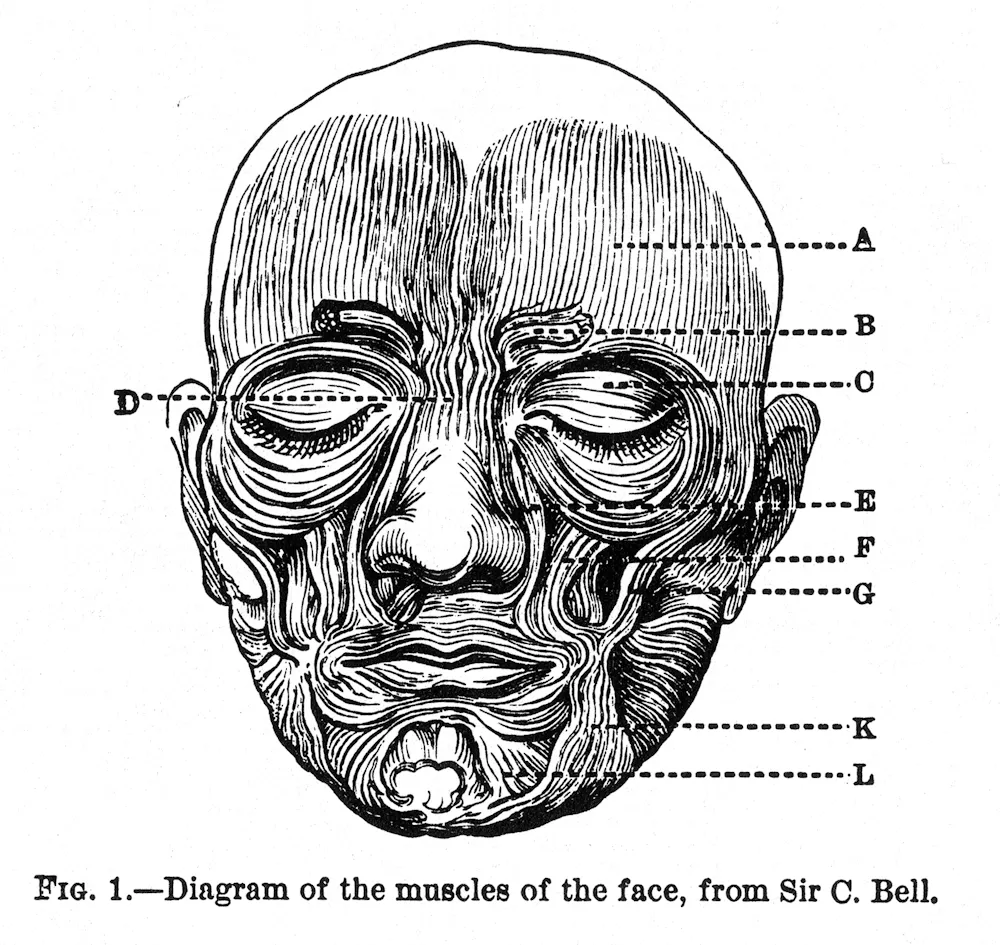
He analysed in great detail more than 70 different components and types of facial expressions plus other non-facial gestures.
Darwin concluded the movements we call expressions, such as smiling and crying, did not evolve to communicate. For Darwin, smiles and tears do not arrive at the body’s surface already steeped in emotional meanings brewed in the hidden recesses of the expresser’s mind. They are accidental side-effects of other “habits”, or of the ways the nervous system works.
“Expressions” only become meaningful when others read them as such, so the meaning of any so-called “emotional expression” depends on context and other people.
Viewed this way, Darwin’s book argues an expression could only ever have evolved or “become instinctive” if the ability to recognise it had also evolved and “likewise become instinctive”. And if recognising expressions is instinctive, Darwin reasoned, humans should be born able to understand gestures and facial displays.
Child’s play
To find out whether this was the case, Darwin carefully studied the social behaviour of his firstborn child, Doddy. He observed Doddy understood, “at a very early period, the meaning or feelings” of those who took care of him, “by the expression of their features”.
Darwin tells us he aimed many “odd noises and strange grimaces” at his four-month-old son. These did not scare Doddy, however, being “taken as good jokes”, because they were “preceded or accompanied by smiles” – the smiles proving legible to Doddy as making humorous his father’s otherwise-fearsome growling and gurning.
These observations pre-empted by more than a century modern psychology’s discovery babies have an inbuilt capacity for sympathetic mind-reading and mental sharing.
Universal emotions?
Darwin made clear his book presented a theory of expression rather than a theory of emotion. While he painstakingly pioneered a modern physiological way of studying the human movements it discusses, he found the meanings of such movements – whether emotional or not – to be inescapably social.
Modern psychologists argue over a split between supposedly “basic”, “biological” or “universal” emotions such as anger, which are held to be directly linked to one’s physical state, and “social” emotions such as envy, which are supposed to result from our readings of others.
Darwin’s work sidesteps this controversy, arguing only the observable patterns of facial action we call “expressions” can ever be universal. Whatever meanings are attributed to those actions must derive from the social relationships they reflect.
Reading faces
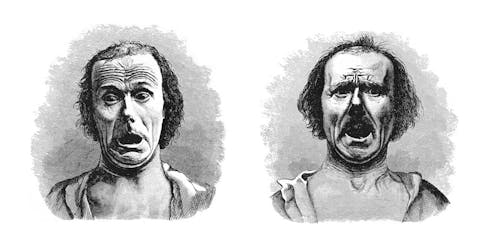
 Darwin used the experiments of the neurologist Guillaume Duchenne, who used electrical stimulation of face muscles to produce expressions.
Wikimedia
Darwin used the experiments of the neurologist Guillaume Duchenne, who used electrical stimulation of face muscles to produce expressions.
Wikimedia
In Darwin’s time, the traditional way of studying emotions was to ask people about why they were smiling or what they were angry about. However, Darwin’s research went the opposite way: he asked people about how they understood the expressions of others.
He asked expatriate Europeans living on six continents to fill in a survey about the forms of expressive movement they had seen in diverse indigenous peoples “who have associated but little with Europeans”.
He also asked 20 or so well-educated members of his circle to judge what meanings they saw in photographs of 11 facial displays neurologist Guillaume Duchenne had produced by attaching electrodes to muscles in the faces of volunteers so as to simulate different emotional expressions.
Darwin held that only photographs which judges agreed about could be called “genuine” expressions. Pictures of terror, sorrow or laughter produced unanimous responses. Other photos, including Duchenne’s portrait of hatred, proved indecipherable.
Blushing
The masterstroke of The Expression of the Emotions in Man and Animals comes in its longest chapter, on blushing. Blushes, Darwin shows, result from the rebounding of our faculty for reading others: it is “the thinking what others think of us which excites a blush”.
Thus blushers will blush when they imagine someone blames them for something, even when they are innocent. This conclusion, that one’s reading of others’ attitudes shapes how one acts, underpins the treatments of conscience and morality, sexual coquetry and culture which fill Darwin’s earlier book The Descent of Man (1871).
It also inspired social theorist George Herbert Mead’s invention of what sociologists now call “symbolic interactionism” – the view that all human actions are shaped by what they signify in the groups where they occur.
Read alongside The Descent of Man, of which it was at first intended to form part, The Expression of the Emotions proves that Darwin’s vision of nature as a theatre of agency did more than anticipate biology’s newest theory of adaptation. That same vision laid the groundwork for an idea of psychology based in evolution, where all human meaning has a social origin.
Authors: Ben Bradley, Professor Emeritus (Psychology), Charles Sturt University



















