

How centuries-old bones from Australia's historic shipwrecks can help us solve crimes
- Written by: Paola Magni, Senior Lecturer in Forensic Science, Murdoch University
Rivers, lakes and the sea frequently host scenes of death and crime. When a body is pulled from a watery grave – due to, for instance, drowning, floods, tsunamis, shipwrecks, air crashes or murder – specialist investigative techniques are used to piece together what may have happened.
This discipline, known as aquatic forensics, brings together knowledge from underwater archaeology, anthropology, marine biology and marine science. But it is still in its infancy and there’s much left to learn.
The investigation of a body recovered from the water is challenging enough, with so much evidence washed (or eaten!) away, and the chemistry of decomposition so profoundly affected by water. But when only the bones or the teeth of a victim are found, the mystery becomes nearly impossible to solve.
To help bridge this knowledge gap, we’ve spent years studying archaeological bones collected from historical shipwrecks that have rested on the seabed for centuries. We’re searching for ways to use recovered bones and teeth to better understand time spent in the sea, and the overall journey of the mortal remains.
Our findings may one day assist forensic investigations on more recent bones, such as when complete or partial skeletons (human or non-human) are recovered from oceans, lakes or rivers – or are just beached on the shore.
Read more: Crime won't stop because of COVID. So how should we protect crime scene investigators?
Reconstructing the chain of events
The study of bones and teeth help investigators learn about the person’s sex and age, and potentially identify a specific individual by studying dental restorations and DNA. In the best case scenario, a facial reconstruction will be be possible. However, sometime we can only determine if it’s not a human bone after all but rather that of an animal.
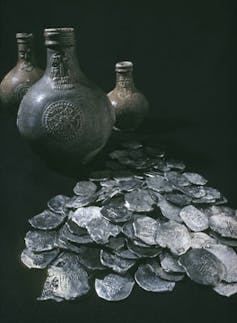
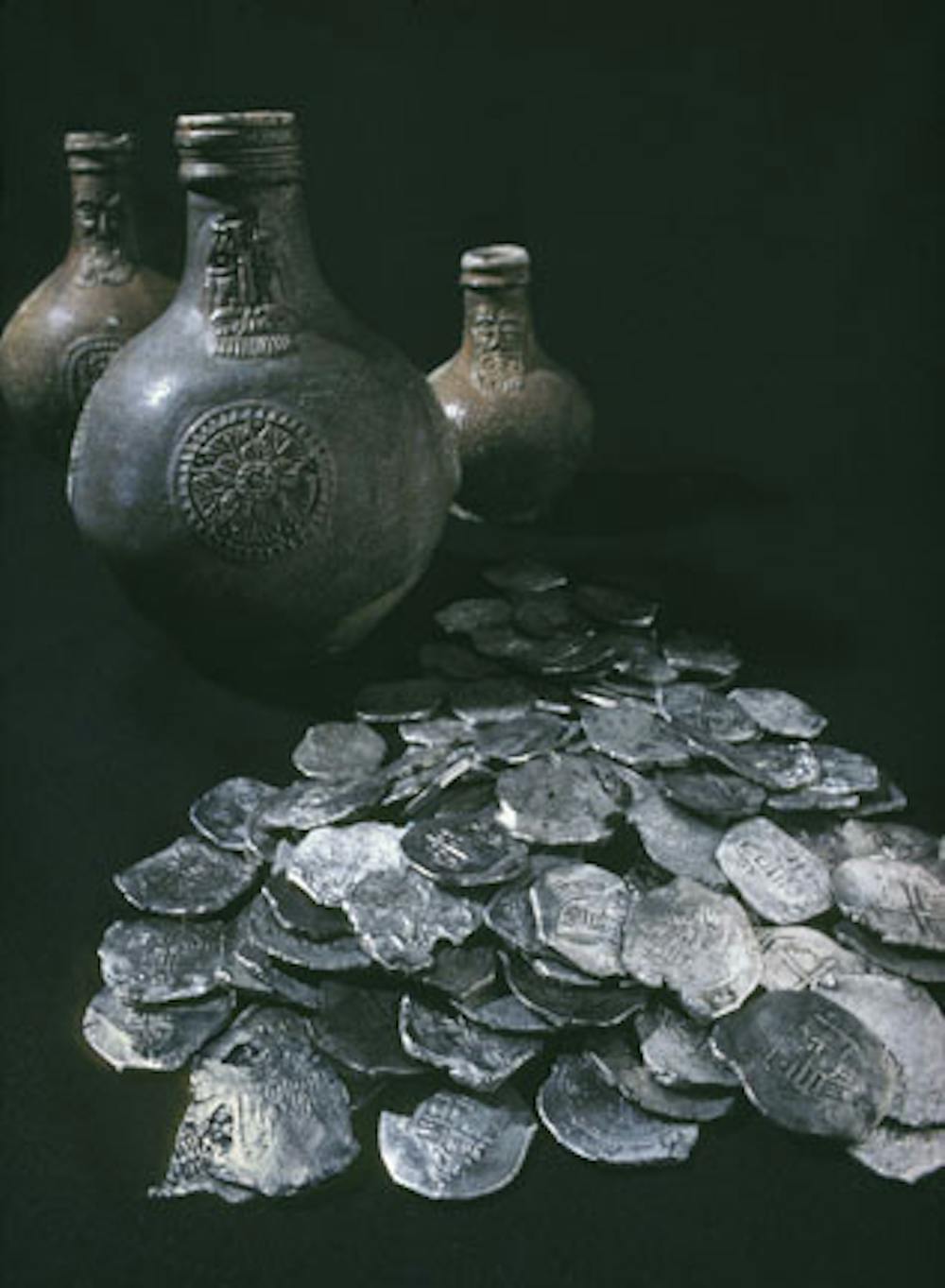 Artefacts recovered from the site of the Dutch vessel Vergulde Draeck include piles of silver coins.
Western Australian Museum
Artefacts recovered from the site of the Dutch vessel Vergulde Draeck include piles of silver coins.
Western Australian Museum
But special characteristics of bones and teeth and the organisms connected to them can help investigators reconstruct the chain of events that occurred after death and before the recovery. This reconstruction is the object of taphonomy research.
Taphonomy is a scientific term coined in 1940 to describe the processes through which organic remains, such as bone and teeth, are transformed over time and pass from the biosphere (the world of life) to the lithosphere (the world of rocks and dust).
Shipwreck bones
Our team has been analysing sheep, pig and cow bones discovered in decayed wooden barrels during underwater archaeological excavations of historical shipwrecks off the coast of Western Australia.
The bones and the teeth of this study are part of the collections of the WA Shipwrecks Museum.
They belong to the underwater archaeological sites of:
the Batavia, a Dutch East India Company ship wrecked in 1629
the Vergulde Draeck a Dutch East India Company ship wrecked in in 1656
the Zeewijk, a Dutch East India Company ship wrecked in 1727, and
the Rapid, an America-China trader wrecked in 1811.
The first three were wrecked while sailing towards Jakarta, following what was known as the Brouwer Route, whereas Rapid was sailing from Boston to Canton (now Guangzhou).
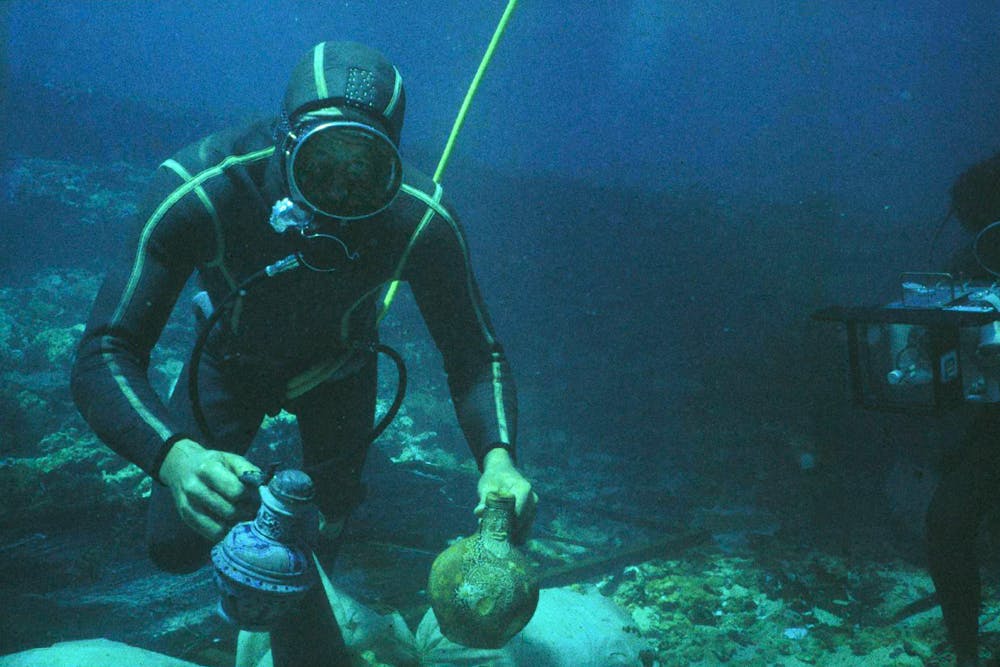
The wrecks were located between the 1960s and 1970s – some accidentally and some after long research – by recreational divers and underwater archaeologists. The wrecks contained many other artefacts, including piles of silver coins.
Our research has been looking at bones submerged in seawater and/or surrounded by marine sediment for anywhere between 169 and 347 years. The work is ongoing but, so far, we’ve:
identified special chemical clues or “geochemical fingerprints” of a process known as diagenesis (meaning the changes that occur on skeletal material over time)
reported new insights into how marine single-celled organisms called foraminifera affect the dissolving spaces inside submerged bone. These microorganisms, largely used for ecological and paleontological studies, can provide a treasure trove of information for investigators trying to work out how much time has passed since death.
built a better understanding of how bioerosion by bacteria and coloniser animals such as barnacles affects bones underwater.
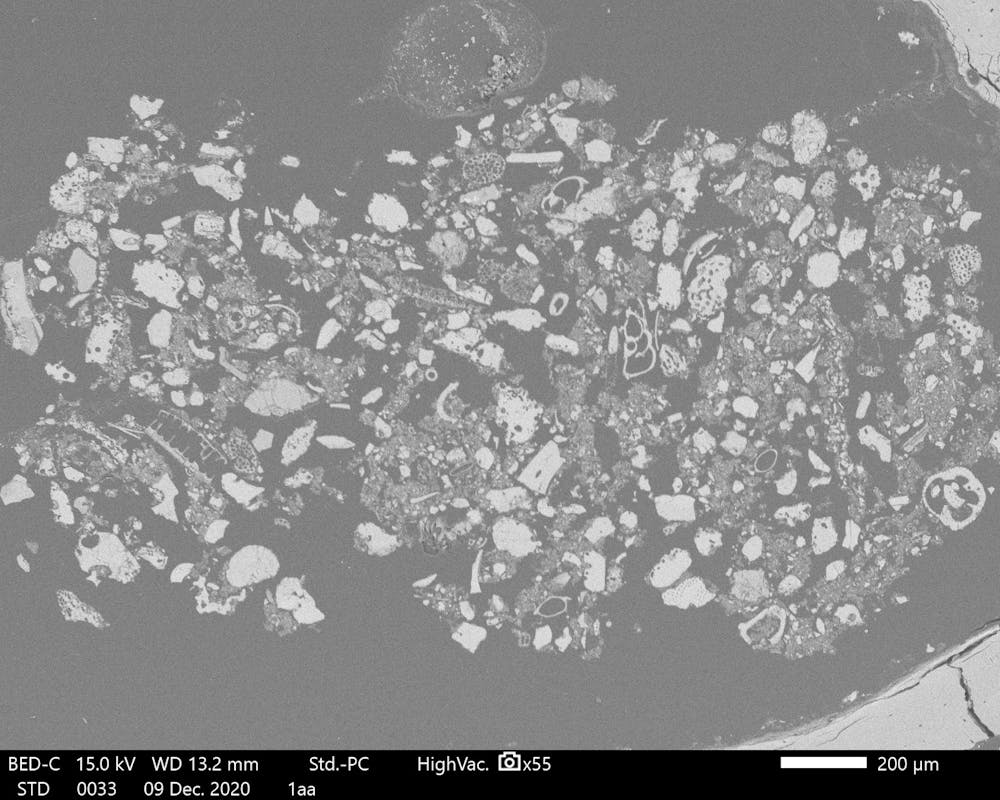 Here’s a bone sample with tiny microfossils in it. These microorganisms can provide a treasure trove of information for investigators.
Edda Guareschi, Author provided
Here’s a bone sample with tiny microfossils in it. These microorganisms can provide a treasure trove of information for investigators.
Edda Guareschi, Author provided
Bones can be found in the sea after a long time only if they have been contained and protected by hard structures, such as the hull of a ship or the cabin of an aircraft. Otherwise, marine animals will attack, scatter and fragment them. Other animals will use them as a shelter.
After a long time within the remnants of a wreck, bones can become enclosed in concretions formed by iron objects that were aboard the ship. As time passes, the chemical elements of the bones change, with the addition of chemical elements normally absent in living bone.
The combination of everything added and removed from bones during their long rest underwater can help investigators reconstruct the events after death.
This knowledge can be crucial in forensic investigations.
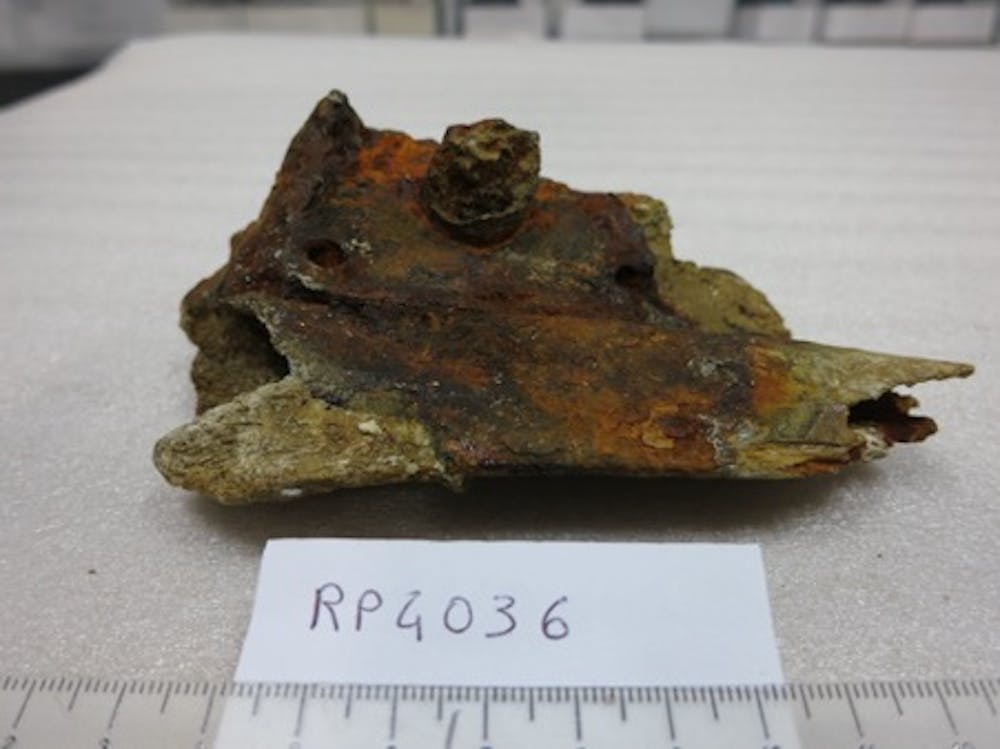 An example of a bone enclosed in a marine concretion, from Rapid (1811).
Author provided, Author provided
An example of a bone enclosed in a marine concretion, from Rapid (1811).
Author provided, Author provided
Authors: Paola Magni, Senior Lecturer in Forensic Science, Murdoch University


















