

small businesses need a national support plan to survive shadow lockdowns
- Written by: Richard Holden, Professor of Economics, UNSW Sydney
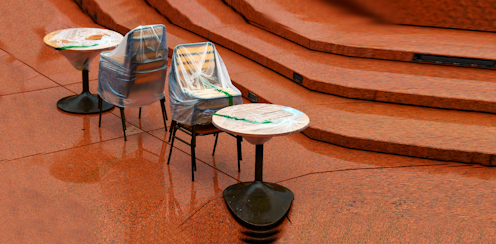
The “shadow lockdown” accompanying the Omicron outbreak should have come as no surprise to Australia’s policy makers. But the type of government support that helped so many individuals and businesses survive the official lockdowns of 2020 and 2021 is absent.
In the face of large case counts, hospitalisations and deaths from Omicron, people voluntarily cut back on economic activity. Why risk going out for a meal or sitting in a theatre while infections are raging?
This effect was quantified as early as mid-2020 by two University of Chicago economists, who calculated (using data from 2.25 million businesses across 110 industries) that nearly 90% of the reduction in economic activity in the United States stemmed from voluntary “self-lockdowns”, rather than government-imposed restrictions.
In Australia, we can see the effect in consumer confidence plummeting in January 2022 to its lowest level since October 2020 (and the worst January result since 1992).
For many small business owners, the past month has felt like the most difficult period of the pandemic. The single biggest government support measure, the A$90 billion JobKeeper wage subsidy scheme, was phased out in March 2021, with most other support winding up by the end of the year.
Given small businesses employ more than 5 million Australians – more than 40% of private-sector jobs – how we can help them survive this pandemic now, and if more COVID variants emerge?
Read more: Vital Signs: the cost of lockdowns is nowhere near as big as we have been told
The current patchwork of state and federal COVID payments
The following tables summarise the COVID-specific support programs that are still available today.
For individuals, the main support is the federal government’s Pandemic Leave Disaster Payment, which provides up to $1,500 for two weeks for individuals who cannot work because of having to isolate, quarantine or care for someone with COVID-19.
Most states and territories also provide a lesser one-off payment to support those who have to isolate but who can’t access the Pandemic Leave Disaster Payment.
On the business side, the federal government has its SME Recovery Loan Scheme, which guarantees 50% of loan amounts for eligible businesses with turnovers up to $250 million. This scheme is scheduled to run until June 30, 2022.
The states and territories have wound up most of their general business support programs, with what remains targeted at particular interest groups or sectors.
Most generous are the Northern Territory and Australian Capital Territory governments, which have “business hardship” packages offering rebates to reduce or waive payments such as payroll tax, utilities bills and rates.
New South Wales has a more limited rebate scheme, offering up to $2,000 to sole traders, small businesses and not-for-profit organisations to offset costs such as food licences, liquor licences, tradesperson licences, event fees, outdoor seating fees, council rates and road user tolls. It also has (my personal favourite) the Alfresco Restart Rebate, giving up $5,000 for restaurants to create or expand their outdoor dining area.
Queensland has a cleaning rebate for businesses and not-for-profit organisations designated exposure sites by Queensland Health. Victoria has a scheme to help commercial tenants cover rent.
Paying to save jobs across NSW
But given how tough small businesses are doing it, many people think these measures aren’t enough.
One of those people is the NSW treasurer, Matt Kean.
On January 30 he announced $1 billion in support for businesses with “JobSaver 2.0”, resurrecting the JobSaver program that had subsidised up to 40% of payroll expenses for businesses suffering a 30% fall in turnover due to official lockdowns.
JobSaver 2.0 reimburses businesses (of less than $50 million turnover) 20% of their weekly payroll, up to a cap of $5,000, if they have lost 40% of turnover during January.
JobSaver had been half funded by the federal government. Kean did not disguise his unhappiness about the federal government refusing to help with JobSaver 2.0, saying:
I was hoping to make this announcement standing beside the Prime Minister today and the Treasurer [Josh] Frydenberg, but they’re not to be found
Frydenberg, reportedly, did take Kean’s proposal to the prime minister, who in March 2020 had approved A$320 billion of fiscal support (equivalent to 16.4% of GDP). But this time, Scott Morrison apparently rejected the idea.
Read more: Post-pandemic, ‘small business fetishism’ could cost us jobs, wages
The case for a national plan
This is more than just a question of who pays – the Commonwealth or the states and territories. It’s about what is going to be required to get small businesses, who often have fragile balance sheets, through this stage of the pandemic.
One view is the Omicron cases are falling and consumer confidence should pick up, so there’s no need for extra support now.
But it would be rather brave to predict there won’t be further COVID-19 variants and outbreaks. If and when there are, consumers will go back into self-lockdown.
Do we really want more argy-bargy between states and the feds in the future, while consumer confidence plummets and with it small business revenues?
Read more: Things look worse for casual workers than at any time during the pandemic
A far better solution would be to have an Australia-wide, federally funded support plan triggered by case numbers.
This would provide predictable support for business, including those working across state borders, by allowing them to plan, invest and keep hiring workers. And it would deliver a shot of confidence for consumers for the remainder of the pandemic – however long that may be.
The alternative is to stay in a constant crouch, waiting for the next outbreak and hoping some form of government support will arrive in time.
We should be able to do better by our small businesses and the many Australians who work for them.
Authors: Richard Holden, Professor of Economics, UNSW Sydney

















