

As the Coalition plays up China fears ahead of an election, how might Albanese position himself?
- Written by Tony Walker, Vice-chancellor's fellow, La Trobe University
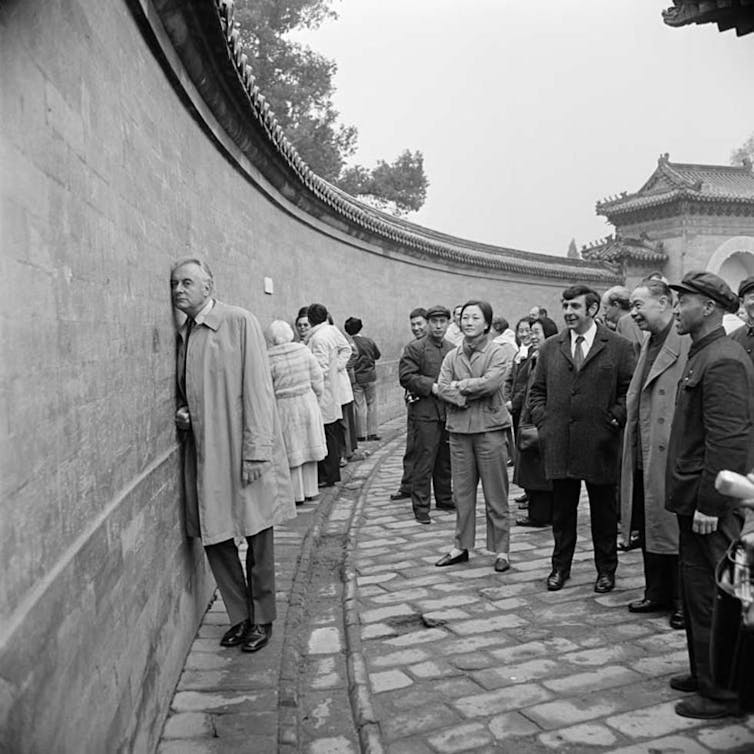
Anniversaries come and go, but 2022 might come to be regarded as unusually significant in Australian election-year politics.
This year marks 50 years since newly elected Gough Whitlam announced on December 22 1972 that he had agreed with Chinese premier Zhou Enlai to normalise relations between Australia and the People’s Republic of China. He said:
The serious distortion in our foreign policy has now been corrected.
At the time, this momentous shift in Australian foreign policy was regarded as relatively uncontroversial, since the United States was on the way to doing the same thing.
Fifty years later, and for the first time in more than a generation, the issue of China is intruding itself into an Australian general election in ways that would have been unthinkable for most of the past half century.
China’s rise, and its economic benefits, have meant a constructive working relationship with Beijing has been regarded as a bipartisan issue.
However, in recent years relations with Australia’s economic guarantor have faltered, and become the subject of persistent attempts by one side to inject a partisan wedge against the other.
One other detail to keep in mind is that later in this historically significant year China’s paramount ruler, Xi Jinping, will almost certainly be confirmed at a party congress as the country’s leader for another five-year term.
In light of all this the question becomes: how does Australia navigate the next stage in relations with a regional behemoth, and how would a prospective Labor government shift policy on China towards a more sustainable footing?
This is not to say a change of government is inevitable. It is simply to note that Australia may well find itself in a situation where a reset of China policy becomes possible, and certainly desirable, under new political management.
In its efforts to make the “China threat” an election issue, and play on Opposition Leader Anthony Albanese’s perceived inexperience in national security, the government is virtually ensuring that relations with Beijing will remain difficult if the Coalition survives.
Scarcely a day passes without a ministerial intervention that depicts Labor as being “weak on China”. These tactics represent something of a throwback to elections of the pre-Whitlam period, in which a “domino theory” of cascading communist influence in the region was deployed to scare voters.
The big difference between then and now, of course, is that China is by far Australia’s largest trading partner. This makes it guarantor of the country’s continued economic well-being.
In calendar year 2020, China’s share of Australian merchandise exports stood at 39.6%, up 12.3% year on year.
This makes persistent criticism of China by Australian ministers a risky enterprise.
Defence Minister Peter Dutton’s speech at the National Press Club on November 26 last year is a case in point.
His speech included the following statements:
Every major city in Australia, including Hobart, is within range of China’s missiles.
Both the Prime Minister and I have spoken about how the times in which we live have echoes of the 1930s.
While the current debate is about Taiwan, the analysis must be more honest. Yes there would be a terrible price of action, but the analysis must also extend to the price of inaction.
This is a small sample of his assessment. If sustained, it would take Australia in one direction – towards even closer military ties with the US, and risks of a more contentious relationship with China.
Read more: China enters 2021 a stronger, more influential power — and Australia may feel the squeeze even more
In light of all of this, and given the pressures of an election campaign, how does Albanese rebuff claims Labor would be “weak” on China?
So far, he has been fairly successful in rebutting attempts to portray him as a “Manchurian candidate” who, once in office, would yield ground to China and so jeopardise Australia’s national security.
The opposition leader was quick to embrace the AUKUS security agreement between Australia, the United Kingdom and the US that envisages a nuclear submarine fleet some time in the distant future.
He has criticised human rights abuses in Xinjiang and decried Beijing’s crackdown on free speech in Hong Kong.
In other words, Albanese has sought to limit Coalition attempts to discredit his security credentials.
Polls show he trails Morrison on security issues.
They also indicate that, at this stage, he remains the nominal favourite to prevail whenever an election is called.
Read more: Newspoll has Labor's biggest lead since Turnbull's ousting as Coalition damaged by COVID
This is why Albanese could do worse than review the historical record of how a Labor government, either in its own right or in partnership with an inflated cross-bench, might navigate Australia’s most important regional and economic relationship.
No doubt he will be mindful of the Whitlam breakthrough, one of the most important events in Labor annals. He would almost certainly give thought to the Hawke-Keating examples of managing relations with China effectively, and it would be surprising if he did not take advice from former prime minister Kevin Rudd.
One name that may not immediately suggest itself when it comes to managing relations with China is Julia Gillard.
Like Albanese, Gillard’s political experience lay in the domestic sphere. However, in dealing with China, she presided over a period when relations were, arguably, at their most productive in the past two decades.
In 2011, she made the first visit to Beijing by an Australian prime minister since Rudd in 2008.
In that year, she commissioned the Australia in the Asian Century White Paper to enable a blueprint for Australia’s engagement with the region, and China in particular.
Also in 2011, she hosted President Barack Obama in Canberra where, in a speech to the Australian Parliament, he announced a US “pivot to Asia” and the stationing of US marines in Darwin.
In 2012, she banned Chinese telecommunications giant Huawei from participating in the buildout of the National Broadband Network on national security grounds.
Perhaps Gillard’s most important contribution in her efforts to consolidate relations with Beijing came with her successful conclusion of an agreement on her visit to Beijing in early 2013 to upgrade relations to that of a “strategic partnership”.
In other words, Albanese, who is from the same left faction of the Labor Party as was Gillard, could do worse than pay attention to her China achievements.
Of course, China in 2022 is not the same China as it was in 2010-2013. Xi Jinping is also not the same relatively benign leader as Hu Jintao, with whom Gillard negotiated the strategic partnership.
In the past decade, China has become much bigger, much more powerful militarily and significantly more assertive under Xi. Nonetheless, Albanese may find guidance in the historical guardrails in which his own party’s China policy has evolved.
Fifty years after Whitlam’s historic initiative, 2022 would provide opportunity for such a rethink. This review should include ways in which Australia’s middle-power and honest-broker role in the region can be re-emphasised without weakening the country’s security partnership with a US riven by internal disputes.
On the other hand, if the Coalition is returned to office, it would be difficult to foresee an early easing of frictions. In that case, the Whitlam anniversary will be seen as an historic footnote and probably not much more.
Authors: Tony Walker, Vice-chancellor's fellow, La Trobe University

















