

Modern Australian
The Times

Exploring Antarctica's hidden under-ice rivers and their role in future sea-level rise

  • Written by Huw Joseph Horgan, Associate Professor of Geophysical Glaciology, Te Herenga Waka — Victoria University of Wellington
Exploring Antarctica's hidden under-ice rivers and their role in future sea-level rise

Underneath Antarctica’s vast ice sheets there’s a network of rivers and lakes. This is possible because of the insulating blanket of ice above, the flow of heat from within the Earth, and the small amount of heat generated as the ice deforms.

Map of Antarctica showing sub-glacial rivers, ice flow velocity, and ocean depth.
This map shows rivers (white) beneath Antarctica’s ice sheets (grey). Warm colours denote regions of fast ice flow. Huw Horgan/Quantarctica3/K862, CC BY-ND

Water lubricates the base of the ice sheets, allowing the ice to slide towards the ocean at speeds of many hundreds of metres per year. When the water emerges from beneath the ice, it enters a cold and salty cavity underneath ice shelves, the floating extensions of ice sheets that fringe the continent.

Here the water mixes, releases nutrients and sediment, and melts the underside of the ice shelves, which act as buttresses and hold back the flow of the ice sheets.

How these processes play out over the next centuries is a major factor in understanding sea-level rise. Unfortunately, this is also one of the least-explored parts of our planet.

Our Aotearoa New Zealand Antarctic Science Platform project is the first direct survey of an Antarctic under-ice river, and it supports earlier research suggesting these sub-glacial rivers form estuaries as they flow into the ocean, albeit at 82.5 degrees south, hidden under 500m of ice and about 500km from the open ocean.

Exploring an under-ice river

Our team has just returned from Kamb Ice Stream on the West Antarctic Ice Sheet (WAIS). Kamb is a sleeping giant.

This massive river of ice lies on the other side of the WAIS from Thwaites Glacier, Antarctica’s “doomsday” glacier which has been losing ice rapidly. Kamb used to flow fast, but this ceased about 160 years ago because of changes in how water was distributed at the base of the ice.

Scientists surveying over Antarctica's ice sheet and snow with skidoo and sleds.
Surveying across the surface of the under-ice river channel (in early 2016), researchers use seismic methods to determine what lies underneath the thick cover of ice. Huw Horgan/K862/VUW, CC BY-ND

While the Kamb region isn’t vulnerable to ocean warming at the present time, it currently offsets much of the ice loss happening elsewhere in Antarctica. Changes at Kamb will herald major changes for Antarctica’s ice sheets and oceans.

One challenge is that ice sheets respond to external changes, such as rising ocean temperatures, but also to difficult-to-predict internal changes, such as flood events that occur when sub-ice rivers and lakes “burst their banks”.

Read more: Antarctica's 'doomsday' glacier: how its collapse could trigger global floods and swallow islands

Getting there

The COVID pandemic has been hard on national Antarctic programmes and the field science they support. Global supply and freight delays kept our team on the edge in the lead-up to our season.

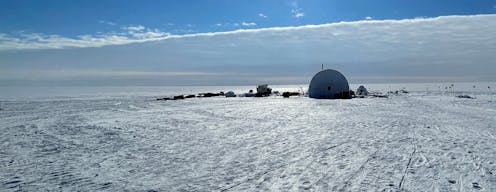
This summer, New Zealand started the rebuild of its main Antarctic station, Scott Base, and has been developing an over-snow traverse to deploy large teams across great distances. Our Kamb team was one of the first to benefit from this new capability, with a camp operating for months, more than 900km from New Zealand’s permanent station.

There’s an art to drilling through Antarctic ice. In reality, we melt our way through with recycled hot water.

Once on site, the team was able to drill through 500m of the ice shelf and keep a 0.4m-diameter hole open for nearly two weeks. This allowed us to take samples and gather observations for a diverse range of science projects.

A group of engineers swarm around a frame to help lower equipment designed to melt a hole in the ice shelf.
A group of engineers swarm around a frame to help lower equipment designed to melt a hole in the ice shelf. Craig Stevens/K862/NIWA, CC BY-ND

A hidden river

Almost a decade of research paid off when the team pinpointed the exact spot to drill to hit the onset of the narrow river beneath. This was even more impressive than initially thought, with borehole surveys revealing a river more than 240m high but less than 200m wide – a much narrower target than indicated by the surface icescape.

Working from a borehole means we can only look in one spot. As an antidote to this limitation, colleagues from Cornell University deployed their ocean robot Icefin to study the space below the ice.

Underwater image showing complex variations in the ice underside.
The camera shows corrugations on the underside of the ice. Craig Stevens/K862/NIWA, CC BY-ND

One of the discoveries that will keep the team going for some time is a dense community of likely amphipods, which we spotted when we lowered cameras to the seafloor. The swarm was so dense, we first thought there was something wrong with our equipment.

Read more: What an ocean hidden under Antarctic ice reveals about our planet's future climate

The last task the team completed was to deploy an ocean mooring beneath the ice. These instruments will continue to report back on ocean conditions over the coming years.

Only five days after deployment, we detected the tsunami from the Hunga Tonga-Hunga Ha'apai volcanic eruption.

An image of camera equipment being lowered down a hole in the ice shelf. The camera is lighting up the walls of the hole, showing complex corrugations in the ice.
The team lowers camera equipment down the ice borehole, which is around 0.4m in diameter. Craig Stevens/K862/NIWA, CC BY-ND

Apart from baseline observations, such discoveries provide strong motivation for deploying long-term monitoring equipment. The team will be watching closely over the coming years for any changes in the under-ice river flow, including flood events.

Authors: Huw Joseph Horgan, Associate Professor of Geophysical Glaciology, Te Herenga Waka — Victoria University of Wellington


Read more https://theconversation.com/exploring-antarcticas-hidden-under-ice-rivers-and-their-role-in-future-sea-level-rise-176456

Vista Cruises Enters "Two-Flagship Era" as Vista Aurora Completes Inaugural Voyage

Vista Aurora Sets Sail along the Yangtze. (Photo courtesy of the company)YICHANG, China — August 5, 2026 — Vista Aurora, a high-end interprovinc...

A Digital Preparation Checklist For International Medical Conferences

An international medical conference compresses many responsibilities into a few days. A delegate may need to present research, move between venues, ...

The Growing Popularity of Lab Grown Diamonds in Sydney and Hong Kong

The diamond industry has changed significantly in recent years as more buyers seek ethical, affordable, and sustainable alternatives to mined diamon...

Modern AI SEO Agency vs Traditional SEO: What’s the Difference

Search engine optimisation has changed dramatically over the past few years. Search engines have become smarter, user behaviour has evolved, and bus...

Caravan Travel for Modern Australian Getaways: Plan a Comfortable Holiday

A family road trip is one of the best ways to explore Australia together. And, travelling by caravan gives you the freedom to take your time, stop a...

Mini Excavator and Trailer Package for Sale: What I Buy as One Deal in 2026

The first client who asked me for a mini excavator and trailer package for sale wasn’t trying to save a few hundred dollars on shipping. They we...

Make Dad a Guest in His Own Home This Father’s Day

Father’s Day can accidentally turn Dad into the unpaid event manager of his own celebration. He lights the barbecue, finds extra chairs, checks wh...

Where to Enjoy Your Off-Road Caravan on the Gold Coast

With a caravan, you can travel anywhere and everywhere without battling the rush of the peak holiday season or last-minute reservations. While the r...

How Osteopathy Supports Recovery from Sciatica and Nerve Pain

Sciatica isn't just annoying. It's genuinely painful. It sits deep in your glute and shoots straight down the back of your leg. It turns something as...

The Winter Jewellery Edit: Five Pieces You'll Wear All Season

As wardrobes shift to cosy knits, tailored coats and rich seasonal textures, jewellery becomes the finishing touch that pulls every winter outfit to...

7 Signs It's Time to Upgrade Your Piston Air Compressor

If you run a workshop, panel shop, or fabrication business anywhere around Perth, you already know what heat and dust do to equipment over a few sum...

How Long Do Bathroom Renovations Melbourne Take? Step-by-Step Process Explained

Planning a bathroom renovation is exciting, but one of the biggest questions homeowners ask is, "How long will it take?" While every project is uniq...

Why Your Skin Breaks Out: The Science of Acne Explained

Acne is the most common skin condition in the world. An estimated 85% of people experience it at some point between the ages of 12 and 24, and a gro...

10 Swimwear Trends Australian Women Are Wearing This Summer

Every Australian summer brings a fresh wave of swimwear trends, but some styles have much greater staying power than others. While fashion constantly ...

Why Regular Skills Updates Are Essential for Licensed Security Officers

A guard at a Brisbane shopping centre gets a call about a shoplifter who's turned aggressive.  They’ve done the job for six years. But their de-...

10 Benefits of Choosing Professional Tutoring Penrith Services

Every student has unique learning strengths, challenges, and academic goals. While classroom teaching provides essential knowledge and structure, so...

Sunshine Coast Baby Classes Prove Big Hit Among First-Time Mums

There's a movement gaining traction on the Sunshine Coast, providing a village of support, socialisation and relief for first-time mothers and babie...

Father's Day Gift Ideas for Men Who Are Hard to Buy For

Some dads are easy to buy for. Others do not want anything, already have everything, or give you the classic "don't worry about me" answer every yea...















