

Google AI


Modern Australian

Exploring Antarctica's hidden under-ice rivers and their role in future sea-level rise

  • Written by: Huw Joseph Horgan, Associate Professor of Geophysical Glaciology, Te Herenga Waka — Victoria University of Wellington
Exploring Antarctica's hidden under-ice rivers and their role in future sea-level rise

Underneath Antarctica’s vast ice sheets there’s a network of rivers and lakes. This is possible because of the insulating blanket of ice above, the flow of heat from within the Earth, and the small amount of heat generated as the ice deforms.

Map of Antarctica showing sub-glacial rivers, ice flow velocity, and ocean depth.
This map shows rivers (white) beneath Antarctica’s ice sheets (grey). Warm colours denote regions of fast ice flow. Huw Horgan/Quantarctica3/K862, CC BY-ND

Water lubricates the base of the ice sheets, allowing the ice to slide towards the ocean at speeds of many hundreds of metres per year. When the water emerges from beneath the ice, it enters a cold and salty cavity underneath ice shelves, the floating extensions of ice sheets that fringe the continent.

Here the water mixes, releases nutrients and sediment, and melts the underside of the ice shelves, which act as buttresses and hold back the flow of the ice sheets.

How these processes play out over the next centuries is a major factor in understanding sea-level rise. Unfortunately, this is also one of the least-explored parts of our planet.

Our Aotearoa New Zealand Antarctic Science Platform project is the first direct survey of an Antarctic under-ice river, and it supports earlier research suggesting these sub-glacial rivers form estuaries as they flow into the ocean, albeit at 82.5 degrees south, hidden under 500m of ice and about 500km from the open ocean.

Exploring an under-ice river

Our team has just returned from Kamb Ice Stream on the West Antarctic Ice Sheet (WAIS). Kamb is a sleeping giant.

This massive river of ice lies on the other side of the WAIS from Thwaites Glacier, Antarctica’s “doomsday” glacier which has been losing ice rapidly. Kamb used to flow fast, but this ceased about 160 years ago because of changes in how water was distributed at the base of the ice.

Scientists surveying over Antarctica's ice sheet and snow with skidoo and sleds.
Surveying across the surface of the under-ice river channel (in early 2016), researchers use seismic methods to determine what lies underneath the thick cover of ice. Huw Horgan/K862/VUW, CC BY-ND

While the Kamb region isn’t vulnerable to ocean warming at the present time, it currently offsets much of the ice loss happening elsewhere in Antarctica. Changes at Kamb will herald major changes for Antarctica’s ice sheets and oceans.

One challenge is that ice sheets respond to external changes, such as rising ocean temperatures, but also to difficult-to-predict internal changes, such as flood events that occur when sub-ice rivers and lakes “burst their banks”.

Read more: Antarctica's 'doomsday' glacier: how its collapse could trigger global floods and swallow islands

Getting there

The COVID pandemic has been hard on national Antarctic programmes and the field science they support. Global supply and freight delays kept our team on the edge in the lead-up to our season.

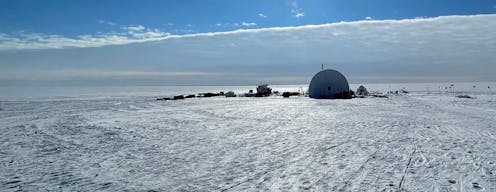
This summer, New Zealand started the rebuild of its main Antarctic station, Scott Base, and has been developing an over-snow traverse to deploy large teams across great distances. Our Kamb team was one of the first to benefit from this new capability, with a camp operating for months, more than 900km from New Zealand’s permanent station.

There’s an art to drilling through Antarctic ice. In reality, we melt our way through with recycled hot water.

Once on site, the team was able to drill through 500m of the ice shelf and keep a 0.4m-diameter hole open for nearly two weeks. This allowed us to take samples and gather observations for a diverse range of science projects.

A group of engineers swarm around a frame to help lower equipment designed to melt a hole in the ice shelf.
A group of engineers swarm around a frame to help lower equipment designed to melt a hole in the ice shelf. Craig Stevens/K862/NIWA, CC BY-ND

A hidden river

Almost a decade of research paid off when the team pinpointed the exact spot to drill to hit the onset of the narrow river beneath. This was even more impressive than initially thought, with borehole surveys revealing a river more than 240m high but less than 200m wide – a much narrower target than indicated by the surface icescape.

Working from a borehole means we can only look in one spot. As an antidote to this limitation, colleagues from Cornell University deployed their ocean robot Icefin to study the space below the ice.

Underwater image showing complex variations in the ice underside.
The camera shows corrugations on the underside of the ice. Craig Stevens/K862/NIWA, CC BY-ND

One of the discoveries that will keep the team going for some time is a dense community of likely amphipods, which we spotted when we lowered cameras to the seafloor. The swarm was so dense, we first thought there was something wrong with our equipment.

Read more: What an ocean hidden under Antarctic ice reveals about our planet's future climate

The last task the team completed was to deploy an ocean mooring beneath the ice. These instruments will continue to report back on ocean conditions over the coming years.

Only five days after deployment, we detected the tsunami from the Hunga Tonga-Hunga Ha'apai volcanic eruption.

An image of camera equipment being lowered down a hole in the ice shelf. The camera is lighting up the walls of the hole, showing complex corrugations in the ice.
The team lowers camera equipment down the ice borehole, which is around 0.4m in diameter. Craig Stevens/K862/NIWA, CC BY-ND

Apart from baseline observations, such discoveries provide strong motivation for deploying long-term monitoring equipment. The team will be watching closely over the coming years for any changes in the under-ice river flow, including flood events.

Authors: Huw Joseph Horgan, Associate Professor of Geophysical Glaciology, Te Herenga Waka — Victoria University of Wellington


Read more https://theconversation.com/exploring-antarcticas-hidden-under-ice-rivers-and-their-role-in-future-sea-level-rise-176456

Understanding a dental implant Melbourne Treatment Plan

A dental implant Melbourne patients may consider is one option for replacing a missing tooth, but suitability depends on oral health, bone support a...

How 3PL Logistics Australia Supports Faster and More Efficient Supply Chains

Why Has 3PL Logistics Become Important for Growing Businesses?  Gone are the days when supply chains were simpler and in minimal quantity. Now, the...

Common Skin Concerns and Treatment Options Available in Melbourne

Skin concerns can develop gradually or become noticeable following changes in age, lifestyle, sun exposure or hormonal factors. Pigmentation, rednes...

Why a Code-Compliant Home Can Still Feel Uncomfortable

When people build or renovate a home, they usually expect that meeting current building requirements will also produce a comfortable place to live. ...

Breach of Contract in Business: What Are Your Options?

Contracts are essential to business relationships. They establish expectations, allocate responsibilities and provide a framework for delivering goods...

How Pest Control Companies Can Rank for the Problems Customers Search First

Introduction SEO for Pest Control needs to start with the customer’s problem. Most people do not search for pest services in a neat or technical wa...

What Are the Benefits of Renovating an Older Home in Sydney?

Sydney has plenty of character homes, from Federation cottages to mid-century brick homes. Renovating rather than rebuilding can preserve what makes t...

Pool and Deck Design: How to Plan the Perfect Outdoor Living Space for Your Sydney Home

For many Australians, the backyard is where life happens. Summer barbecues, weekend swims and long evenings outdoors are all part of the lifestyle, ...

Is Solar Pool Heating Worth It? What Sydney Homeowners Should Know

There's nothing quite like a backyard pool on a hot Sydney day. But once autumn rolls in, many pools sit unused for months because the water is simp...

Planning a Luxury House Move: A Week-by-Week Timeline for Prestige Sydney Homes

Selling or buying a prestige home is a major milestone. Whether it's a waterfront residence in Birchgrove, a grand Federation home in Haberfield or ...

Downsizing or Upgrading Your Caravan? Here's How to Sell It Without the Hassle

Selling a caravan can feel like a major task, especially when you are unsure about its value, paperwork, or how to find a buyer. Whether you are dow...

The Best Overseas Adventure Holidays for Australians Who Love the Outdoors

Australia offers no shortage of incredible outdoor experiences, but sometimes the best way to satisfy your sense of adventure is to head overseas. A...

Cape Town Wine Shuttle: Winelands Tasting & Tours

Embark on an unforgettable journey through the picturesque Cape Winelands, where world-class wines and breathtaking scenery await. Our Cape Town Win...

Metal Fabrication: Choosing Metal Fabrication Melbourne Services for Custom Projects

What Modern Metal Fabrication Involves From individual components to complete structures, metal fabrication brings together processes such as desig...

Why Giant Rats Tail Grass Keeps Coming Back After Spraying

Giant Rats Tail Grass (GRT) is one of the most frustrating pasture weeds for farmers and lifestyle property owners. You spray an infested area, see th...

When Custom Cardboard Boxes Make Sense for Your Business

Custom cardboard boxes can be useful when a standard carton does not fit a product, packing method or presentation requirement particularly well. A ...

Full-Height vs. Pop-Top Caravan: Which Is Better for Family Travel across WA?

A pop-top caravan is an excellent choice for travellers who want the comfort of a caravan without committing to a larger, bulkier setup. With a lowe...

Bottle Label Printing: Key Factors for a Professional Finish

Why the Printing Method Matters When businesses need packaging or printed containers developed for a particular application, the right supplier can m...
















