

I helped introduce silver medallist Jaclyn Narracott to the fearsome 130kph skeleton event. Here's how it's done
- Written by Dale Chapman, Senior Lecturer, Applied Sports Science, Curtin University
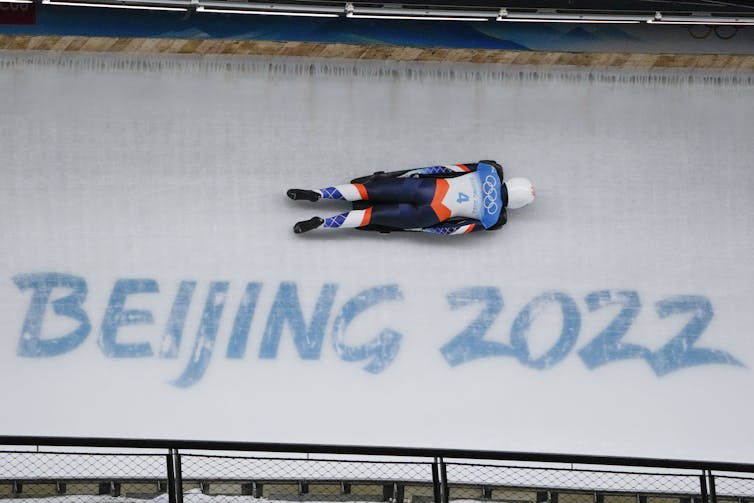
Australian Jaclyn Narracott admits it took a significant change of mindset to help her claim silver at the Beijing Winter Olympics in the women’s skeleton – the bobsled event in which competitors hurl themselves down a curving track at speeds of 130 kilometres per hour, with mere centimetres between their chin and the ice.
I was part of the coaching team that introduced her to this event more than a decade ago, in March 2011 at Lake Placid, New York, the venue for the 1980 Winter Olympics. I was the sport scientist and program manager of the Olympic Winter Institute of Australia’s Skeleton Program, along with my colleagues from the Australian Bobsleigh Skeleton Association (now Bobsleigh Skeleton Australia).
These days, Jacklyn splits her training time between sunny Queensland, at the Queensland Academy of Sport, and training with her partner in the UK during the off-season. On-ice training happens either during the northern summer in an “ice push house” – an indoor facility that lets athletes practise the start component of the event – or during the northern winter at one of just 15 tracks worldwide.
So what does it take to produce a medal-winning performance? And, perhaps more intriguingly, how does someone even begin to learn this fearsome sport?
What is skeleton?
Skeleton racers ride along a banked, ice-covered track, lying face-down on a single-piece sled with no suspension, no steering and no brakes. It’s a bumpier ride than it looks – ice isn’t smooth when you’re travelling faster than a car on a freeway!
Unlike the related events of bobsleigh, in which athletes sit inside a sled with steering cables attached to the front runners, and luge, in which competitors lie on their backs and use their legs to activate steering paddles, a skeleton sled is steered mainly by applying pressure via the knee or shoulder, or by subtly shifting the head or body position.
Beginners’ guide to skeleton.How do you win?
Olympic skeleton athletes make four runs down the track, which is typically 1.2km long and features about 20 corners, with the fastest cumulative time taking the gold.
The overall speed depends on three things: the momentum generated during the short running start; the kinetic energy supplied by gravity as athletes descend along the course and by centrifugal force as they round the corners; and how effectively competitors can conserve energy by taking the most efficient line through the corners.
In general, athletes prefer to steer using their knee, shoulder or both. Steering left, for example, would involve pressing the right shoulder or left knee down onto the sled, or both at once for a sharper turn. This flexes and twists the sled, affecting the direction of the runners.
When approaching a corner, both the entry point (either early or late into the corner) and the direction of the sled affect how the centrifugal force of the corner will act on the slider. The athletes seek to anticipate the centrifugal force in the corner, to stick to a natural flowing line so as to carry more speed through the corner exit. Dragging a toe along the ice, while very effective for changing direction, can cost a lot of speed, so generally racers avoid this move where possible.
In straight sections of track, where there is no centrifugal force, steering the sled in the usual way doesn’t work, but a subtle tilt of the head can create an “air dam” that slightly changes the sled’s direction. But you don’t want to break the sled into a power slide skid, as you will lose a lot of momentum.
Finding an aerodynamic position is relatively straightforward: arms and hands by the competitor’s sides or tucked slightly under the top of the thighs; legs together and toes slightly pointed to remain off the ice. The head and chin are not tucked down, but instead held in a neutral position to maintain a clear view down the track.
As athletes develop, they become comfortable in this sliding position despite the alarming proximity of face and ice.
Ok, but how do you learn?
An athlete’s approach to skeleton depends on what we sports scientists call their “fear/risk profile”. This is an analytical tool that can help any athlete who may need to deal with significant fear or risk in their chosen event. It can boost confidence by allowing athletes to describe and contextualise their previous experiences of a track, with reference to particular weather or ice conditions.
When first learning this discipline, all skeleton sliders will begin from a lower position in the track, and only navigate the final six or so corners. This reduces both the speed and complexity of the run. At Lake Placid a decade ago, Jaclyn began her first ever run from corner 10 and completed four runs that day, before moving up to corner 7 the next day.
This might sound like a very small amount of practice for such a complex sport, but the on-ice vibrations and the g-forces involved are very fatiguing. After training, some athletes can show symptoms similar to impact trauma without having suffered any actual impact.
Their coach will then ask them to describe their entrance and exit from each corner, when and where they steered, and what steering technique they used. Using visual and video feedback, the athlete and their coach reviews their performance, thus building their risk profile and improving their speed.
As the athlete improves, they move further up the track to include more corners and greater speeds, until eventually they have mastered the entire course. But an experienced slider like Jaclyn will tackle a new course from the top straight away, as they have the necessary skills and confidence.
To cement their performance and learning, athletes take detailed track notes which they use to perform “mind runs”, either purely by mentally picturing the descent, or while lying on their sled and rehearsing the moves in the correct sequence.
Read more: The slippery science of Olympic curling: we still don't know how it works
And finally, how do you stop?
As mentioned above, a skeleton bobsled has no brakes. Bobsled courses generally have a long uphill ramp beyond the finish line, and competitors can also drag their spiked shoes along the ice or aim to rub off speed by steering into the walls of the track. After crossing the finish timing eye, the finishing straight or “outrun” of a track is usually about 100m long.
Stopping comes with its own risk of injury – athletes have fallen off their sleds, usually bruising nothing more than their ego, but occasionally something may be tweaked or broken. But compared with the challenge of successfully navigating a succession of corners at speeds faster than a car on a freeway, stopping is the relatively easy part.
Authors: Dale Chapman, Senior Lecturer, Applied Sports Science, Curtin University

















