

Google AI


Modern Australian

can you really fry an egg on the footpath on a hot day?

  • Written by: Chris Thompson, Associate Dean (Education) - Science, Monash University
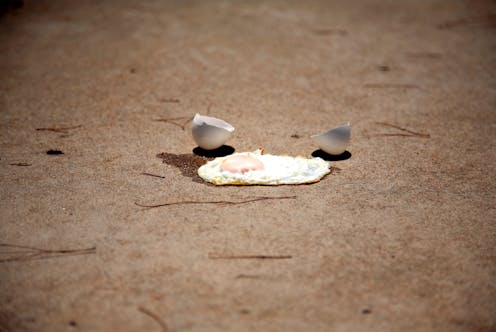
can you really fry an egg on the footpath on a hot day?

Aahh, the Australian summer. When the temperatures top 40℃ and only the bravest or most foolhardy would venture outside in bare feet, there’s a cherished old saying: “it’s so hot outside you could fry an egg on the footpath!”

But what does the science say? Does this claim stack up, or it half-baked?

To answer this question, we need to understand the chemicals inside an egg, what happens to them during the cooking process, and whether the footpath really gets hot enough to drive these chemical changes.

The first and most obvious point is that the egg’s yolk and white are chemically very different. The white, which makes up about two-thirds of an egg’s mass, is roughly nine parts water and one part protein. The key here is that the protein’s structure changes if you heat it above a certain temperature.

About half the yolk’s mass is water, about a quarter is “fat”, about one-sixth is protein, and less than 5% is carbohydrates. The protein in the yolk is a completely different type of protein, but much like with the egg white, it’s how the protein responds to heat that gives us the texture of fried, scrambled, poached or hard-boiled eggs.

Ok, so how does this work?

We can think of proteins as being long chains of molecules called amino acids. In a raw egg, the protein is suspended in the watery mixture. The chain is curled up in a very particular way, held in shape by weak chemical bonds between different parts of the chain as it folds over on itself (the animation below shows the folded structure of ovalbumin, the main protein in egg white). This keeps it stable, and able to mix with the water.

But once it’s heated up, the heat energy starts to break these weak chemical bonds and the chain begins to uncurl, rearrange itself and stick together again in a completely different way.

Suddenly, these reconfigured clumps of protein molecules are no longer water-soluble, and so they solidify. This is why eggs get harder if you cook them for longer.

This process is called denaturation, and it can happen to any type of protein. Denaturation is what turns milk into curds and whey, and changes the texture of meat as it cooks.

Read more: Kitchen Science: the chemistry behind amazing meringue and perfect cappuccino

For eggs, denaturation begins at around 60℃, but this is likely to only slightly cook the egg whites, and the yolk will not turn solid at all.

As you slowly go from 60℃ to 70℃, however, there is more heat energy available and all of the egg’s proteins now begin to denature. The egg white begins to turn gel-like and eventually rubbery, and the yolk begins to solidify into a viscous goo, before eventually becoming solid or even slightly powdery in texture.

Get the temperature right and this process unfolds nice and gradually, which means with a bit of practice you can get your eggs to turn out exactly how you like them.

Righto, so is a footpath hot enough for this?

That leaves us with the crucial question: how hot does pavement get on a scorching summer day? Does it reach the almost 70℃ you would need for a footpath fry-up?

This depends on a lot of factors, including the air temperature, direct sunlight, the footpath material and even its colour. Black-painted concrete, for example, absorbs more heat than white or unpainted concrete.

All in all, at the peak of these conditions, on a boiling summer day, a footpath can potentially just about reach the right temperature. But sadly, that’s still not enough to sizzle an egg.

First, concrete is a poor conductor, so it will transfer heat to the egg much more slowly than a metal frying pan. Second, after cracking the egg onto the footpath, the footpath’s temperature will drop slightly.

Read more: Why you can’t fry eggs (or testicles) with a cellphone

So if you were hoping for a cheap way to cook your sunny-side-up eggs on the footpath this summer, you might be disappointed. It’s much wiser to head back indoors to the kitchen. Your egg will be hotter, and you’ll be much cooler.

Authors: Chris Thompson, Associate Dean (Education) - Science, Monash University

Read more https://theconversation.com/sunny-side-up-can-you-really-fry-an-egg-on-the-footpath-on-a-hot-day-172616

Breach of Contract in Business: What Are Your Options?

Contracts are essential to business relationships. They establish expectations, allocate responsibilities and provide a framework for delivering goods...

How Pest Control Companies Can Rank for the Problems Customers Search First

Introduction SEO for Pest Control needs to start with the customer’s problem. Most people do not search for pest services in a neat or technical wa...

What Are the Benefits of Renovating an Older Home in Sydney?

Sydney has plenty of character homes, from Federation cottages to mid-century brick homes. Renovating rather than rebuilding can preserve what makes t...

Pool and Deck Design: How to Plan the Perfect Outdoor Living Space for Your Sydney Home

For many Australians, the backyard is where life happens. Summer barbecues, weekend swims and long evenings outdoors are all part of the lifestyle, ...

Is Solar Pool Heating Worth It? What Sydney Homeowners Should Know

There's nothing quite like a backyard pool on a hot Sydney day. But once autumn rolls in, many pools sit unused for months because the water is simp...

Planning a Luxury House Move: A Week-by-Week Timeline for Prestige Sydney Homes

Selling or buying a prestige home is a major milestone. Whether it's a waterfront residence in Birchgrove, a grand Federation home in Haberfield or ...

Downsizing or Upgrading Your Caravan? Here's How to Sell It Without the Hassle

Selling a caravan can feel like a major task, especially when you are unsure about its value, paperwork, or how to find a buyer. Whether you are dow...

The Best Overseas Adventure Holidays for Australians Who Love the Outdoors

Australia offers no shortage of incredible outdoor experiences, but sometimes the best way to satisfy your sense of adventure is to head overseas. A...

Cape Town Wine Shuttle: Winelands Tasting & Tours

Embark on an unforgettable journey through the picturesque Cape Winelands, where world-class wines and breathtaking scenery await. Our Cape Town Win...

Metal Fabrication: Choosing Metal Fabrication Melbourne Services for Custom Projects

What Modern Metal Fabrication Involves From individual components to complete structures, metal fabrication brings together processes such as desig...

Why Giant Rats Tail Grass Keeps Coming Back After Spraying

Giant Rats Tail Grass (GRT) is one of the most frustrating pasture weeds for farmers and lifestyle property owners. You spray an infested area, see th...

When Custom Cardboard Boxes Make Sense for Your Business

Custom cardboard boxes can be useful when a standard carton does not fit a product, packing method or presentation requirement particularly well. A ...

Full-Height vs. Pop-Top Caravan: Which Is Better for Family Travel across WA?

A pop-top caravan is an excellent choice for travellers who want the comfort of a caravan without committing to a larger, bulkier setup. With a lowe...

Bottle Label Printing: Key Factors for a Professional Finish

Why the Printing Method Matters When businesses need packaging or printed containers developed for a particular application, the right supplier can m...

Virtual Livestock Fencing and GPS Tracking: Improving Visibility Across Cattle Properties

What Virtual Livestock Fencing Means for Modern Cattle Management Managing cattle across extensive properties requires more than knowing where anim...

Sydney Pawnbrokers Explained: How Hocking Your Car Actually Works

Sometimes you need cash, and you need it soon. If you own a car, you may already have a way to get it. That's what people mean when they say they've...

Moving Interstate from the Gold Coast to Brisbane (or Back)? What Removalists Wish You Knew First

Have you talked to anyone who’s done the move? They say the same thing: the drive up the M1 is the easy part. It's everything around it that catches...

Why the Spring School Holidays Are a Great Time to Visit Coffs Harbour

The spring school holidays are a good time to spend a few days on the Coffs Coast. The weather is starting to warm up, there is plenty to do outdoor...

















