

How Australia's geology gave us an abundance of coal – and a wealth of greentech minerals to switch to
- Written by Melanie Finch, Lecturer in Structural Geology and Metamorphism, James Cook University
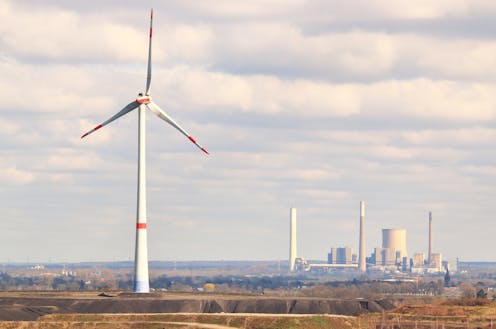
Two recent announcements hint at a seismic shift about to hit Australia’s coal industry.
Australian tech billionaire Mike Cannon-Brookes and Canada’s Brookfield put forward an extraordinary joint bid to takeover AGL Energy, Australia’s biggest emitting company, over the weekend. If successful, it would see AGL’s coal-fired power stations shut down early. And last week, Origin Energy announced that the country’s largest coal plant, Eraring, will close seven years early.
These developments have confirmed what many already knew: the death of the coal industry is now inevitable.
Australia’s coal industry directly and indirectly supports less than 1% of the Australian workforce, with these jobs heavily concentrated in a handful of small regions in Queensland, Victoria, New South Wales and Western Australia.
Coal is the reason some of these communities exist. If we don’t transition carefully, these communities will break apart, as so many mining towns have before.
But Australia is also abundant in many of the minerals and rare earth elements our society will run on in the future, including lithium, cobalt and copper. If government and industry pivot from coal to green energy, Australian jobs in energy and the minerals industry will still exist. All we need is a plan.
But why did coal end up in these dense deposits in a small number of places? And how can we ensure the end of the coal industry happens in a way that doesn’t decimate people’s livelihoods? The answers to those questions can be found in Australia’s ancient past – let’s take a trip back 299 million years.

The past shapes the present
Our destination: eastern Australia, 299 million years ago during the Permian age. In this period, Australia was much further south, close to where Antarctica is now.
Australia was slowly emerging from a long, cold period which had lasted for millions of years. Ice sheets still covered parts of southern and western Australia and glaciers were common in the mountains of the eastern states.
As the world warmed and ice sheets melted, high rainfall saw dense forests grow in eastern Australia. Swamps and extensive river systems covered swathes of land.
In these dense, swampy forests, the most abundant trees were from a now-extinct group called Glossopteris. These trees, known as seed ferns, reached heights of 40 metres with long, bare trunks giving way to a dense canopy of branches bearing broad, tongue-shaped leaves.
Read more: The epic, 550-million-year story of Uluṟu, and the spectacular forces that led to its formation
Australia’s animal life was vastly different to today. Our oceans were full of trilobites, which looked a little like slaters with a hard mineral exoskeleton. They lived underwater and had incredible vision with eyes made of calcite – the same mineral that makes up stalactites and stalagmites in caves.
On land, the vertebrate fossil record from this time is intriguingly sparse, but we suspect animals such as the Labyrinthodont wandered the swamps (think of a salamander but the size of a crocodile and with razor-sharp teeth).
It was in this glorious, terrifying swampy wonderland that eastern Australia’s coal deposits formed. When the towering Glossopteris died, they toppled into the swamps and rivers. High rainfall meant dead trees were completely covered by water so deep it contained little oxygen.
The lack of oxygen meant the trees didn’t break down like they normally would, instead retaining some of the energy they accumulated when alive. More and more plant matter was deposited, and the swamps and rivers deepened.
Under the weight from above, the lowest layers compacted and became more dense, eventually forming peat. When peat is buried deeper, compacted and heated it eventually forms a carbonaceous black rock: coal.
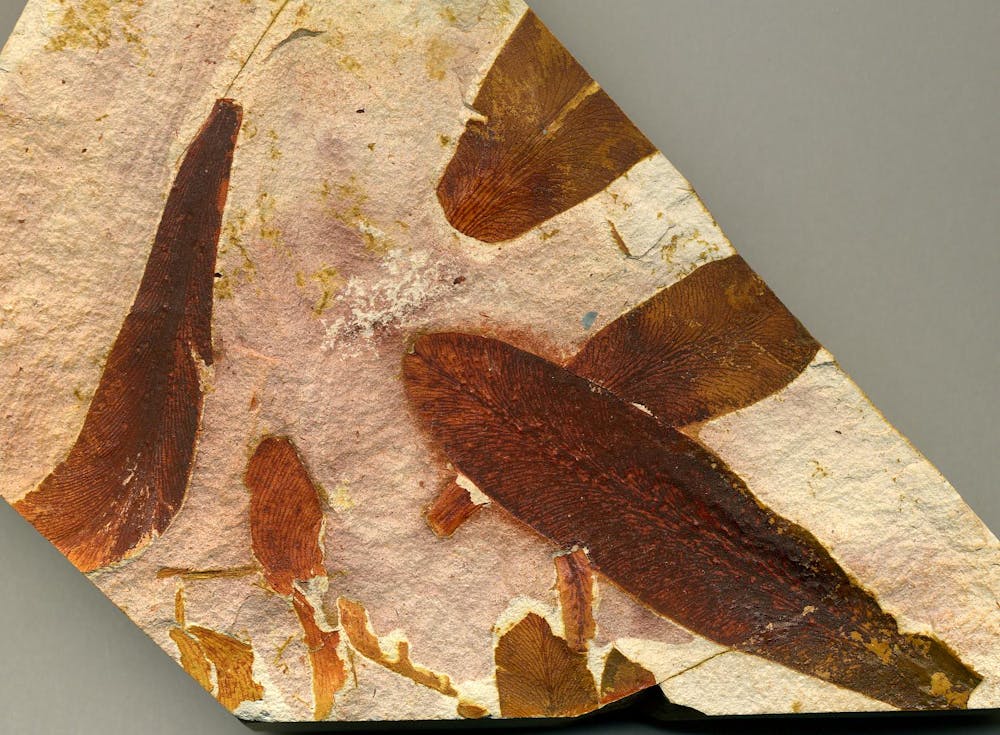 The fossil leaf of a Glossopteris seed fern found in coal deposits in New South Wales.
James St John, Wikimedia Commons, CC BY
The fossil leaf of a Glossopteris seed fern found in coal deposits in New South Wales.
James St John, Wikimedia Commons, CC BY
Coal is remarkably rare
Coal deposits are extraordinarily rare on Earth and require very specific circumstances to form. You need enormous volumes of woody plant matter being deposited into a swamp, river or shallow marine environment. Australia’s Glossopteris trees were uniquely adapted to grow prolifically in swamps and rivers, so they were the perfect coal ingredient.
But the coal checklist doesn’t stop there. The watery graveyard for the trees had to deepen over time to make room for more trees on top, while keeping the whole system covered in water. This environment had to exist for a very long time. To make a 1m-thick black coal deposit, you need a 10m-thick layer of trees.
Read more: Plant fossils have a lot to teach us about Earth's history
After the coal deposit forms, it needs to be preserved. That usually means no major tectonic activity after the deposit forms.
Australia’s deposits formed close to the coast. If the sea level had risen just a little, many coal deposits would be submerged and inaccessible.
In short, several environmental and geological processes have to occur at the same time for coal deposits to form. Australia’s eastern margin proved to be the perfect setting.
Using our geology for a just transition
Today, Australia is a coal giant, the world’s largest exporter of coking coal and second-largest of thermal coal. While this might be lucrative for the companies involved, coal is not compatible with a liveable climate. Every year, burning coal causes 40% of global greenhouse gas emissions.
Governments often hold up coal jobs as a reason Australia can’t part ways with coal mining. Recent modelling of a net-zero emissions by 2050 scenario shows between 100,000 and 300,000 jobs will be lost in Australia’s coal-mining communities.
This would be devastating for coal towns if it happened suddenly. But we don’t have to do it like that. If new industries are brought into these towns over the next 20 years, it may have minimal impact.
Not only that, but Australia will need mining workers for the foreseeable future – just not in coal.
Coal, gas and oil are quickly getting replaced with renewables, electric cars and battery storage, among other technologies. That means mining. To build wind turbines, solar panels and battery storage we need minerals such as copper, cobalt, lithium and rare earth elements.
Luckily, Australia’s geology means we have rich deposits of many of these minerals, too.
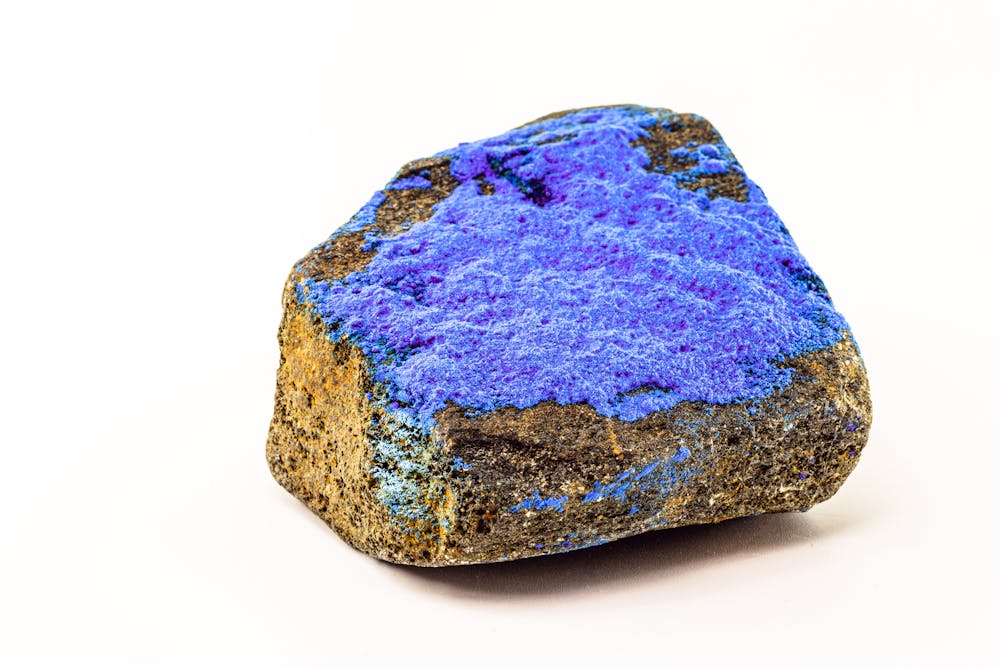 Could we switch from coal to cobalt?
Shutterstock
Could we switch from coal to cobalt?
Shutterstock
Like coal, these minerals are concentrated in particular regions. And like coal, they have been millions of years in the making. Mount Isa’s copper and rare earth element deposits formed when hot, salty fluids acted like a magnet for metals, bringing them up to the surface and depositing them in little pockets we can find by understanding the geology.
Much of this happened 1.5 billion years ago, but the deposits are still there, just under the surface.
Read more: 5 rocks any great Australian rock collection should have, and where to find them
Indeed, modelling suggests Australia’s switch to export clean energy and green technology minerals could generate 395,000 jobs in locations likely to be affected by global decarbonisation.
On a wider scale, the million jobs plan, proposed by the Beyond Zero Emissions thinktank, details how 1.8 million new jobs could be created in Australia in renewables and low-emissions technology.
We have the potential to be a global leader in climate action through our mining prowess and human capital coupled with our geological wealth of minerals vital to the decarbonisation push now under way. No one need be left behind in the coal towns – as long as our leaders plan for this now.
Authors: Melanie Finch, Lecturer in Structural Geology and Metamorphism, James Cook University


















_(15448560516).jpg)