

Today's aged care falls well short of how we'd like to be treated – but there is another way
- Written by Davina Porock, Professor of Nursing, Director of Centre for Research in Aged Care, Edith Cowan University
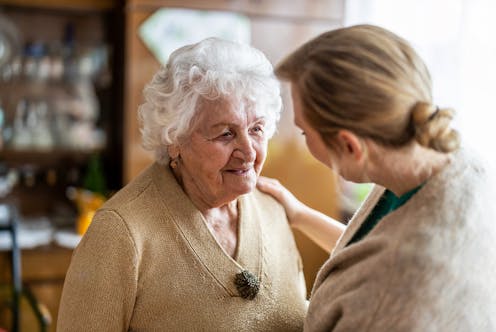
Bill? Why isn’t he home from work? I have to go and look for him. He’s never late – something’s happened. My chest is getting tight and tears start on my cheeks.
A friendly face comes into view, smiling warmly, facing me directly. A gentle hand reaches to me. I go with them and sit in the kitchen. Something smells good.
The man at the table with the children looks like Bill – I pat him on the shoulder. He smiles. He’s home from work; that’s good. Come in the kitchen, the friendly face says. Would you like to help with dinner? There’s potato to mash or perhaps you could lay the table?
The children are doing some drawing and one has a tiny TV in her hand and she’s pointing on the screen. “Look Nana,” she says and shows me colourful things jumping onscreen. I am home.
This is what many of us might hope for if we need residential care as we age. We want to feel safe, loved, to take part in the ordinariness of home life.
With an aged care system under extreme pressure, the federal government is seeking thousands of volunteers to help with daily care tasks including talking with residents, brushing their hair and helping them exercise. This follows the announcement 1,700 Australian Defence Force personnel would help at aged care homes, though fewer than 200 have been deployed so far.
Dementia Australia chief Maree McCabe last week called for federal budgeting to “ensure everyone receives the standard of care we would all expect for ourselves”. Indeed, the reality of aged care today is a different story.
Read more: Nursing home residents are paying $800 a week for services they are barely getting
A feeling of loss and failure
Having a sense of security, belonging, continuity, purpose, significance, and achievement through relationships is what creates a feeling of well-being. When an older person is moved into an aged care facility, it is usually because their health needs are too complex for family or partners to manage at home, not because they aren’t loved.
The latest available figures show around 350,000 Australians using residential aged care.
Older age, multiple chronic conditions, complex medication and treatment needs exist in addition to the “activities of daily living”: getting dressed, going to the toilet, eating, and moving.
This move can bring a sense of loss and even failure for residents and families. Well-being can suffer.
The reality for care workers
Quality care is built on relationships and is person-centred with time to know the person, to understand their life and preferences. Time is a luxury not permitted in the current system.
Care work is reduced to tasks in line with a factory assembly-line approach. Residents are rarely permitted or invited to do things for themselves or help with food preparation – so skills and purpose are lost.
With a long list of jobs to do, staff are not encouraged to sit with residents – that isn’t seen as work or vital to their caring role. One aged care worker we contacted as part of our research told us:
We run out of time every time. We have so much to do within too short a time. We are not able to help or meet the needs of all our residents.
Despite this, aged care workers often build strong attachments to the elders in their care. As one care worker said:
When I don’t go to work for few days, I miss my residents, and feel like going back to work soon. It is a very sad feeling seeing a resident in palliative care and dying. Even worse to see is, family members grieving over the loss of their loved ones.
This sense of connection, pathos and responsibility keeps many aged care workers committed to their work, despite poor rates of pay and intensifying workloads.

Read more: When aged care workers earn just $22 an hour, a one-off payment won’t fix the wage problem
Models we could learn from
The World Health Organization advocates for a care model that gives residents a sense of autonomy within a homelike environment. The Household model is based on a person-centred care approach where the residents plan and decide for their health, well-being, and care as much as they are able. Households are small scale homes with eight to ten residents with an environment they find meaningful and engaging.
Small household models have been established in the US and the Netherlands, and researchers are showing their positive impact. A few residential aged care facilities in Australia have moved to introduce these models and allow aged care workers to focus more on quality person-centred care rather than just tasks and time. But of course, funding is needed to make this viable.
 Helping with simple meal preparation in a home-like environment can provide a sense of purpose.
Unsplash/CDC, CC BY
Helping with simple meal preparation in a home-like environment can provide a sense of purpose.
Unsplash/CDC, CC BY
Despite everyone having an opinion about the quality of care, few people are prepared to work in the sector. Care for the vulnerable in our society – whether the very young in childcare, people living with disability, or the old and frail – is woefully undervalued and underpaid.
If we valued this work, we would expect the people doing it to have appropriate training, to have the support and guidance of registered nurses and nurse practitioners. We would not be asking volunteers or soldiers to do it. There would be better staff-to-resident ratios to allow time to care, not just do tasks related to keeping a body clean, dry, fed and watered.
The staff in aged care are currently set up to fail. But the real failure of the system is the lack of funding that prevents making the changes already shown to work better.
Authors: Davina Porock, Professor of Nursing, Director of Centre for Research in Aged Care, Edith Cowan University


















