

this decade is critical for adapting to inevitable climate change impacts and rising costs
- Written by Judy Lawrence, Senior Research Fellow, New Zealand Climate Change Research Institute, Te Herenga Waka — Victoria University of Wellington
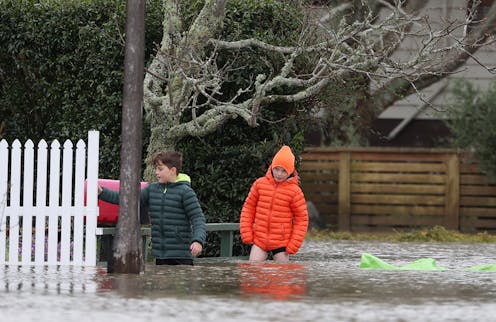
Climate change impacts in Aotearoa New Zealand are real and future risks are high, according to the latest report released today by Intergovernmental Panel on Climate Change (IPCC).
The report is part of the IPCC’s Sixth Assessment and focuses on impacts, adaptation and vulnerability to climate change. It highlights that some impacts such as sea-level rise are now unavoidable in the near-term, irrespective of the emissions trajectory, and will require new, larger-scale and timely adaptation efforts.
At 1.1℃ above pre-industrial temperatures, climate change is already affecting New Zealand’s natural and managed land and water systems, coastal areas, glaciers and oceans. Impacts include extreme weather, heat waves, heavy and more frequent rainfall, droughts, fire, changing seasons and sea-level rise.
Some impacts are projected to become widespread and systematically pervasive, and potentially irreversible, if average global temperature rises by 1.5–2℃.
But if we take action immediately to limit global warming to 1.5℃, the losses and damage to human systems and ecosystems in Aotearoa will be less, albeit not completely avoidable. Sea-level rise will continue, even with rapid cuts to emissions. Beyond 2040, projected impacts could be several times higher than those we currently observe.
The IPCC report presents new evidence on climate change risks that threaten nature, human well-being and planetary health.
Without interventions, our region faces increasing food production failures and nutrition-related diseases, mental health impacts, new water-borne diseases and many harmful effects of extreme heat. This decade is critical for effective adaptation.
How climate change already affects us
Rising temperatures and more heavy rainfall are damaging to health. For instance, heavy rainfall increases the chances New Zealand children will be admitted to hospital with gut infections.
Glaciers and kelp forests are shrinking, and communities dependent on these systems are already affected by growing economic and social costs from compounding climate change impacts. Those who are already socially disadvantaged are affected the most.
As global temperatures rise, the risks to our human and natural systems become greater. The scale and speed of global emissions cuts will determine whether the impacts of climate change outpace our ability to adapt.
The IPCC’s earlier report, released in August last year, found it is now most likely global warming will reach or exceed 1.5℃ during the 2030s. This will be challenging. Communities in low-lying coastal areas face more flooding and progressive risks from storm surges and sea-level rise. This means more costly damages, potential loss of insurance, relocation, community dislocation and increasing inequality.
Accelerating our adaptation efforts and cutting emissions will give us a greater chance of reducing current and future impacts. The report reiterates we have the knowledge to adapt to many of these impacts if temperatures do not rise much beyond 1.5℃.
Examples include changing sowing or harvesting times in agriculture and developing adaptation strategies for river and coastal flooding by local government that are flexible to changing risk. But there is a wide gap between what is happening now and what is needed, in terms of investment, planning, implementation and monitoring and evaluation.
Delaying adaptation shifts the burden
To date, Aotearoa has typically focused on recovery after disasters. Investing before extreme events happen can seem expensive, but it is likely to be cheaper in the long run.
The necessary investment to improve resilience before disasters happen will require strong community and sector engagement to include long-term impacts and costs into decision making.
The report stresses that investing in adaptation efforts now will not only be cheaper, but easier and more effective than delaying action. The effectiveness of adaptation measures will decline with increased warming.
Delaying adaptation raises the exposure of people to risks and shifts the burden to future generations and the most vulnerable, which is unfair. As the impacts and costs of climate change increase over time, our financial systems could become less stable and the government less able to support those affected, placing a greater burden on New Zealanders and increasing existing vulnerabilities and inequalities.
Climate change in other countries will affect New Zealand through its impacts on international trade, including supply chains for goods and services and impacts on our trading partners. Other pressures will flow on to New Zealand from humanitarian crises related to conflicts, food shortages, sea-level rise, extreme weather events and migration within and between countries.
Effective adaptation
The most effective adaptation is integrated and coordinated across governance levels. It is also inclusive of diverse cultures, ages and societal groups. Mātauranga Māori knowledge based on human-nature relationships and social-cultural networks that promote collective action already informs our adaptation effort and has a strong role going forward, while also upholding Māori interests under Treaty of Waitangi obligations.
Drawing together different ways of knowing will be even more important in the future to ensure consistent efforts to protect the integrity of our ecosystems on land and in the ocean.
Protecting our natural land and ocean systems will be essential to ensure they in turn protect our well-being in a warming world. Think of trees in urban areas providing cooling or wetlands moderating flood waters. We are already removing invasive species to safeguard native biodiversity and this will be even more urgent if climate change boosts their populations.
We need to adapt infrastructure to better protect drinking water supplies and support health services. Such improvements will generate benefits to New Zealanders beyond climate change. But they won’t happen without long-term planning, coherence across all areas of policy and robust and consistent political commitment.
New risks for Aotearoa arise from the scale of cascading and compounding impacts which become even greater after 1.5℃. This increases the urgency for adaptation, but adaptation effectiveness has limits.
Global and national efforts to reduce greenhouse gas emissions are a prerequisite to successful adaptation. Further delay will make climate change vulnerabilities worse, more expensive and difficult to address.
Authors: Judy Lawrence, Senior Research Fellow, New Zealand Climate Change Research Institute, Te Herenga Waka — Victoria University of Wellington

















