

how do small states like New Zealand respond in an increasingly lawless world?
- Written by Alexander Gillespie, Professor of Law, University of Waikato
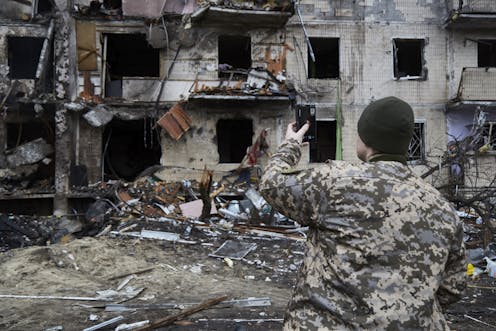
New Zealand’s official response to Russian aggression and violations of international law have so far been strong – but they could go further.
While no NATO-aligned country can – under any circumstances – put boots on the ground in Ukraine (which could lead to world war), New Zealand must do everything tangibly possible to oppose the Russian invasion.
To that end, New Zealand’s sanctions regime must be nothing less than those of its allies. This should extend to passing legislation under urgency to allow sanctions beyond those mandated by the United Nations (UN).
Avoiding the need for UN approval is essential because of Russia’s Security Council veto. As other like-minded countries provide military hardware to Ukraine, New Zealand should also consider offering logistical support, with non-lethal military aid such as body armour and medical packs being a minimum.
New Zealand should continue to strengthen its relationship with NATO and consider seeking to become an “enhanced opportunity partner” as Australia did in 2014. Finally, the government needs to reflect on whether its current defence spend and strategic focus are adequate for the world we now live in.
Decline of the UN
These measures are warranted, given the state of the United Nations Charter. Designed to prevent the scourge of war and uphold international law, there are now tank tracks all over it.
In theory, UN member states promise to settle disputes by peaceful means and refrain from the threat or use of force against other sovereign nations. Those commitments are supplemented with bilateral arrangements.
Read more: Ukraine's military is outgunned but can still inflict a great deal of pain on Russian forces
Just such an arrangement underpinned Ukraine’s decision in 1994 to hand its nuclear arsenal over to Russia in return for Russia promising to respect its independence, sovereignty and existing borders.
But two decades of decline lie behind today’s crisis. Since the end of the 1990s we have witnessed the continued destabilisation of the international architecture designed to keep peace.
Erosion of international law
We can trace this decline to the US withdrawal from the Anti-Ballistic Missile Treaty with Russia in 1999. That same year, NATO (whose member states regard an attack on one as an attack on all) began to expand eastward.
The UN’s effectiveness was dealt a serious blow by the unlawful US invasion of Iraq in 2003, while further NATO expansion in 2004 added to Moscow’s anxiety. But Russia appeared to learn by example.
Read more: 'Just short of nuclear': the latest financial sanctions will cripple Russia's economy
Military interventions in Chechnya and Georgia, and support for the Assad regime in Syria from 2011, were followed by Russian recognition of breakaway eastern regions of Ukraine in 2014 and its illegal annexation of Crimea the next year.
Russia then withdrew from the Treaty on Conventional Armed Forces in Europe and in 2016 quit the jurisdiction of the International Criminal Court (which the US has never even joined).
Meanwhile, then-US president Donald Trump pulled out of the Intermediate Nuclear Range Treaty (which kept intermediate range nuclear weapons out of Europe) and then exited the Open Skies Treaty which gave European and allied nations the ability to verify arms control commitments.
Putin’s impossible demands
The net result is today’s parlous situation. Whether Russia will try to annex all or just some of Ukraine we cannot say. But before the invasion Putin put peace offers on the table in the form of two draft treaties, one for the US and one for the other NATO states.
Essentially, Putin is proposing the removal of collective defence guarantees by NATO in eastern Europe. He believes this is fair, based on the unwritten promises after the Cold War that former Soviet bloc countries would not join NATO.
Read more: What can the West do to help Ukraine? It can start by countering Putin's information strategy
Those promises were never made into a legally binding treaty, however, and Putin now wants that changed. Specifically, he wants a rollback of NATO forces and weaponry in the former Soviet allies to 1997 levels.
Russia also wants the US to pledge it will prevent further eastward expansion of NATO, and a specific commitment that NATO will never allow Ukraine or other bordering nations (such as Georgia) to join the western alliance.
But the prospect of a nuclear power like Russia dictating what its neighbour states can or can’t join is untenable in 2022. If anything, applications to join NATO are more likely to increase in the wake of the Ukraine invasion.
Read more: Putin is on a personal mission to rewrite Cold War history, making the risks in Ukraine far graver
Where now for NZ?
These are sobering times for small countries like like New Zealand that rely on a rules-based international order for their peace and security.
With the failure of various treaties and the basic principles of international law to deter Putin, and the UN rendered virtually impotent by Russia’s veto power, New Zealand needs other ways to respond to such superpower aggression.
Until a semblance of normality and respect for the UN Charter and international treaties return, small states must focus on their core foreign policy values and finding common ground with friends and allies.
By being part of a united front on sanctions, military aid, humanitarian assistance and defence, New Zealand can leverage its otherwise limited ability to influence events in an increasingly lawless world.
Authors: Alexander Gillespie, Professor of Law, University of Waikato

















