

Sudden mould outbreak after all this rain? You’re not alone – but you are at risk
- Written by Rebecca Bentley, Professor of Social Epidemiology, Principal Research Fellow in Social Epidemiology and Director of the Centre for Research Excellence in Healthy Housing in Melbourne School of Population and Global Health, The University of Melbourne
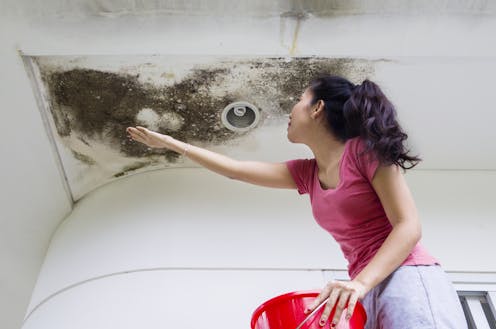
Recent torrential rain along the east coast of Australia has sparked renewed fears of mould in people’s homes, which can cause dangerous health problems. Many flood-affected residents in northern New South Wales and Queensland will also be contending with mould as part of the post-flood cleanup.
Moulds are fungi – microbes like viruses or bacteria. There are some microbes in every building and they’re usually harmless.
In a damp or water-damaged environment, however, toxic mould species grow and release spores that can cause health problems if inhaled.
Here’s what you need to know.
Read more: Floods herald creeping problem of mould and growing health risks
More than just lungs: mould can affect health in other ways
Many of us know someone whose asthma is triggered by exposure to mould. But even non-asthma sufferers are at risk.
Research shows dampness, mould and related airborne particles are associated with a range of adverse health outcomes, including increased risks of asthma, allergies, and respiratory infections and symptoms.
A parliamentary Inquiry into Biotoxin-related Illnesses in Australia noted the need for further research into mould prevalence, mould measurement and the potential health effects of exposure to damp and mould.
Some research suggests people exposed to mould in their homes report more severe depression and anxiety symptoms. Of course, this association isn’t just about mould, and worsening mental health is likely to do with a range of factors associated with living with damp and mould, including poor housing condition, poverty, and general ill health.

Mould hot spots in Australia
The World Health Organisation advises no level of exposure to mould can be considered safe for health. It says dampness and mould-related problems should be prevented and remediated early to avoid potentially harmful exposure.
Despite this strong advice, mould is a common problem in Australia. Until recently, not much has been known about mould prevalence, with the official WHO guidelines on indoor air quality estimating 10-50% of Australian homes are affected by dampness and mould.
We can also make an estimate using the large-scale Australian Rental Housing Conditions Dataset, which collates robust data collected from over 14,000 rental households in 2020.
Our analysis of this data set shows 27% of renters say their current home has problems with mould and 21% report problems with dampness.
Mould is often found in the south eastern states of Australia due to a combination of lower temperatures and damp weather. It is also a problem in New South Wales and Queensland, where 39% and 26% of regions respectively have a high prevalence of mould in rental homes. Sydney has more mould than Melbourne.
We have mapped the data for Melbourne, Sydney and Brisbane here:
 Data source: the Australian Rental Housing Conditions Dataset.
Centre for Research Excellence in Healthy Housing
Data source: the Australian Rental Housing Conditions Dataset.
Centre for Research Excellence in Healthy Housing
You’re also more likely to find mould in poorly maintained, low-income housing. These poor housing conditions are more common among people who already experience health issues.
Children are another group at higher risk of living in housing with mould – 33% of people living with two or more children reported mould in the Australian Rental Housing Conditions Dataset (compared to 27% of childfree households).
Other risk factors for mould included roof and plumbing defects, and the need for urgent repairs.
Building codes and rental policy can help
Mandated building standards are important to ensure design, building and maintenance sufficiently address mould growth.
Our current building codes do not focus on preventing damp conditions. In fact Australia’s National Construction Code previously inadvertently promoted moist indoor environments by solely focusing on well-sealed, energy-efficient buildings.
The National Construction Code is to be updated in late 2022. Hopefully, the new code will directly address the mould-promoting condensation problem caused by measures to increase energy efficiency in buildings.
New builds, of course, don’t house the whole population. Almost a third of Australian households rent, and this includes older homes with a range of structural issues. Policies targeting renters and landlords could have a significant impact on population health.
While tenancy regulations vary across Australia, some states and territories have begun to address the issue of mould in rental housing.
For example, the recent Victorian rental reform mandates premises:
must be free from mould and damp caused by or related to the building structure.
It allows tenants to log an urgent repair request where issues, such as leaking roofs or plumbing, lead to mould.
Since there are no accepted standards for mould measurement or remediation, legislation referring to “mould and damp” may not end up improving housing conditions.
An agreed definition of what level of mould is harmful, and how it can be measured, would allow governments to set cut-offs above which homeowners are compelled to intervene.
What can you do about mould in your home?
Prevention is more efficient than removal. The key is keeping the house dry and free of dust. Make sure you:
fix leaks, including roofs and walls as well as plumbed appliances such as dishwashers
increase ventilation and air circulation with windows and fans
use extractor fans when cooking, bathing or drying laundry
use a dehumidifier
clean condensation from inner windows.
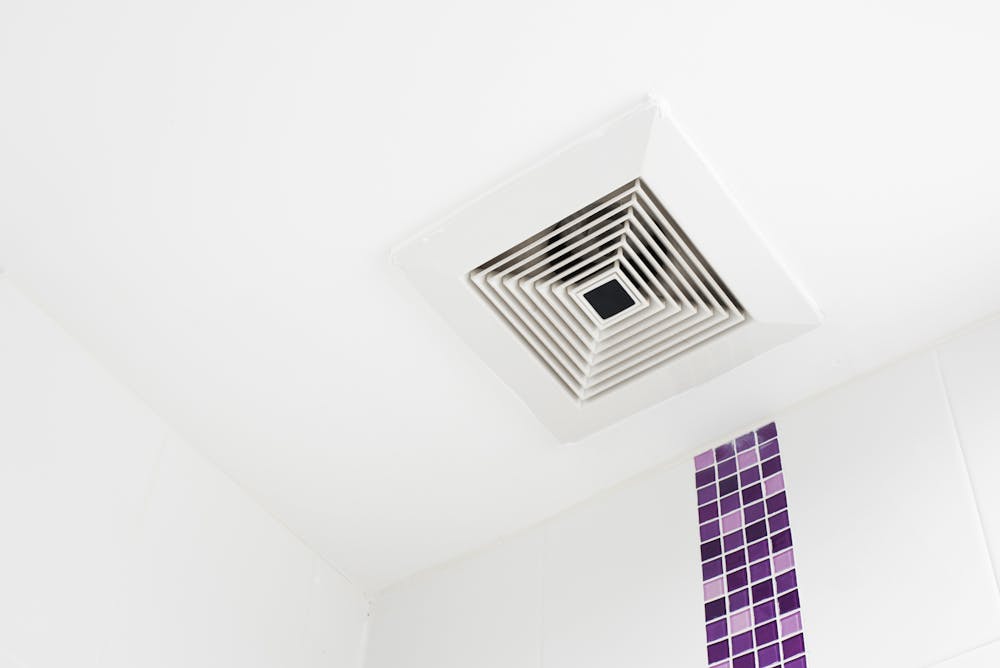 Use extractor fans when cooking, bathing or drying laundry.
Shutterstock
Use extractor fans when cooking, bathing or drying laundry.
Shutterstock
If mould has already set in, the best option is to remove it physically with a microfibre cloth.
Mould remediation is complex and often best undertaken with professional advice. Australian state and territory governments provide advice on dealing with dampness and mould in the home.
For example, see advice sheets from the Victorian Department of Health, NSW Health and the Queensland government.
This explainer by the Healthy Housing Centre of Research Excellence on mould and damp also provides information on where you can seek help.
Read more: Queenslanders at risk from mould as flood clean-up continues
Authors: Rebecca Bentley, Professor of Social Epidemiology, Principal Research Fellow in Social Epidemiology and Director of the Centre for Research Excellence in Healthy Housing in Melbourne School of Population and Global Health, The University of Melbourne

















