

Google AI


Modern Australian

Still 'Waiting for Gonski' – a great book about the sorry tale of school funding

  • Written by: Rachel Wilson, Associate Professor in Education, University of Sydney
Cover of Waiting for Gonski

You may think “not another article on school funding”. But this important story has to be told and the book, Waiting For Gonski: how Australia failed its schools, should be read by every parent, economist and Australian committed to “the fair go”.
Cover of Waiting for Gonski
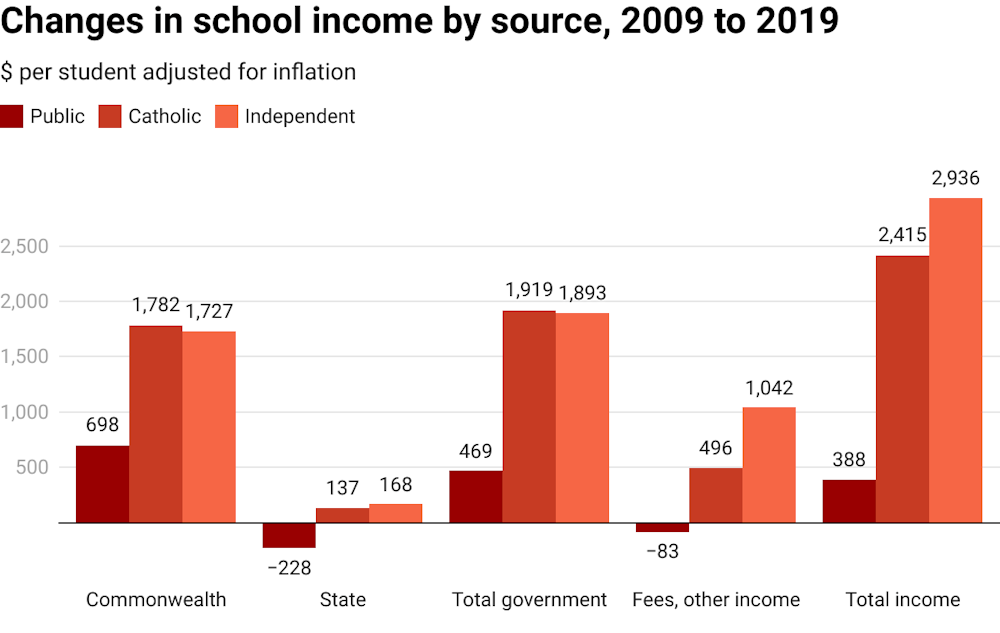
UNSW Press The title is apt and who would have thought a book on school funding would be a riveting read? Authors Tom Greenwell and Chris Bonnor have all the angles covered. What went wrong? The much-lauded Gonski reforms, recommended ten years ago, have not been effectively enacted. The book provides a clear account of how it all went wrong in “the Gonski we got” and “postmortem” analysis chapters. Rather than levelling the playing field, it is clear the system has become more unfair. More funding has gone to less needy schools. Government funding to non-government schools grew at five times the rate of funding for government schools over the past decade. Chart showing changes in funding for public, Catholic and independent schools from Commonwealth, states and all governments, fees and other income, and total income. Chart: The Conversation. Data: Analysis of ACARA, National Report on Schooling data by Trevor Cobbold (2021), Save Our schools website The review introduced the concept of the Schooling Resource Standard (SRS). The review panel said this was the funding “needed as the starting point for […] transparent, fair, financially sustainable and educationally effective” resourcing. The SRS uses a base funding amount each student, plus “loadings” for particular school and student needs. The majority of government schools are yet to be fully funded to the SRS. At the same time, many non-government schools are overfunded, well beyond the standard (and fees sit on top of this government funding). Shortfalls and excesses in SRS funding by state and territory, 2018-2023 Chart showing shortfalls and excesses in School Resource Standard (SRS) funding by state and territory, 2018-2023 Source: Review of needs‑based funding requirements: final report, December 2019/DESE, CC BY A 2019 federal government review of needs-based funding makes it clear government schools’ needs are not being met and the system lacks transparency. New South Wales, Queensland, Victoria and Tasmania committed to reach 75% of SRS funding for government schools beyond 2023. NSW and Tasmania will reach 75% in 2027, Victoria in 2028 and Queensland in 2032. A quote from the then Grattan Institute school program director, Peter Goss, is instructive: “The federal government has locked in a model where every private school will get fully funded by 2023, whereas very few government schools will ever get fully funded. By 2030 we’re going to be having this same argument and it’s all predictable from now.” Unlevel playing field has a long history While many schools are still waiting to receive the Gonski needs-based funding, Greenwell and Bonnor make it clear there was also a sense of waiting in the lead-up to the review and 2011 report. Pre-Gonski history provides important insights, including coverage of mistakes in the original establishment of Australia’s inclusive public education system. The system wasn’t really inclusive and created the first unlevel playing field, with well-resourced free education for most, alongside struggling Catholic schools. This changed after the 1960s, when the private sector successfully lobbied for funding. But, as the authors point out, “one unlevel playing field replaced another”. The 1973 Karmel report followed, but was criticised because, as Simon Marginson wrote in 1984: “[The report] did not develop an understanding of the dynamics of the dual system of schooling that operates in Australia […] [and] failed to go to the roots of inequalities in schooling”. Gonski also failed on this score Bonnor and Greenwell point out this criticism also applies to the Gonski review. Rather than tackle the complexities of the public-private system, Gonski left untouched the issues of school fees and very different school sector obligations, operations and accountabilities. Inequities in school operations, including enrolment policies, were not addressed. While recommending adequate funding for schools where students had greater needs, the review did not question or seek to resolve why these students concentrated within disadvantaged schools, most of them government schools. The segregation of schools has since increased. Both the OECD and UNICEF have identified this as a key weakness in Australian schooling. Greenwell and Bonnor point to the significance of the review’s focus on the impact of peers on student achievement, in a structure where fees sort and segregate students into different schools on the basis of socio-educational advantage. Bonnor says: “The review panel couldn’t, or chose not to, join the dots between this phenomenon and Australia’s increasingly mediocre levels of student achievement.” Gonski review panel member Ken Boston now agrees and attributes much of our educational woes to weaknesses in the report and failures of implementation. Noting the model was to be needs-based and sector-blind, he says: “Quite the opposite has occurred”. Waiting for Gonski is a riveting, but depressing, account of how that happened. Drawing on interviews with key figures, the authors describe the manoeuvrings to get the funding legislation passed, the distorting of Gonski’s recommendations, the intensity of the activities of the lobby groups, and the eventual sabotage of the remnants of Gonski that managed to get over the line. School children in uniform walking across school grounds Since the Gonski review, tens of thousands of students have gone through a school system that failed to meet their educational needs. Shutterstock Students – and Australia – continue to miss out The story is complete with a coming-of-age personal drama highlighting the impacts of funding on two young students as they move through their schooling. It is important to remember that many thousands of children have completed all their schooling in the post-Gonski era, without the funding deemed necessary for the system to be “educationally effective”. The pathways of those lives have missed out on the educational enrichment funding to the Schooling Resource Standard would have brought. Alongside Waiting for Gonski, a Why Money Does Matter conference marked the 10th anniversary with further sobering analysis, available here. Gonski made “needs-based” equity funding part of our vocabulary but not part of our system. It is clear that action to fully implement true needs-based funding is urgently needed. Waiting for Gonski ends with a call to action. For our education system to thrive nothing short of substantial structural change will do. Greenwell and Bonnor also argue public funding brings public obligations, and a public contract is needed, requiring non-government schools to operate with policies comparable to those of government schools. Such an approach would “level the playing field”, which would undoubtedly strengthen Australian education and our economy. Do we have to wait much longer? “Let us do something, while we have the chance! … Let us make the most of it, before it is too late!” ― Samuel Beckett, Waiting For Godot. Authors: Rachel Wilson, Associate Professor in Education, University of Sydney

Read more https://theconversation.com/still-waiting-for-gonski-a-great-book-about-the-sorry-tale-of-school-funding-178016

Better Business Photos Without Misleading Customers: An Australian Guide

A timber dining set looks inviting against a sunny deck, with cushions, lanterns and enough chairs for the whole family. But imagine the retailer sell...

Understanding a dental implant Melbourne Treatment Plan

A dental implant Melbourne patients may consider is one option for replacing a missing tooth, but suitability depends on oral health, bone support a...

How 3PL Logistics Australia Supports Faster and More Efficient Supply Chains

Why Has 3PL Logistics Become Important for Growing Businesses?  Gone are the days when supply chains were simpler and in minimal quantity. Now, the...

Common Skin Concerns and Treatment Options Available in Melbourne

Skin concerns can develop gradually or become noticeable following changes in age, lifestyle, sun exposure or hormonal factors. Pigmentation, rednes...

Why a Code-Compliant Home Can Still Feel Uncomfortable

When people build or renovate a home, they usually expect that meeting current building requirements will also produce a comfortable place to live. ...

Breach of Contract in Business: What Are Your Options?

Contracts are essential to business relationships. They establish expectations, allocate responsibilities and provide a framework for delivering goods...

How Pest Control Companies Can Rank for the Problems Customers Search First

Introduction SEO for Pest Control needs to start with the customer’s problem. Most people do not search for pest services in a neat or technical wa...

What Are the Benefits of Renovating an Older Home in Sydney?

Sydney has plenty of character homes, from Federation cottages to mid-century brick homes. Renovating rather than rebuilding can preserve what makes t...

Pool and Deck Design: How to Plan the Perfect Outdoor Living Space for Your Sydney Home

For many Australians, the backyard is where life happens. Summer barbecues, weekend swims and long evenings outdoors are all part of the lifestyle, ...

Is Solar Pool Heating Worth It? What Sydney Homeowners Should Know

There's nothing quite like a backyard pool on a hot Sydney day. But once autumn rolls in, many pools sit unused for months because the water is simp...

Planning a Luxury House Move: A Week-by-Week Timeline for Prestige Sydney Homes

Selling or buying a prestige home is a major milestone. Whether it's a waterfront residence in Birchgrove, a grand Federation home in Haberfield or ...

Downsizing or Upgrading Your Caravan? Here's How to Sell It Without the Hassle

Selling a caravan can feel like a major task, especially when you are unsure about its value, paperwork, or how to find a buyer. Whether you are dow...

The Best Overseas Adventure Holidays for Australians Who Love the Outdoors

Australia offers no shortage of incredible outdoor experiences, but sometimes the best way to satisfy your sense of adventure is to head overseas. A...

Cape Town Wine Shuttle: Winelands Tasting & Tours

Embark on an unforgettable journey through the picturesque Cape Winelands, where world-class wines and breathtaking scenery await. Our Cape Town Win...

Metal Fabrication: Choosing Metal Fabrication Melbourne Services for Custom Projects

What Modern Metal Fabrication Involves From individual components to complete structures, metal fabrication brings together processes such as desig...

Why Giant Rats Tail Grass Keeps Coming Back After Spraying

Giant Rats Tail Grass (GRT) is one of the most frustrating pasture weeds for farmers and lifestyle property owners. You spray an infested area, see th...

When Custom Cardboard Boxes Make Sense for Your Business

Custom cardboard boxes can be useful when a standard carton does not fit a product, packing method or presentation requirement particularly well. A ...

Full-Height vs. Pop-Top Caravan: Which Is Better for Family Travel across WA?

A pop-top caravan is an excellent choice for travellers who want the comfort of a caravan without committing to a larger, bulkier setup. With a lowe...

















