

IPCC reports still exclude Indigenous voices. Come join us at our sacred fires to find answers to climate change
- Written by Bradley J. Moggridge, Associate Professor in Indigenous Water Science, University of Canberra
The Intergovernmental Panel on Climate Change’s (IPCC) assessment reports have great influence over government decision-making on climate change. The latest report, launched this week, for the first time features Indigenous Knowledges alongside Western scientific research.
Previous IPCC reports have only included evidence on how climate change has affected Indigenous Peoples. It is an historic improvement in this report to include actual Indigenous Knowledges after many years of lobbying by IPCC lead authors and outside organisations.
But, like most other IPCC chapters, the Australasian chapter did not include Indigenous lead authors. Our inclusion could have contributed ways of thinking, knowing and understanding that would have strengthened and deepened the report and subsequent media coverage.
Better representation of Indigenous Voices
IPCC lead authors are selected on the basis of their expertise and approved by their home country’s government.
The five authors of this article recommended to the Australian government that the next IPCC assessment report (AR7) appropriately represent Indigenous voices in the lead author selection for the Australasian section.
Two authors (Lansbury and Pecl) are non-Indigenous lead authors on the current report. We invited three Indigenous scholars (Moggridge, Creamer and Mosby) to be contributing authors to specific sections of the draft report.
These contributing authors brought science and cultural understanding from their respective heritages and Countries of Kamilaroi (Moggridge) and Waanyi and Kalkadoon (Creamer), and the Meriam Nation in the Torres Strait (Mosby).
The invitation to be contributing authors relied on the lead authors’ goodwill, not on government selection. The contributing authors co-wrote sections on Indigenous Peoples and screened the draft of the Australasian chapter for appropriate and respectful portrayal of Indigenous Peoples.
However, as per IPCC’s strict protocols for any contributing authors, this was only a reviewing role. The lead authors had final say on the text. If the lead authors had not asked Indigenous authors to contribute, the Australasian chapter of the report may not have had Indigenous input at all.
We are the first to be impacted and the last to be heard
Australia has among the world’s highest greenhouse gas emissions per person. Indigenous Peoples in Australia contribute the least emissions, but are among those most affected by the consequences.
The current severe floods, recent droughts, fish-kills and bushfires of 2019-2020 show the climate has changed. The delay of urgent action means our People and Country are being forced to rapidly adapt.
One-fifth of the Indigenous Australian population lives in remote areas where climate change raises risks to our health and way of life.
This include a loss of access to traditional foods on Country. In some cases, communities have been forced to change their diet, which affects nutrition levels.
Some communities are also experiencing water insecurity, loss of land and cultural resources through land erosion and sea-level rise. Parts of the Torres Strait are seeing their ancestors’ burial sites exposed following saltwater intrusion and sea level rise.
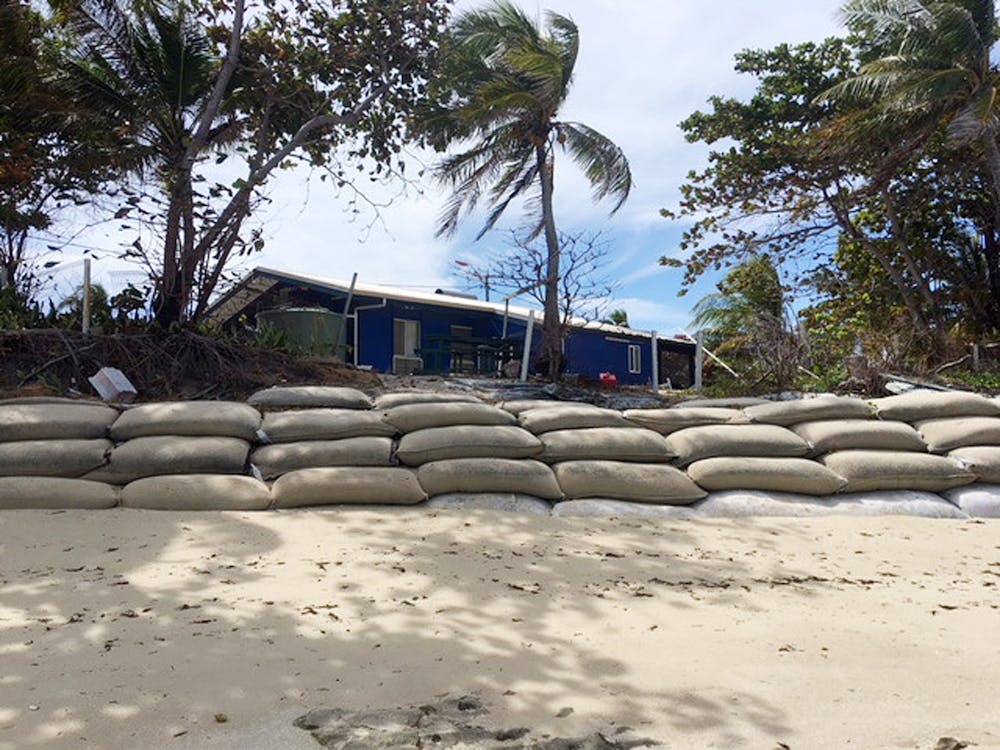
High levels of poverty and underlying health conditions in some First Nations communities make many of our mob even more vulnerable to a warming climate.
Yet, recognition of our role in identifying solutions to problems caused by climate change are only slowly being recognised. This is despite the United Nations’ Declaration on the Rights of Indigenous Peoples supporting self-determination. This should include Indigenous Peoples as key stakeholders on climate change decisions.
Such self-determination is already occurring in Aotearoa/New Zealand, which has a treaty obligation ensuring Māori Knowledges are considered.
In-built survival and stewardship
Indigenous Peoples manage around 25% of the earth’s territory, containing 80% of the world’s remaining biodiversity. On average, trends of declining biodiversity have been less severe or avoided in areas managed by Indigenous Peoples and local communities.
Clearly, the global population of over 370 million Indigenous Peoples take seriously their responsibility to maintain the land and water for the future.
The Indigenous-led review of climate change impacts on the health and well-being of Indigenous Peoples in Australia, commissioned by the Lowitja Institute, documented our diverse leadership in maintaining the care of Country.
The review highlighted that Indigenous-led initiatives on both climate change adaptation and emissions reduction can strengthen well-being among Indigenous Peoples. It was launched at last year’s COP26 climate meeting in Glasgow.
Read more: Why the Australian government must listen to Torres Strait leaders on climate change
Positive steps towards recoginising Indigenous Knowledges
The IPCC report is a reminder of how Indigenous Australians have been largely excluded from climate change decision-making. Indigenous Knowledges are often treated as inferior, or described as myth, legend or fable.
But in fact, our Knowledges provide evidence from thousands of years of observations and practices to keep Country healthy.
The Uluru Statement from the Heart is a powerful proposal to enable a direct voice in decision-making in Australia. But it has been dismissed by two successive prime ministers.
However, this latest IPCC report suggests that inclusion is improving. The IPCC chapter featuring Australia now recognises:
Aboriginal and Torres Strait Islander Peoples can enhance effective adaptation through the passing down of knowledge about climate change planning that promotes collective action and mutual support.
It then describes the value of Indigenous Knowledges regarding fire management, cultural flows, Indigenous protected areas and Indigenous ranger programs.
And the IPCC chapter on climate resilient development looks to Indigenous Knowledges in oral histories for improved understanding of ecosystem change over time.
But despite this progress, our Peoples still need better upfront inclusion and representation in climate change research, dialogue and decision-making.
Looking to the next IPCC report
The IPCC and governments can look to the Intergovernmental Science-Policy Platform on Biodiversity and Ecosystem Services (IPBES) for leadership on respect and inclusion of Indigenous Knowledges and Indigenous scholars. This platform acts on its policy to recognise:
Indigenous Peoples and local communities possess detailed knowledge on biodiversity and ecosystem trends. This knowledge is formed through their direct dependence on their local ecosystems, and observations and interpretations of change generated and passed down over many generations, and yet adapted and enriched over time.
The next iteration of the IPCC’s work will benefit from Indigenous representation and leadership as appointed by governments in their lead author teams.
We Indigenous People are here and ready. Come join us at our sacred fires to listen. We can answer the call for action on climate change, just as our thousands of past generations have done.
Authors: Bradley J. Moggridge, Associate Professor in Indigenous Water Science, University of Canberra

















