

Russian shelling caused a fire at a Ukrainian nuclear power plant – how close did we actually come to disaster?
- Written by Tony Irwin, Visiting Lecturer, Nuclear Reactors and Nuclear Fuel Cycle, Australian National University
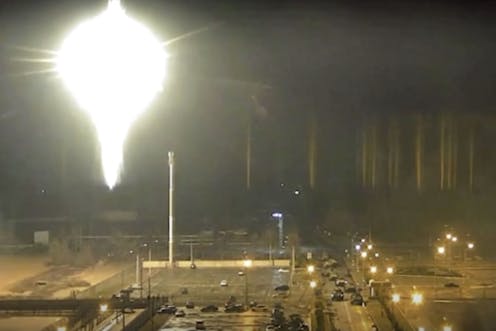
It sounds like a nightmare come true. During a military offensive as part of Russia’s invasion of Ukraine, fire broke out at Europe’s largest nuclear power station, the Zaporizhzhia power plant in the southern city of Enerhodar.
From what we understand of the situation, Russian troops were shelling the area during a battle for control of the facility, which supplies 25% of Ukraine’s electricity.
The plant has six large 950-megawatt reactors, built between 1980 and 1986 – crucially to a different design to the notorious and now decommissioned Chernobyl power station.
The fire evidently broke out in a multi-storey training building but has since been reportedly extinguished.
Was there a real risk of nuclear contamination?
The incident understandably raised the spectre of the 1986 Chernobyl disaster. But it’s important to remember these are two different types of reactor. Chernobyl used RBMK-type reactors, a Soviet design from the 1970s that was never built in the West because of inherent safety flaws.
The Zaporizhzhia power station features Russian-designed VVER reactors, which use broadly the same design as the Pressurised Water Reactor (PWR), the most popular reactor design used worldwide and also the type used in nuclear-powered submarines.
A PWR has a self-contained primary cooling water system to transfer heat from the reactor core to a steam generator. This system is kept pressurised so the water doesn’t boil - hence its name. A second, separate water loop transfers the steam produced in the steam generator to the turbine that produces the electricity.
Another crucial contrast with Chernobyl is the fact that VVER and PWR reactors have a massive concrete containment around the reactor to stop any radioactive release. This completely surrounds the reactor and steam generators, ensuring any water that could potentially be radioactive is within the containment.
The containment is typically constructed from pre-stressed concrete with a steel liner. In contrast, the Chernobyl-type reactor was physically very large, meaning a similar containment to enclose that system would have been very expensive.
Read more: Military action in radioactive Chernobyl could be dangerous for people and the environment
Besides the normal cooling systems, VVER reactors have emergency core cooling systems consisting of four “hydroaccumulators” – vessels pressurised with gas and filled with water that can be automatically released into the reactor to cool it. These are called “passive” systems because they rely only on gas pressure to inject the water, rather than pumps that would require electrical power.
They also have multiple systems that use pumps to inject water into the reactor to prevent a core meltdown if the normal cooling systems are not available, for instance as a result of a loss of electrical power.
If the connection to the grid is lost, standby diesel generators can provide electrical supplies to essential plant. This backup plant has several “trains” - identical and independent sets of plant that are physically separated and perform the same safety function. For example, this VVER has three trains of high-pressure water injection and three trains of low-pressure injection.
The four trains of passive hydroaccumulators do not need diesel supplies and will still provide the necessary cooling.
Previous disasters
In 1979, one of the PWRs at Three Mile Island in the US state of Pennsylvania suffered a core meltdown, but there was practically no radioactive release to the environment because of the concrete containment system.
After the 2011 Fukushima disaster in Japan, Ukraine’s nuclear regulator examined the capability of its nuclear power plants to withstand extreme events so all nuclear plants are better prepared to cope with these situations. This led to the installation of mobile diesel-driven pumps that can be connected to the reactor’s cooling system to provide water in an emergency.
Read more: Is Fukushima still safe after the latest earthquake?
The Zaporizhzhia plant supplies 25% of Ukraine’s electricity, and Russia presumably wanted to gain control of it so as to control the electricity supply. Despite the self-evident recklessness of fighting near a nuclear power plant, it would not be in Russia’s interest to cause a radioactive release because this would immediately affect its army personnel in the vicinity, and also potentially cause a radioactive cloud to spread over western Russia and particularly the annexed region of Crimea, just to the south of the plant.
Authors: Tony Irwin, Visiting Lecturer, Nuclear Reactors and Nuclear Fuel Cycle, Australian National University

















