

How will NZ's law targeting sanctions against Russia work – and what are the risks?
- Written by Alexander Gillespie, Professor of Law, University of Waikato
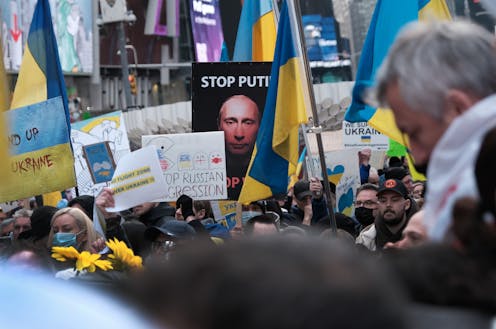
With the cabinet meeting today agreeing to targeted Russian sanctions legislation, New Zealand is preparing to circumvent its normal United Nations-based response to international crises.
The Russia Sanctions Bill will allow additional sanctions against Russia, including the ability to:
freeze assets in NZ
prevent people and companies from moving their money and assets to NZ to escape sanctions imposed by other countries
stop super yachts, ships and aircraft from entering NZ waters or airspace.
Passing the law under urgency this week is justified due to Russia being one of the UN Security Council member states, allowing it to use its veto power to block any proposed UN sanctions.
But this is a sad development, and a break with 30 years of diplomatic history. Since 1991, New Zealand has worked within the UN framework and largely based its sanctions regimes around what the UN has mandated.
Over Ukraine, New Zealand has taken some small and supplementary steps against Russia, such as travel bans and export controls over technologies that may have military value. But this has been inadequate compared with the actions of its allies, and the rapidly worsening situation.
NZ must align with allies
To create a new sanctions regime outside the UN system, New Zealand will need to take into account various important factors, including the law’s scope and how it fits with the actions of its allies.
Above all, the legislation must recognise this is a unique situation and must not create a precedent that enables other actions outside the UN system. The new law must expressly state why the urgent actions are justified and the objectives it wants to achieve, and it should have a sunset clause whereby it will lapses on a set date unless expressly renewed.
Read more: Ukraine crisis: how do small states like New Zealand respond in an increasingly lawless world?
The law must be effective, proportionate and targeted. Anti-Russian hysteria must be avoided. Due process, fairness to those involved, and compliance with existing international obligations, must be uppermost.
Detail must be applied to the creation of a cross-party sanctions committee and a monitoring group. The evidence used to justify sanctions should come from secure and robust sources, which should be as transparent as possible.
Coordination with friends and allies is uppermost. It’s not a question of how large New Zealand’s sanctions are, but rather that they are consistent with those of other countries. If there are inconsistencies, these risk being exploited both politically and economically.
Military aid an option
In a normal situation, a “laddering” process for sanctions is used: sanctions start softly (sporting or cultural events, for instance) and escalate (with some diplomatic restrictions) towards increasingly harsh trade restrictions prohibiting goods, from luxuries to near essentials.
Exclusion from airspace, maritime zones and even travel restrictions for ordinary citizens may be added to the mix, as Russia is increasingly isolated from the wider world. With events moving so fast already, New Zealand is already halfway up the ladder.
Read more: As the Ukraine war drags on, how secure will Putin's hold on power remain?
Military aid needs to be an option, too. The goal is to help the Ukrainians fight for their own freedom, without putting foreign “boots on the ground”. A distinction between lethal and non-lethal aid (such as body armour, communications equipment, food and medical kit) will need to be made.
Again, the question is not one of scale but consistency with friends and allies. The symbolism of such support is important. Supplementing the efforts of Australia, for example, would be useful.
The new law may also need to cover those New Zealanders who want to fight in Ukraine – on either side. New Zealanders without dual Ukrainian citizenship are unlikely to be given prisoner of war status if they’re captured.
Such volunteers will be in a grey area of domestic law, too, as current legislation covering the activities of mercenaries, or those who seek to go overseas to fight for terrorist groups, is inadequate.
Fighting the Russian invasion of a sovereign country is not an act of terrorism, and some may be willing to fight without significant financial incentives. The government should make the rules clear – again, consistent with friends and allies.
Risk of unintended consequences
Despite what Vladimir Putin has suggested, sanctions are not an act of war. They are an unfortunate but sometimes necessary non-military strategy aimed at changing or ending a country’s harmful actions.
But even if New Zealand and other like-minded countries apply maximum pressure through sanctions, there is no guarantee Putin will change his policies.
Read more: Russian sanctions are biting harder than it could have imagined, and it'll get worse
Sanctions have the best chances of success when a country’s leadership feels affected by the pressure of its own citizens – or in Russia’s case, its oligarch class, as the prime minister hinted today.
So, sanctions may work better with Russia than North Korea. But there is also a risk, if Putin starts to feel this pain, that he will respond in unexpected ways.
The only real certainty is significant collateral economic damage – for Russia and the world, including New Zealand. Everyone will see or feel the impact as economic and diplomatic relationships hit turbulence. Right now, however, there is no viable alternative.
Authors: Alexander Gillespie, Professor of Law, University of Waikato

















