

Modern Australian
The Times

The east coast rain seems endless. Where on Earth is all the water coming from?

  • Written by Chiara Holgate, Hydroclimatologist, Australian National University
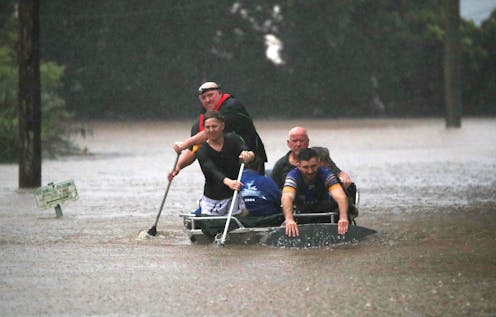
The east coast rain seems endless. Where on Earth is all the water coming from?

At any one time, Earth’s atmosphere holds only about a week’s worth of rain. But rainfall and floods have devastated Australia’s eastern regions for weeks and more heavy rain is forecast. So where’s all this water coming from?

We recently investigated the physical processes driving rainfall in eastern Australia. By following moisture from the oceans to the land, we worked out exactly how three oceans feed water to the atmosphere, conspiring to deliver deluges of rain similar to what we’re seeing now.

Such research is important. A better understanding of how water moves through the atmosphere is vital to more accurately forecast severe weather and help communities prepare.

The task takes on greater urgency under climate change, when heavy rainfall and other weather extremes are expected to become more frequent and violent.

aerial view of flooded streets and roofs
Rain has hammered Australia’s east coast for weeks. Nearmap

Big actors delivering rain

The past few months in eastern Australia have been very wet, including the rainiest November on record.

Then in February, heavy rain fell on already saturated catchments. In fact, parts of Australia received more than triple the rain expected at this time of year.

So what’s going on?

In the theatre that is Australia’s rainfall, there are some big actors – the so-called climate oscillations. They’re officially known as:

  • El Niño-Southern Oscillation (ENSO): this cycle comprises El Niño and its opposite, La Niña. ENSO involves temperature changes across the tropical Pacific Ocean, affecting weather patterns around the world

  • Southern Annular Mode (SAM): the north-south movement of strong westerly winds over the Southern Ocean

  • Indian Ocean Dipole (IOD): changes in ocean temperatures and winds across the tropical Indian Ocean.

Like swings in a character’s mood, each climate mode has positive, negative and neutral phases. Each affect Australia’s weather in different ways.

ENSO’s negative phase, La Niña, brings wetter conditions to eastern Australia. The IOD’s negative phase, and SAM’s positive phase, can also bring more rain.

Read more: Why water inundates a home during one flood but spares it the next

woman sits in rain with raincoat and umbrella
Climate oscillations affect Australia’s weather in different ways. Lucas Coch/AAP

Going back in time

We studied what happens to the moisture supplying eastern Australian rainfall when these climate drivers are in their wet and dry phases.

We used a sophisticated model to trace moisture backwards in time: from where it fell as rain, back through the atmosphere to where it evaporated from.

We did this for every wet winter and spring day between 1979 and 2013.

This research was part of a broader study into where Australia’s rain comes from, and what changes moisture supply during both drought and heavy rain.

We found most rain that falls on eastern Australia comes from moisture evaporated from a nearby ocean. Typically, rain in eastern Australia comes from the Coral and Tasman seas. This is depicted in the strong blue colours in the figure below.

Eastern Australian rainfall moisture supply.
Sources of moisture for rain falling in eastern Australia. Holgate et al, 2020

But interestingly, some water comes from as far as the Southern and Indian oceans, and some originates from nearby land areas, such as forests, bare soils, lakes and rivers.

Natural processes can alter the typical supply of moisture to the atmosphere, causing either droughts or floods.

Our research shows of all possible combinations of climate oscillations, a La Niña and a positive SAM phase occurring together has the biggest effect on eastern Australian rainfall. That combination is happening right now.

During La Niña, more moisture is transported from the ocean to the atmosphere over land and is more easily converted to rainfall when it arrives.

During the positive SAM, the usual westerly winds shift southward, allowing moisture-laden winds from the east to flow into eastern Australia.

Our research focused on winter and spring. However, we expect the current rainfall is the result of the same combined effect of the two climate oscillations.

The Indian Ocean Dipole is not active at this time of the year. But it was in a weak negative phase last spring, which tends to bring wetter-than-normal conditions.

Read more: Back so soon, La Niña? Here's why we're copping two soggy summers in a row

three boys in wetsuits and boogie boards play in water
Most rain falling on eastern Australia comes from moisture evaporated from a nearby ocean. Jason O'Brien

Looking to future floods

Under climate change, extreme La Niña and El Niño events, and weather systems like those causing the current floods, are expected to worsen. So reducing greenhouse gas emissions is crucial.

The current La Niña event is past its peak and is predicted to dissipate in autumn. But because our catchments are so full of water, we still need to be on alert for extreme weather.

The current devastating floods are a sobering lesson for the future. They show the urgent need to understand and predict extreme events, so communities can get ready for them.

Read more: People could've prepared for the floods better if the impacts of weather forecasts were clearly communicated

Authors: Chiara Holgate, Hydroclimatologist, Australian National University

Read more https://theconversation.com/the-east-coast-rain-seems-endless-where-on-earth-is-all-the-water-coming-from-178316

Road Signs: Understanding Their Role in Clear and Effective Signage

Effective signage and display hardware can help businesses communicate information, promote products and organise customer or visitor movement. Road...

Bottle Label Printing: Key Factors to Consider Before Your Next Packaging Run

Effective packaging begins with understanding the product, bottle material, artwork and production requirements when planning bottle label printing. H...

Planning a Long-Distance Move With Interstate Movers Melbourne

Moving between states involves more planning than a typical local relocation. Along with packing and transporting household belongings, you need to...

Understanding the Role of an I/O Controller in Industrial Automation

Modern industrial systems depend on accurate communication between sensors, machines and control systems. An I/O controller can help manage this commu...

How the Right Mining Hose Supports Demanding Operations

Mining environments place considerable demands on equipment used for material transfer, water management and processing. Hoses operating in these co...

Simple Ideas for Making Social Gatherings More Memorable

We have all been to those parties where everyone just stands around the kitchen island, staring at their phones, waiting for someone else to make a mo...

Outdoor Wall Lights: Improving Exterior Lighting Around Your Home

Lighting can influence how a room looks, feels and functions, so the right fitting should be selected according to both appearance and practical req...

Commercial Office Cleaning: Combining Routine Office Cleaning With Melbourne Service

Keeping a workplace clean requires a service that can accommodate everyday tasks as well as the particular needs of the business. Professional comme...

Caravan Sales in Queensland: How to Find the Right Caravan for Sale QLD

Caravan ownership is about more than having somewhere to sleep while travelling. For many Queenslanders, it is one of the best ways to explore regio...

What Sir Walter Buffalo Turf Actually Costs in 2026 (And Why Quotes Vary So Much)

Two quotes landed on a Hills District homeowner's kitchen table last spring for the exact same 80-square-metre backyard. One said $12 a metre. The o...

Nearly 1,300 NSW Hospital Beds Are Occupied By People Who Are Ready To Go Home

1,276 people in NSW hospitals have been medically cleared for discharge but remain in hospital because they're still waiting for NDIS or aged care sup...

National Survey Launched to Measure Operational Impacts of Federal NDIS Policy Reforms

The effects of recent NDIS reforms are beginning to move beyond policy papers and into day to day service delivery. A new national survey is asking ...

Beyond the Nappy Cake: Baby Shower Gifts That Get Used

What new Australian parents unwrap, keep, and quietly thank you for months later. Six weeks after my daughter was born, I did an audit of the baby sh...

Parent-Advocates Are Reshaping Frontline Disability Service Delivery

Parents have always been part of the disability sector. They advocate, coordinate services, challenge decisions and often become the person holding ev...

Vista Cruises Enters "Two-Flagship Era" as Vista Aurora Completes Inaugural Voyage

Vista Aurora Sets Sail along the Yangtze. (Photo courtesy of the company)YICHANG, China — August 5, 2026 — Vista Aurora, a high-end interprovinc...

A Digital Preparation Checklist For International Medical Conferences

An international medical conference compresses many responsibilities into a few days. A delegate may need to present research, move between venues, ...

The Growing Popularity of Lab Grown Diamonds in Sydney and Hong Kong

The diamond industry has changed significantly in recent years as more buyers seek ethical, affordable, and sustainable alternatives to mined diamon...

Modern AI SEO Agency vs Traditional SEO: What’s the Difference

Search engine optimisation has changed dramatically over the past few years. Search engines have become smarter, user behaviour has evolved, and bus...
















