

I’m at home with COVID. When do I need to see a doctor? And what treatments are available?
- Written by Tari Turner, Director, Evidence and Methods, National COVID-19 Clinical Evidence Taskforce; Associate Professor (Research), Cochrane Australia, School of Population Health and Preventive Medicine, Monash University, Monash University
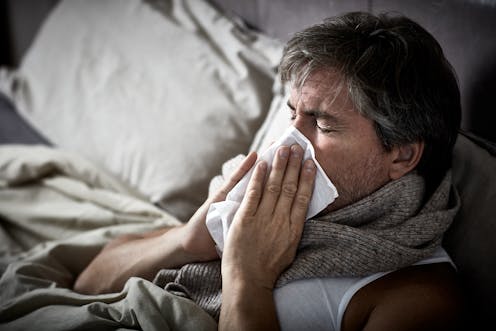
Sorry to hear you tested positive.
Fortunately, for most people – and especially those who are vaccinated – COVID won’t lead to serious illness. Around 30% of people with COVID won’t have any symptoms.
People with mild and even moderate COVID are likely to be managed at home, rather than going to hospital.
In the past month, new drug treatments have become available for people with mild COVID who are at risk of more severe disease.
Symptoms to expect
Common symptoms include sore throat, cough, headache and fatigue.
Some people may also experience muscle pain, nausea, vomiting, diarrhoea, or loss of taste and smell.
You can treat these as you normally would, with paracetamol or ibuprofen, plenty of fluids, rest and patience.
Read more: At home with COVID? 5 easy tips to help you breathe more easily
Some people are at greater risk of severe disease
Most people with COVID will only ever have mild symptoms, and will recover in one to two weeks without the need for any treatment.
Some people are at higher risk of developing serious illness from COVID because they are:
- over 65 years, or over 50 years for Aboriginal and Torres Strait Islander people
- unvaccinated or partially vaccinated
- pregnant.
And/or because they have one or more of the following underlying conditions:
- lung disease, including chronic obstructive lung disease, asthma or bronchiectasis
- heart disease
- obesity (body mass index over 30 kg/m2)
- diabetes
- kidney failure
- immunocompromising conditions (weakened immune system).
If you have one or more of these risk factors, talk to your GP, particularly if you’re not up-to-date with your COVID vaccinations.
Your GP might suggest you use a pulse oximeter to keep a track of the oxygen levels in your blood.
Falling oxygen levels (below 92%) can indicate you’re developing more serious illness, and might need to head to hospital for further treatment.
If you have severe trouble breathing or severe chest pain, call 000 for an ambulance to take you to hospital.
What treatments are available for mild COVID?
If you’re in a higher-risk group, your GP will also assess whether you might benefit from one of the new medications now available to treat COVID:
the oral antiviral tablets nirmatrelvir plus ritonavir (Paxlovid) or molnupiravir (Lagevrio)
the monoclonal antibody sotrovimab (Xevudy), which is given as a single injection at a hospital infusion centre.
These medications can reduce the risk of serious illness in people who aren’t vaccinated and have risk factors for severe disease.
Ritonavir and molnupiravir affect the way the virus replicates, while sotrovimab enhances the body’s immune response.
They may also benefit people who are vaccinated, but for whom vaccination is less likely to work because their immune systems are less effective. This includes people who have had an organ transplant and those with conditions requiring immune-suppressing treatment, such as rheumatoid arthritis, Crohn’s disease, multiple sclerosis and cancer, for those undergoing chemotherapy.
These medications need to be given within five days of symptoms developing, so it’s important you talk to your GP as soon as possible.
Your GP will carefully consider the benefits of these medications for you, given your health status and other factors, as well as the risks. Each of these drugs have potential side effects.
Who shouldn’t have them?
These drugs aren’t suitable for everyone.
Paxlovid (ritonavir), for example, has potentially serious interactions with several common medications for high blood pressure, epilepsy, depression and others.
None of the oral antivirals are recommended in pregnancy.
What else might a GP prescribe?
If you have mild or moderate COVID at home, and are at risk of developing serious illness, your GP might also suggest you take inhaled steroids.
Budesonide and ciclesonide are steroid medications which are also used in asthma.
Research suggests they may decrease the risk of deterioration from COVID and may accelerate recovery if started within 14 days of your first symptoms.
What happens if you get worse?
Most people with mild COVID recover without any treatment, but if your symptoms start getting worse, or your blood oxygen levels start to fall, your GP might decide it’s best for you to head to hospital where other treatment options are available.
In hospital, you might be given drugs such as:
remdesivir (an intravenous antiviral drug) which affects the way the virus replicates
dexamethasone, baricitinib or tocilizumab. These powerful anti-inflammatory drugs reduce the damaging effects the body’s inflammatory response can have on the lungs.
You may also need support for your breathing.
Can I take my normal medications?
In most cases, you can and should continue to take your existing medications for conditions such as asthma, diabetes or high blood pressure.
Talk to your doctor if you are taking oral menopause hormonal therapies (MHT, also sometimes called hormone replacement therapy or HRT). Your doctor may suggest that you stop these until you have recovered. Both severe COVID and some forms of menopause hormonal therapies can increase the risk of developing blood clots.
New treatments don’t replace vaccination
New treatments for COVID are a welcome addition, especially for those who can’t be vaccinated or for whom vaccination is unlikely to be effective.
The COVID research pipeline is expected to deliver more new treatments for COVID in 2022 and the National COVID-19 Clinical Evidence Taskforce will review this new research and update our guidance as the evidence emerges.
However vaccination remains the best form of defence against serious disease and death for COVID.
Authors: Tari Turner, Director, Evidence and Methods, National COVID-19 Clinical Evidence Taskforce; Associate Professor (Research), Cochrane Australia, School of Population Health and Preventive Medicine, Monash University, Monash University

















