

Is Russia really about to cut itself off from the internet? And what can we expect if it does?
- Written by Mohiuddin Ahmed, Lecturer of Computing & Security, Edith Cowan University
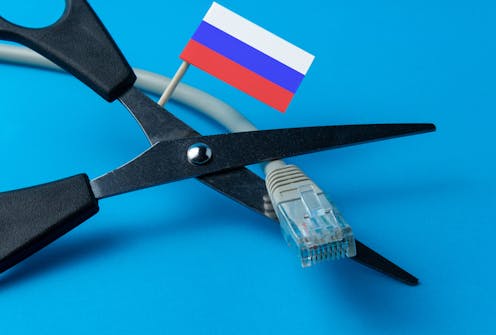
The invasion of Ukraine has triggered a significant digital shift for Russia. Sanctions imposed by governments around the world – together with company closures or mothballing – have significantly impacted the country.
A plethora of events have escalated the invasion into the digital world, with cyber attacks, cyber criminals taking sides, and even an IT army of civilians being mobilised by Ukraine.
The sanctions imposed on Russia have not only directly hit its economy (and by extension the global economy), but are now also threatening Russian citizens’ access to the internet.
It’s expected the nation will limit its reliance on the global internet very soon. Although a complete disconnection isn’t yet confirmed, even a partial disconnection would be a difficult task. And the repercussions of Russia’s growing digital isolation for its citizens will be immense.
Russia’s increasing digital isolation
More than 85% of Russians use the internet. Since the Ukraine invasion began, people in Russia have found themselves increasingly deprived of online services such as Facebook, Twitter and even Netflix – with Russia either limiting access to sites, or providers withdrawing services.
Major financial players have pulled out too, including Apple Pay, Google Pay and most major credit card providers, significantly impacting e-commerce.
Russia itself has also introduced a digital divide with the rest of the world, despite the fact this may further cripple its economy. It is expected to start withdrawing from the global internet by March 11, according to Kremlin documents.
Russia has long-imposed control over state-run media, but tolerated a level of free access to content and services through the internet. While such freedoms have been progressively diminished, citizens have still been able to stay connected to the wider web.
This open access is now being revoked. Russia will assert dominance over internet services and impose strict censorship on local media organisations in an attempt to control information and reinforce Kremlin propaganda.
The Kremlin’s orders
As part of this plan, the Russian government has directed businesses to move their web hosting and business services to Russian servers.
While it may be assumed a “.ru” website is located in Russia, this isn’t always the case. Large organisations will often host their services in remote regions’ servers. This may be to gain access to enhanced technologies, increase the resilience of the service, or to benefit from reduced service costs.

A good example would be a content delivery network, where content is hosted on multiple servers around the world. This ensures fast access for users and resilience to outages and malicious attacks.
Relocating an individual website to a new server is relatively easy, but doing this on a national scale is a huge logistical challenge. It’s unknown whether Russia even has the capacity and capability to deliver the required resources.
Not the first attempt at disconnection
With mounting pressure from the West, Russia may create its own version of the “great firewall of China”. With this, the Chinese government implemented a number of measures allowing it to regulate and censor the domestic internet as it sees fit.
Although the current demands from the Kremlin relate to service availability – and migrating websites and services to Russian territories – this could be the first stage of a national disconnection from the global internet.
It’s worth noting, however, even if Russia adopts a domestic internet, it will still need to keep some bridges with the global internet to communicate with other countries.
In 2019, Russia tested disconnecting the country from the internet. There are few details relating to how long this test ran.
The test was reportedly successful, but not adopted. It could be the Kremlin stopped short of a full disconnection due to Russia’s reliance on global services, such as social media and financial gateways.
With Russia now becoming increasingly isolated from global networks, it’s potentially easier to implement network changes that would grant the Kremlin full control of Russia’s internet.
The repercussions
Disconnecting from the global internet and imposing censorship will inevitably slow down democratic progress in Russia.
It will also impact the country’s technological development. Russia is already facing significant chip shortages and a loss of access to advanced telecommunication technologies, including deliveries from Ericsson and Nokia.
Even if Russia successfully creates its own separate internet, this would be challenging for citizens to accept.
Until recently, Russian citizens have enjoyed the benefits of the global internet, and they will likely be concerned at its disappearance. The social impact would be incredibly difficult to manage.
And while virtual private networks have previously been used within Russia to maintain anonymity, or access censored sources, a properly implemented set of controls could effectively block the use of such techniques.
Is the internet safer without Russia?
Given the amount of cyber crime regularly attributed to Russian sources, you might imagine Russia’s withdrawal from the global internet would make it a more secure space for everyone else.
While isolating Russia will have an initial impact, cyber-criminal gangs and state-sponsored attacks will quickly return as perpetrators find ways to escape domestic controls.
In fact, state-sponsored attacks will likely increase in the coming months as Russia seeks retribution against the countries (and organisations) that imposed sanctions on Russia.
If cyber warfare reaches heightened levels, other nations will have to focus more on their defence capabilities to protect their infrastructure. We could see the digital economy reshape itself, as it tries to contend with increased Russian threats.
Authors: Mohiuddin Ahmed, Lecturer of Computing & Security, Edith Cowan University

















