

Research shows voters favour financial relief after disasters, but we need climate action too
- Written by Hannah Melville-Rea, Research Fellow, Environmental Arts & Humanities, New York University
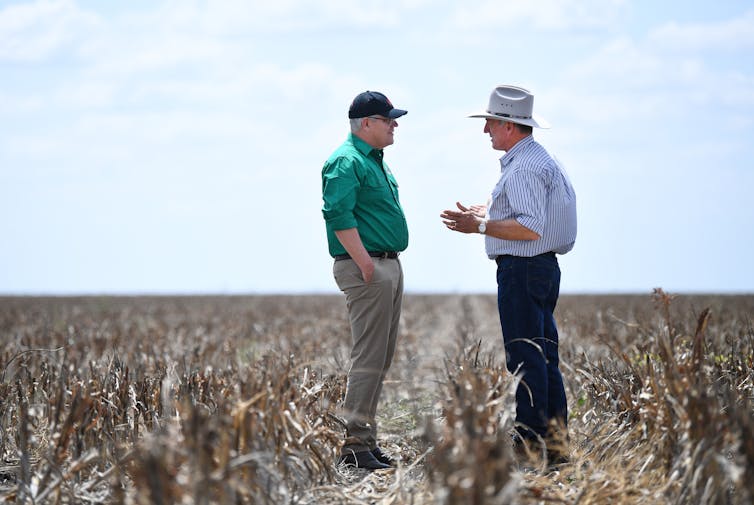
Within two months, Australians will vote in a federal election. It comes after a political term marked by major societal challenges, including catastrophic drought, bushfires and floods.
Such natural hazards are expected to become worse under climate change. So how does a person’s experience of disasters affect the way they vote?
This is the question I set out to answer in my new research into the last federal election. I found when people experienced drought, they tended to place more importance on economic security, not environmental policies, in deciding how to vote.
Crucially, on election day this translated to more votes for micro-parties and fewer votes for the incumbent Coalition. The findings may provide insight into how the current floods in southeastern Australia will influence the next election.
Cast your mind back
Heading into the May 2019 election, much of Australia was gripped by heatwaves and drought.
The four months to April had been the hottest period on record. Dams were low and farmers were barely getting by.
The parched Murray–Darling Basin had experienced mass fish kills and nationally, rainfall in Australia that year would be 40% below average, the lowest on record.
In light of these conditions, political parties and candidates took drastically different drought strategies to the election.
Labor and the Greens promised significant cuts to Australia’s greenhouse gas emissions, to varying degrees. Labor also pledged to promote renewable energy and offered farmers climate adaption programs, and the Greens promised to help farmers implement sustainable agricultural systems.
In contrast, the Liberal-National government largely offered economic relief for rural communities, rather than pledging to mitigate climate change and future drought.
Read more: Just because both sides support drought relief, doesn’t mean it's right
Various micro-parties largely favoured the Coalition’s compensation approach. But importantly, they also tended to advocate strongly for local measures.
For example, Katter’s Australian Party agitated for more money to local councils. One Nation said Australia should withdraw from international climate agreements and advocated for greater local ownership of water resources.
Research shows a local experience of abnormal weather tends to increase public belief in climate change, as does low rainfall.
In some cases, extreme weather events lead to support for “green” policies and politicians. And incumbent governments that fail to prepare for or remedy harm from disasters can do worse in elections.
But belief in climate change does not always translate into political support for climate action. For example, previous research has shown how after a natural disaster, voters in the United States favour politicians who offer disaster relief spending over those who invest in disaster preparedness.
I wanted to discover whether the same dynamic played out in Australia. Specifically, how did voters affected by drought in 2019 change their voting patterns compared with the drought-free 2016 election?
What I found
My research drew on the Australian Election Study’s first ever panel survey of Australian voters. The study surveyed the same 968 participants after both the 2016 and 2019 elections.
By matching the participants’ postcodes with rainfall maps from the Bureau of Meteorology, I separated voters into those who were impacted by drought in 2019, and those who were not.
I found that if voters experienced drought, they placed more importance on the management of the economy and government debt when deciding how to vote. In addition, counter to my expectations, they placed less importance on the environment.
The Coalition is traditionally seen as better at economic management than other parties. And as the incumbents, the Coalition could credibly promise drought compensation and relief to Australians.
But this apparent advantage did not translate into voting patterns in 2019.
Compared with the 2016 election, the Coalition lost votes in drought-affected areas. I calculated that drought decreased first-preference vote share by 3% in the House of Representatives and 1.6% in the Senate, across 7,443 national polling places.
Support for local micro-parties in drought-exposed areas increased by almost 5%. Drought did not significantly impact the vote share of Labor or the Greens.
I looked for reasons, other than the drought, which might explain the trend. These included a region’s employment profile and population density, climate scepticism, and rates of political disaffection such as the number of blank ballots cast.
But the voting patterns remained consistent across these variables.
Balancing short and long horizons
So while drought-hit voters at the 2019 election were worried about economic security, they did not reward the Coalition for its promises of economic relief. Instead, they favoured smaller parties that emphasised both economic security and strong local leadership.
Minor party support may indeed bring local economic benefits. For example, analysis has found since 2013, electorates represented by independents or minor parties received the most per-capita funding from national grant programs with ministerial discretion.
My research suggests in the aftermath of a natural disaster, voters place higher importance on economic security than climate solutions.
Yet, prioritising relief and recovery, without disaster prevention and preparation, is highly detrimental in the long run.
Climate change threatens to supercharge both droughts and heavy rain which leads to floods. And as the latest report by the Intergovernmental Panel on Climate Change shows, Australia is on the frontline of these worsening disasters.
So what does all this mean for politicians and parties wanting to tackle climate change?
My research suggests they should pursue policies that not only reduce emissions and protect Australians from the effects of an unstable climate, but bring immediate and tangible economic benefits.
Read more: Weather forecasts won't save us – we must pre-empt monster floods years before they hit
Authors: Hannah Melville-Rea, Research Fellow, Environmental Arts & Humanities, New York University

















