

How New Zealand's review of ecologically important land could open the door to more mining on conservation land
- Written by Matthew Hall, Senior Researcher, Environmental Law Initiative and Visiting Scholar, Faculty of Law, Te Herenga Waka — Victoria University of Wellington
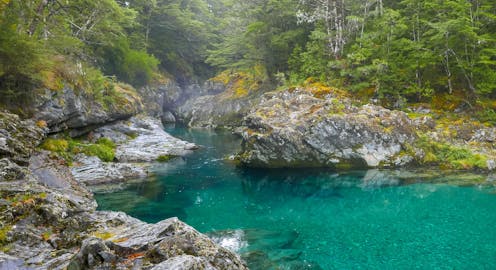
The government’s plans to fast-track a long overdue review of large tracts of ecologically important land, known as “stewardship land”, could result in the loss of legal protections for some conservation land.
A third of all land in Aotearoa New Zealand is managed by the Department of Conservation (DOC). When DOC was formed in 1987, it was allocated land that had been carefully assessed for conservation values and then classified into national parks, scenic reserves or similar. But this classification job was only two-thirds completed at the time.
The remaining third of the land was called “stewardship land”, which takes in pristine areas such as the Southern Alps between Mount Aspiring and Aoraki/Mount Cook national parks.
About 2.7 million hectares (9%) of New Zealand’s land area is stewardship land. Officials put stewardship land in a holding pen with the same level of protection as other conservation land to make it relatively easy to add protections and hard to sell or swap.
Only 100,000ha of this has been reclassified since the 1980s, including recent additions to the Kahurangi National Park, but successive governments have not had the appetite to finish the job.
Last year, the government announced plans to reclassify all remaining stewardship land, but we argue the process is flawed. It opens the door to vested interests, including sale or disposal of public conservation land, in particular for mining.
Speed versus care
The government appointed national panels to assess the land and make recommendations to the minister. Cabinet papers show the assessments were supposed to be a “genuine technical assessment” of conservation values.
But the panels are due to report their recommendations on all of Westland by next month, before moving on to other regions at similar speed. The need for speed has never been explained in light of the care required for this once-in-a-generation task.
The panels replace the statutory reclassification and advisory functions of conservation boards and the New Zealand Conservation Authority (NZCA) – without changing the Conservation Act. The process was never put out for consultation.
The panels’ terms of reference are loose, with expertise that does not fully overlap with conservation boards or the NZCA. The information the panels used and the stakeholder consultations they have been undertaking have yet to be made public.
The conservation values the panels should be assessing have not been clarified, despite long established guidelines.
Most importantly, buried in the cabinet paper, the minister has given interim direction that panels must prioritise “the assessment for reclassification of any stewardship land where applications are sought for mining access arrangements”.
Any disposals for mining will automatically compromise later assessments of conservation values for surrounding land, resulting in weaker classifications. This could pave the way for fragmentation of ecosystems at the margins of conservation land like Kahurangi, Paparoa and Westland/Tai Poutini national parks.
In South Westland, any weak classifications, or disposals for mining within the world heritage area Te Wāhipounamu/South-West New Zealand would endanger its very status.
The Environmental Law Initiative (ELI), of which we are members, raised these and other concerns directly with DOC.
Our view is that, when combined, these flaws undermine the assessment process and could open the door to vested interests. This may lead to weak classifications, sale or disposal of public conservation land to mining interests. Although stewardship land can only be disposed of if it has low or no conservation values, if there is no genuine assessment, this seems more likely.
More mining on conservation land
Our concerns are reinforced by key issues in a current DOC consultation on improving the reclassification process and disposing of stewardship land through legislative reform.
This consultation places disposal on the table by proposing to remove a key Conservation Act barrier. This would make it easier to dispose of land before any value assessments have actually been made.
In other proposals, the hand of vested interests is clear. DOC proposes to leave commercial activities, including mining proposals, on reclassified land unaffected. This means if stewardship land were to be designated as a national park, this reclassification would have no effect on existing concessions or mining permits.
In our view, this could undermine the very conservation values the reclassification process is supposed to protect. It would also allow for even more mining on conservation land, decisively ending the 2017 Labour/New Zealand First government’s policy of “no new mines on conservation land”.
The current proposals would also cement the ouster of conservation boards and the NZCA, and shorten public consultation time frames. The combined effect of these proposals is that the public will have less say on the fate of large swathes of public land.
We call on the government to slow down the reclassification and increase the transparency of the process, particularly with regard to vested interests. Failure to confront these issues is likely to attract years of delay, serious legal challenges and possibly even new mines in pristine areas.
Authors: Matthew Hall, Senior Researcher, Environmental Law Initiative and Visiting Scholar, Faculty of Law, Te Herenga Waka — Victoria University of Wellington


















