

To get to the rainforest canopy, it helps to have a crane
- Written by Nigel Stork, Emeritus Professor in the Centre for Planetary Health and Food Security, Griffith University
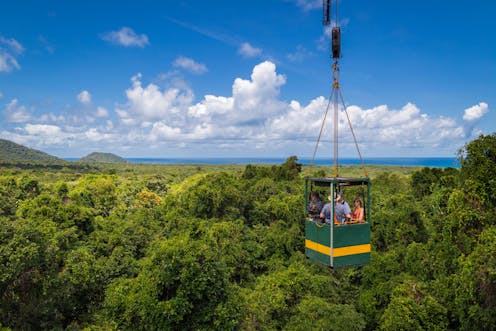
When you walk through a rainforest, you might feel like you’re missing out. You can hear birdsong and insect noises from way up high. For decades, the rainforest canopy was called “the last biotic frontier,” due to the sheer difficulty of getting up there.
Just over 30 years ago, that began to change. Researchers from the Smithsonian installed an industrial crane in a Panama rainforest to give scientists access. Ten more were installed around the world over the next decade.
In 1998, Australia joined in, building a canopy crane in the Daintree rainforest, near Cape Tribulation. Our new research covers the story of how the canopy crane was installed, and what research has stemmed from it.
While canopies are hard to access, they are well worth the effort. The tree canopy is where the atmosphere meets the biosphere. As much as half of all biodiversity on Earth is found in tropical rainforests – and a large proportion of all these species are found in the canopy.
What’s it like riding a canopy crane?
Riding the crane is an eerily quiet experience, as the power driving the crane comes from offsite.
You step into a kind of dangling gondola, suspended from the rig of the crane. As you go up, you immediately notice how uneven the canopy is. The crowns of some trees are way higher than others. Some trees are covered in vines and epiphyte air plants. Birds and large insects are abundant, particularly around trees in flower.
Read more: Tiny treetop flowers foster incredible beetle biodiversity
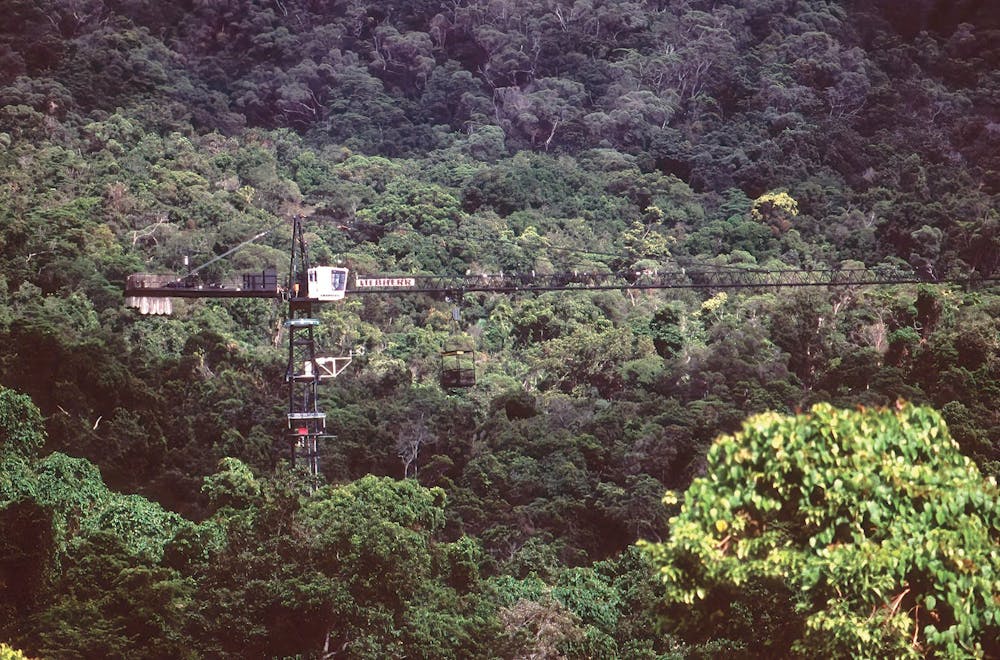
The tower crane is 45 metres tall. But even if you’re not great with heights, you may well find yourself too distracted by the sights to be worried. With a 55 metre jib, the crane can pivot to cover an area of forest larger than the size of a soccer field, with more than 80 species of trees.
The canopy crane is nestled so deeply in World Heritage-listed rainforest it can be hard to imagine the mammoth task involved in building a 70-tonne steel crane in the middle of the forest. In a serendipitous twist to the story, a heavy lift helicopter was available right when the crane was being erected, with the effort captured on film.
Funded by the Australian Research Council, the crane forms a key part of a nationally unique research and teaching facility at the Daintree Rainforest Observatory, where school and university students can stay for extended periods.
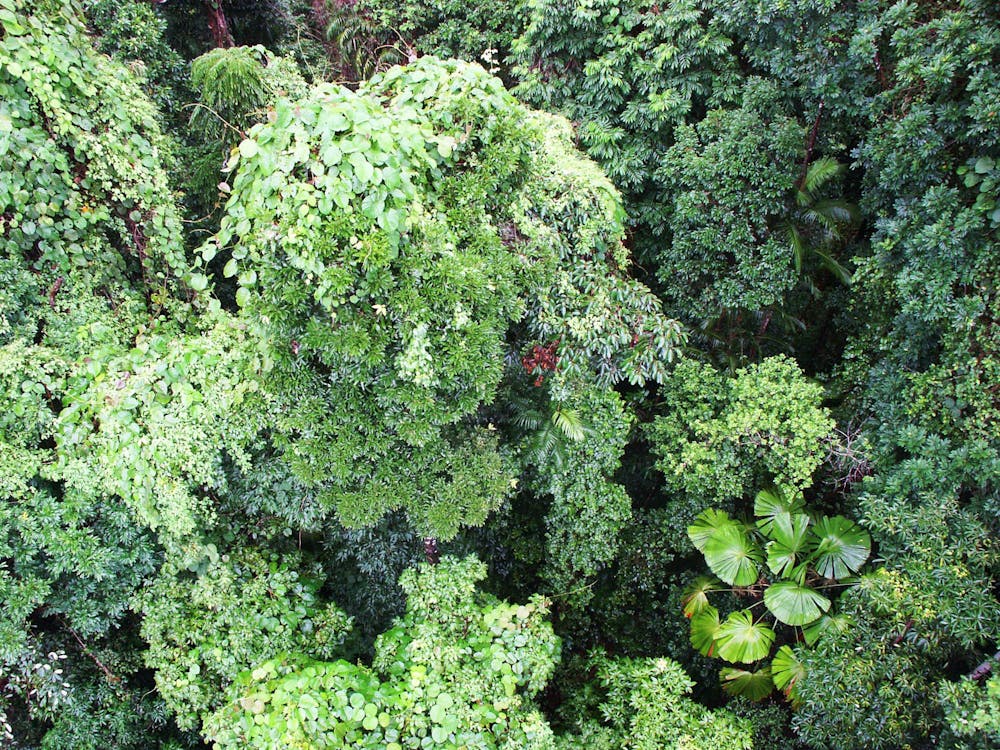 A view not often seen: the Daintree rainforest canopy from above.
Author provided
A view not often seen: the Daintree rainforest canopy from above.
Author provided
What knowledge has the crane unlocked?
Over the past 24 years, this industrious workhorse has made possible more than 120 studies across fields as varied as entomology, plant phenology and physiology.
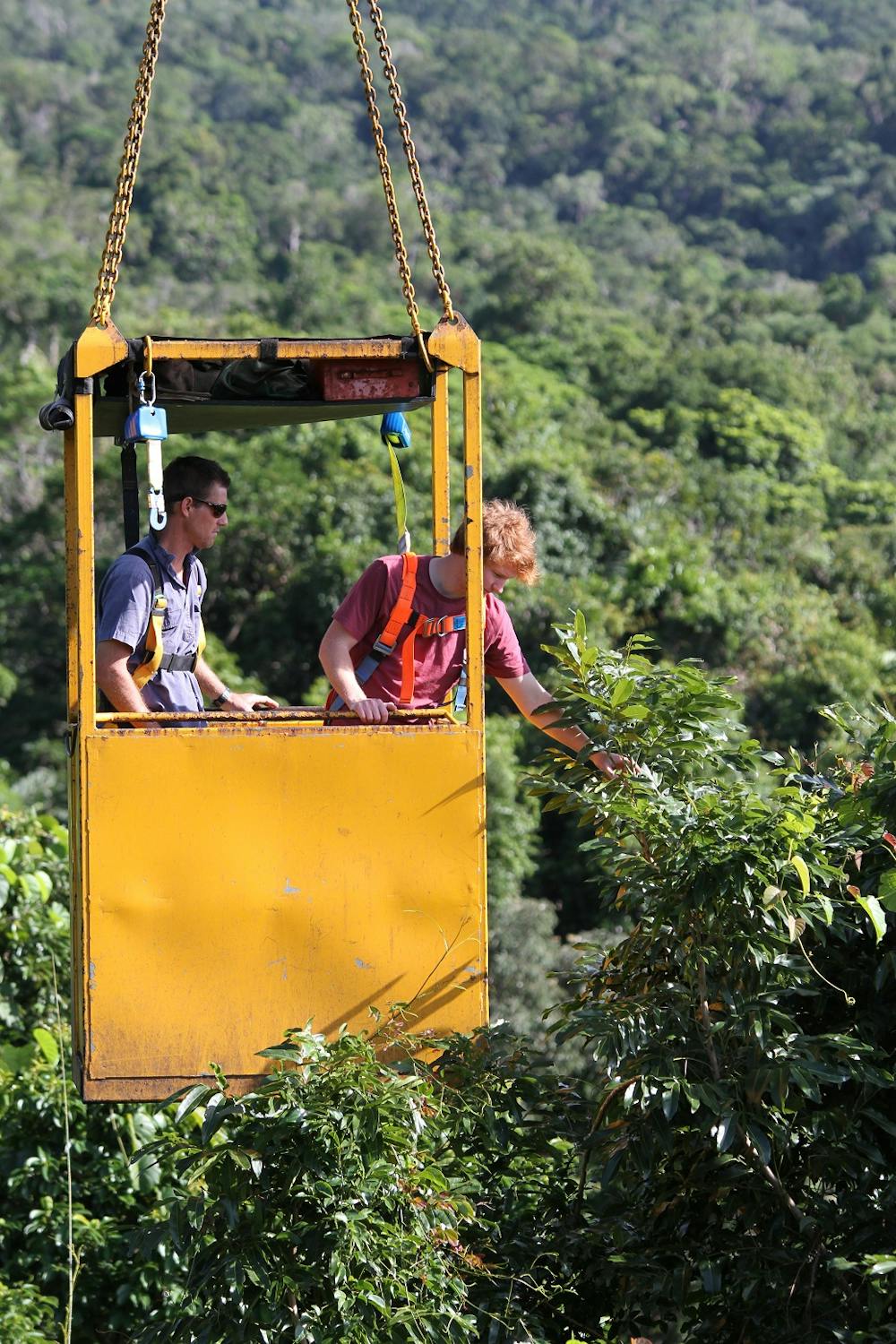 Researchers examine the canopy.
Author provided
Researchers examine the canopy.
Author provided
One important discovery has been the influence on ant communities by honeydew produced by bugs as well as nectar exuded from a plant’s glands other than flowers. Some ant species specialise in extracting these high energy foods to become the dominant species in the canopy.
Not only that, but studies from the crane have shown us our assumptions that rainforest canopies are unusually rich in species may not be entirely correct. It has allowed us to test the theory two thirds of all insect species are found in the canopy. In fact, intensive sampling of beetles showed both canopy and ground habitats are equally important for this hugely species rich group.
What will reduced rainfall mean for the Daintree?
Australia’s canopy crane has given us a bird’s eye view of how rainforests cope with a drying climate and drought conditions, with a large scale experiment under way.
Our Daintree experiment consists of two large areas covered by clear plastic roof panels which prevent almost all the rain from reaching the ground.
Researchers monitor what occurs in these areas. With much less rain, plant productivity drops. Plants change the way their wood grows to cope with lower water availability.
When shrubs and saplings in the understorey are water-stressed, we see reduced rates of photosynthesis occuring alongside higher levels of insect attack on leaves. Wood-boring insects are more common on these saplings, while termites were more active across the drought experiment area.
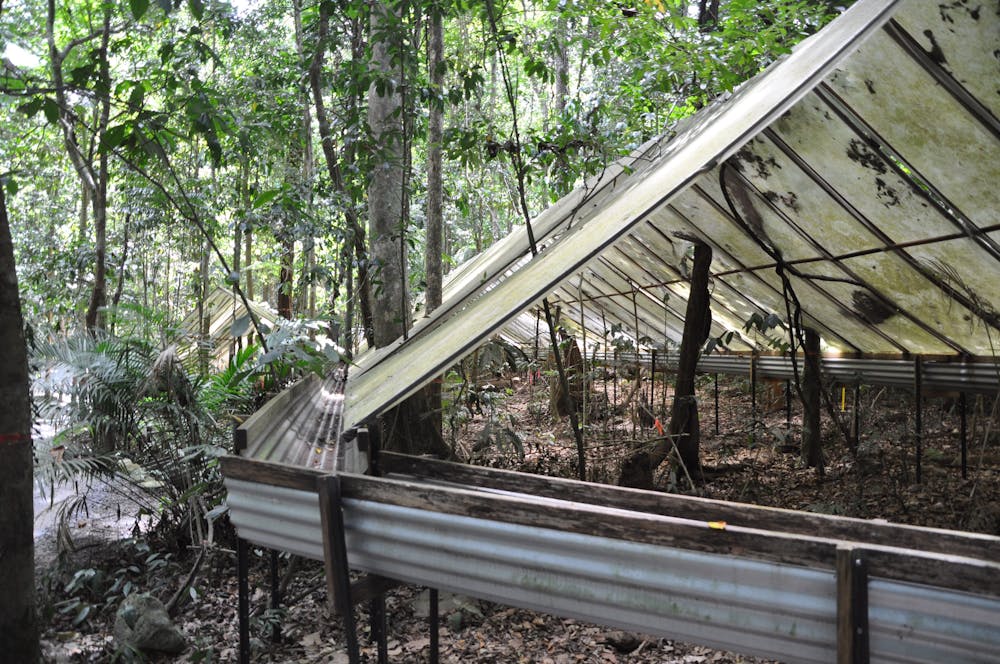 The Daintree drought experiment we are running examines the effect of much less rainfall on the rainforest.
Author provided
The Daintree drought experiment we are running examines the effect of much less rainfall on the rainforest.
Author provided
Up on the crane, we’ve discovered that insects in the canopy may respond differently to drought stresses compared to those lower down in the forest.
We found more insects feeding on sap and fungi in drought-stressed trees down in the understorey, while we found little change in the canopy insects. This suggests insects up high are either very mobile or that the large canopy trees are less affected by drought.
Australian research could benefit from more canopy cranes
If we are to answer important questions about how ecosystems will function as the climate changes, we could benefit from more cranes. Six cranes have proved vital to Western Sydney University’s large scale experiment on how Australian forests, animals and soils will fare at 550 parts per million of carbon dioxide (we’re currently at 400).
While nimble new technologies like drones give us exciting new data on canopies, canopy cranes will have a place for years to come. That’s because drones cannot give humans direct access to the canopy.
As the Daintree crane ages, questions will arise over whether it’s worth replacing when the time comes. The fact that understorey and canopy plants respond differently to drought shows us we cannot simply extrapolate what happens at ground level to what happens at height in the rainforest.
Canopy cranes give us vital access and make possible studies across whole forest ecosystems. Australia’s only tropical forest canopy crane has proven its worth.
Authors: Nigel Stork, Emeritus Professor in the Centre for Planetary Health and Food Security, Griffith University
Read more https://theconversation.com/to-get-to-the-rainforest-canopy-it-helps-to-have-a-crane-176253

















