

The BOLT II hypersonic flight test could bring superfast global travel a step closer
- Written by Chris James, ARC DECRA Fellow, Centre for Hypersonics, School of Mechanical and Mining Engineering, The University of Queensland
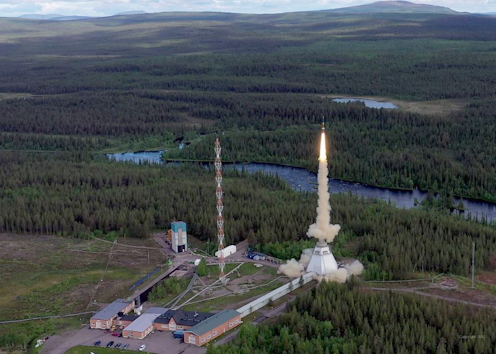
The BOLT II hypersonic flight experiment will launch tonight from NASA’s Wallops Test Flight Facility in Virginia.
Hypersonic vehicles, which can fly much faster than passenger jets, would allow passengers to go from Sydney to Los Angeles, for instance, in just a couple of hours.
They could also offer more flexible options for launching payloads into space than conventional rockets and their speed and manoeuvrability mean they have a range of potential tactical military uses too.
Russia and China already claim to have operating hypersonic missiles, but hypersonic passenger aviation is still a dream rather than reality.
Read more: Hypersonic missiles are fuelling fears of a new superpower arms race
Nevertheless, several types of hypersonic vehicles already exist, including rockets, planetary entry vehicles such as SpaceX’s Dragon capsule and intercontinental ballistic missiles.
What is hypersonic flight?
Hypersonic flight is faster than supersonic flight – the latter term, by definition, means faster than the speed of sound.
To break the sound barrier – and surpass “Mach 1” – you need to travel faster than about 1,235km per hour, or a kilometre in just under 3 seconds. Mach 2 is twice as fast, and so on.
There is no clearly defined Mach number that marks the boundary between supersonic and hypersonic flight. But Mach 5 is generally taken by aerospace engineers to be where hypersonic speed begins.
Hypersonic travel presents a few extra problems that aren’t encountered at more pedestrian speeds. Chief among these is the fact that the air flow over the vehicle causes so much friction the outside of the craft can exceed 1,000℃.
Like all aircraft, flying depends on not having too much mass on board. So specialist materials, either high-temperature ceramics or “ablative” materials that slowly burn away during flight, are required on the outside of vehicles to insulate the craft against this heat and still be light enough to fly.
Hypersonic engines, called scramjets (supersonic combustion ramjets), need to burn fuel in a supersonic air flow, which is very complicated.
Another persistent issue is that hypersonic flight is difficult to model accurately, because of the interplay of various different physical effects that come into play at extreme speeds.
So if you want to understand everything together, you have to do real flight tests such as today’s launch. But these are expensive and technically demanding.
Read more: The race to hypersonic speed: will air passengers feel the benefits?
Testing boundaries
One of the trickiest hypersonic problems is predicting something called the “boundary layer transition location”.
When an aircraft flies through the air, a thin layer of air forms around its surface and is dragged along with the vehicle.
This “boundary layer” is very important, as most of the heating happens here, along with a significant portion of the drag forces that try to slow down the vehicle.
As this boundary layer grows along the vehicle’s length, it will eventually “transition” from the calm “laminar” flow near the leading edge of the vehicle, to violent “turbulent” flow further downstream.

While we understand what leads to this “boundary layer transition”, we can’t perfectly predict it, especially at hypersonic speeds.
The problem is that predicting the boundary layer transition location accurately is very important for designing hypersonic vehicles. In most cases, turbulent flow is bad. It greatly increases both heating and drag.
Uncertainty in where the flow will be turbulent is a major issue, as large heating and drag uncertainties make some vehicle designs inefficient or completely unfeasible.
BOLT II: a new transition flight experiment
BOLT (short for Boundary Layer Transition) was a US$6 million hypersonic flight test that launched in June 2021 from Esrange Space Center in northern Sweden to study boundary layer transition.
But it failed to reach hypersonic speeds, after problems with its rocket launch mechanism.
BOLT II (this time short for Boundary Layer Transition and Turbulence) is the next planned flight in the program, with a similar budget but a larger vehicle to ensure more flow turbulence can be studied.
Both the BOLT and BOLT II vehicles have a complex, swept geometry with a concave surface to represent a real hypersonic vehicle. The aim is to produce complex, real-world data that engineers and scientists can use to improve their models for predicting transition on hypersonic vehicles.
A separate experiment is run on each side of the vehicle, with one “smooth” side and one “rough” side. The flow running length along the vehicle is 1 metre, slightly larger than the original BOLT vehicle.
BOLT II will be launched on a suborbital trajectory by a two-stage sounding rocket. During its ascent, it is planned to reach Mach 6, where an ascent flight experiment will occur. It will turn over in space and then re-enter the atmosphere, before performing a descent experiment at Mach 5.5.
BOLT II is a fully autonomous vehicle and it has more than 400 sensors and instruments mounted onboard to capture data about the flow environment during the experiments.
Assuming that BOLT II’s planned trajectory will be similar to the planned original BOLT flight trajectory, BOLT II will reach a maximum altitude of around 281km. The whole mission will be over in less than 10 minutes after launch.
Where to from here?
To develop the hypersonic vehicles of the future, we need to properly understand how to predict boundary layer transition on realistic vehicle shapes and what the minute effects of turbulent flow on hypersonic vehicles are. Data from the BOLT II flight experiment will help do just that.
Read more: Sydney to London in an hour? The future of hypersonic air travel
The launch will be livestreamed on the NASA Wallops Youtube channel, so we’ll know straight away if the flight is a success or not. Assuming it is, in the coming years we will see many scientific papers published on the breakthroughs from this significant experiment.
The ability to accurately predict hypersonic boundary layer transmission will bring us much closer to hypersonic passenger flight one day. NASA’s planned NASP hypersonic space-plane was cancelled in the 1990s, partly due to the inability to accurately predict its transition location. Hopefully, soon we can move past that.
However, many issues will still remain. Air-breathing hypersonic engines are still in their infancy; the materials used to shield hypersonic vehicles are very expensive; and the design of hypersonic vehicles is still very complicated. Companies like Australia’s own Hypersonix, which aims to use an air-breathing hypersonic vehicle to launch small payloads into orbit, will hopefully bring us closer to making the hypersonic flight dream a reality.
Authors: Chris James, ARC DECRA Fellow, Centre for Hypersonics, School of Mechanical and Mining Engineering, The University of Queensland

















