

How Indonesia's counter-terrorism force has become a model for the region
- Written by: Greg Barton, Chair in Global Islamic Politics, Alfred Deakin Institute for Citizenship and Globalisation; Co-Director, Australian Intervention Support Hub, Deakin University
As last month’s attacks in Indonesia remind us, ISIS has proven to be a resilient threat, with far-reaching influence that hasn’t disappeared with the collapse of its self-proclaimed caliphate in Syria and Iraq.
The wave of deadly attacks in Java and Sumatra in May left a total of 53 people dead, including 15 civilians, seven police and 31 attackers or suspected militants. A further 50 people were injured, many seriously.
It was the highest death toll from terrorist attacks in Indonesia since the 2002 Bali bombings, which killed 202 people, including 88 Australians.
Read more: How Indonesia is dealing with the new threat posed by returning Islamic State fighters
The attacks caught many Indonesians by surprise, including the elite counter-terrorism squad known as Detachment 88 (or Densus 88). Formed in the wake of the Bali bombings in June 2003, and building to full operational status two years later, Detachment 88 has established itself as one of the world’s best counter-terrorism units, exceeding all expectations given its unpromising origins.
The success of Detachment 88 has been the result of excellent intelligence work, but no agency has perfect intelligence. And just like every counter-terrorism team in the age of ISIS, Detachment 88 is also dealing with a ten-fold increase in “persons of concern”, making its work even more challenging.
Advanced training techniques
During the three decades of the Suharto regime, the Indonesian National Police (Polri) were considered the poor cousins of Indonesia’s armed forces (then ABRI, now TNI). In the wake of Suharto’s resignation in 1998, Polri became independent from the military, but remained poorly funded, equipped and trained, and as a result, ill-disciplined and corrupt.
Following the shock of the Bali attack, perpetrated by the al-Qaeda-linked militant group Jemaah Islamiyah, Australia and the US poured several hundred million dollars into counter-terrorism capacity building, police reform and training in Indonesia.
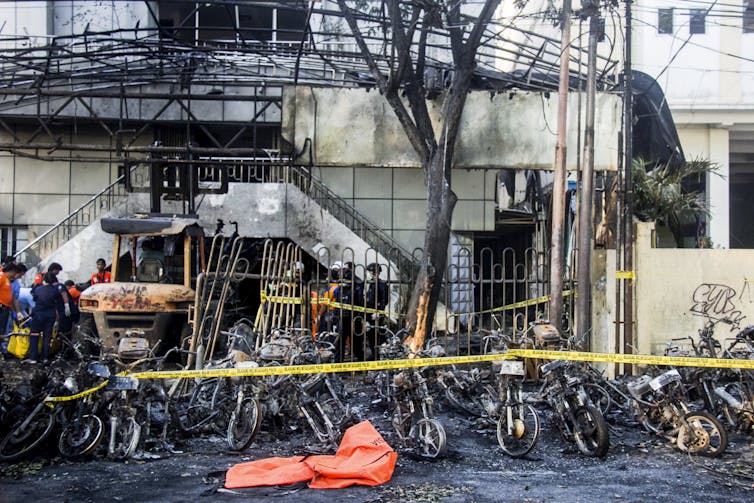 The carnage after suicide bombings at a church in Surabaya last month.
Fully Handoko/EPA
The carnage after suicide bombings at a church in Surabaya last month.
Fully Handoko/EPA
As part of this effort, a bilateral initiative involving the Australian Federal Police (AFP) and Polri led to the establishment of a specialist centre for providing counter-terrorism training to police and government officials from across Southeast Asia – the Jakarta Centre for Law Enforcement Cooperation (JCLEC). This initiative worked in parallel with the development of Detachment 88.
Nearly 15 years later, JCLEC has grown into one of the most robust counter-terrorism training facilities in the world, delivering training to more than 20,000 officials from 70 nations. And Detachment 88 has recently doubled in size to more than 1,300 officers, with plans to increase its operational presence from 16 of Indonesia’s provinces to all 34.
Read more: When parents take their children to die in jihadist suicide bombings, what can be done?
The public is by now familiar with Detachment 88’s black-clad tactical response teams, equipped with standard-issue, American-supplied counter-terrorism weapons, such as M4A1 carbines, AR-10 rifles, MP5 submachine guns, Glock 17 pistols and Remington shotguns. The force includes specially-trained snipers and breach squad teams.
Less well-known are Detachment 88’s technical experts, such as specialists in explosives and post-blast forensics. Much of the training and support has come via the US Department of State’s Diplomatic Security Services and Anti-Terrorism Assistance program, as well as similar Australian programs, including substantial involvement initially from the AFP.
Detachment 88 forces are now trained in a dedicated facility south of Jakarta staffed by former US and Australian special forces trainers, together with experts from the CIA, FBI, US Secret Service and the AFP.
Winning hearts and minds
It’s not just hard power and tactical capacity that sets Detachment 88 apart, but also its intelligence work. The force doesn’t just rely on its own officers to gather intelligence; it works closely with local councils of key religious and community leaders to get valuable information on militant activity in a program run by the Ministry of Home Affairs dubbed the “early warning system”.
Although reviled by terrorist groups like ISIS and Jemaah Islamiyah, Detachment 88 officers have proven effective at using soft interview techniques to build rapport and establish trust with many of militants they’ve captured.
Using sophisticated psychological techniques and backed by experts with deep religious knowledge, Detachment 88 has succeeded in winning over many members of terrorist networks. This is often made possible with the assistance of militants’ parents and other family members. This nuanced approach is a distinctive strength of Detachment 88 and, in tandem with other elements of intelligence gathering, has enabled it to disrupt developing terrorist plots with remarkable consistency.
Detachment 88’s intelligence work has led to over 1,200 arrests since it was formed in 2003, with most resulting in successful prosecutions. Since 2010, the group is credited with disrupting more than 80 terrorist plots.
Ten days ago, Aman Abdurrahman, founder of the extremist group Jemaah Ansharut Daulah, which had pledged its allegiance to the Islamic State, was found guilty and sentenced to death for ordering attacks in the country in 2016 and 2017. He’s already in prison serving an unrelated terrorism-related sentence.
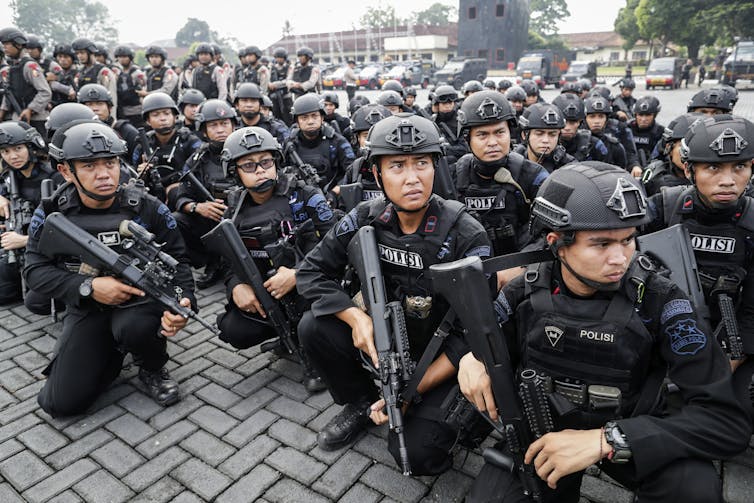 Counter-terrorism forces in Indonesia’s Mobile Brigade Corps after five officers were killed by inmates at a detention centre last month.
Mast Irham/EPA
Counter-terrorism forces in Indonesia’s Mobile Brigade Corps after five officers were killed by inmates at a detention centre last month.
Mast Irham/EPA
And although the force was uncharacteristically caught unaware by last month’s attacks, it quickly addressed the intelligence lapse and identified the larger networks behind the violence. Within days, Detachment 88 officers had conducted raids across Java and Sumatra and arrested dozens of suspects.
While its efficacy is impressive, its track record is not perfect. Apart from the inevitable counter-terrorism misses, there are ongoing concerns about the extent to which the bitter struggle between police and extremists is causing officers to be too quick to use lethal force in violent confrontations.
Read more: To fight radicalisation in Southeast Asia, empower the women
Frequent attacks on law enforcement, such as the execution of five officers by rioting inmates at a high-security detention centre last month, place tactical response teams under immense pressure. As does the grim reality that, when confronted, many militants would rather die in a gun fight or suicidal explosion, or launch a pre-emptive strike on a lightly guarded police post.
However, none of this justifies human rights abuses - a perennial problem in policing. And in dealing with an opponent whose stock-in-trade is propaganda, any failings by Detachment 88 serve to undermine the force’s credibility and moral authority with key communities.
More cooperation with Australia
In its formative years, Detachment 88 benefited greatly from the training, resources and investment provided by the AFP and other Western police forces.
Today, the learning flows in both directions and the AFP, for one, is appreciative of what it learns from its Indonesian partners, both in terms of effective intelligence and in tactical responses under pressure.
With ISIS now expanding its reach around the world, it’s an ideal time to facilitate such cooperation between Detachment 88 and counter-terrorism police units at the state level in Australia.
There is much we can learn from the rich experience of our neighbours in their battle against extremism and opening the way for state policing level exchanges would be a benefit to both nations.
Authors: Greg Barton, Chair in Global Islamic Politics, Alfred Deakin Institute for Citizenship and Globalisation; Co-Director, Australian Intervention Support Hub, Deakin University


















