Modern Australian
The Times

The Greens' liveable income guarantee is a serious idea the major parties won't touch – yet

  • Written by John Quiggin, Professor, School of Economics, The University of Queensland
The Greens' liveable income guarantee is a serious idea the major parties won't touch – yet

The Australian Greens have lobbed a large rock into the placid pool of economic policy by announcing a proposal for a “Liveable Income Guarantee”.

The policy would increase all income support payments – for those looking for work, studying full-time or unable to work because of age, disability or caring responsibilities – to A$88 a day (about $32,000 a year) from July 2023.

This payment level is based on the poverty line calculated by the Melbourne Institute. Increases to all payments would be indexed to changes to the poverty line. The policy would also scrap mutual obligation programs such as “work for the dole” and relax eligibility restrictions.

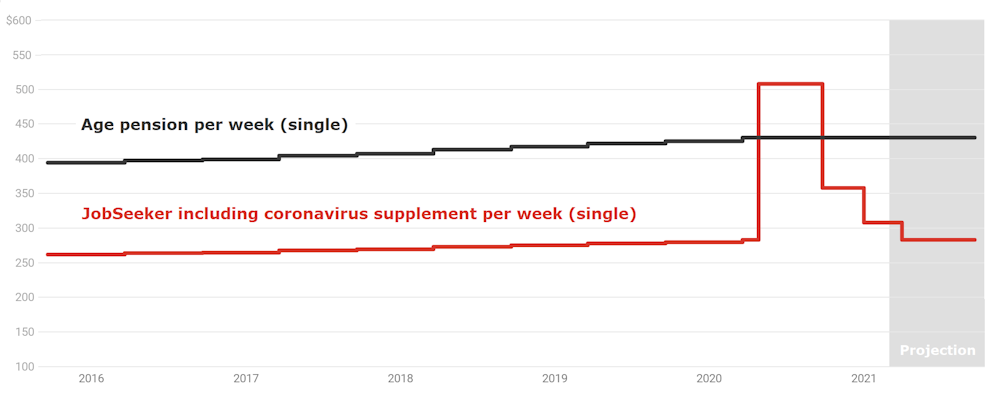
Currently welfare payments vary widely, with the age pension for a single person being about $70 a day, while JobSeeker is about $44 a day.

JobSeeker vs age pension

Source: Ben Phillips ANU, Services Australia This is the first significant economic policy in the undeclared campaign for the next federal election campaign. Up to to this point it looked like there wouldn’t be much to talk about. Apart from some sweeteners carefully targeted at marginal seats and voting blocs, and small-scale initiatives like Labor’s social housing program, the only significant new policy from either major party likely to follow the election is the “Stage 3” tax cuts legislated under the Turnbull government. These cuts are supported by both the government and the opposition. Both major parties have also committed to “budget repair”, a euphemism for expenditure cuts, but are unlikely to provide any details until after the election. COVID-19 changed the landscape The Greens’ plan shares its name, and many of its design features, with a proposal put forward in July 2020 by Tim Dunlop, Elise Klein and myself. We proposed this after the massive expansion of the JobSeeker program to deal with COVID-19 demonstrated Australia did have the resources to eliminate most sources of poverty when it was considered necessary to do so. We argued a liveable income guarantee would be an ideal way to make the achievements of JobSeeker permanent. Read more: Forget JobSeeker. In our post-COVID economy, Australia needs a 'liveable income guarantee' instead The Greens’ policy differs from our 2020 proposal in two main respects. First, it is more generous, raising all benefits. The Parliamentary Budget Office has calculated this will cost about $43.7 billion in the first year, and $44.9 billion in the second. On the other hand, we proposed expanding payment eligibility to people engaged in volunteering, community projects and artistic and creative activity. The Greens’ proposal maintains the existing set of benefit categories. People queuing outside a Centrelink office in Melbourne in March 2020. Stefan Postles/AAP How to pay for liveable welfare payments As debt and deficits have faded as a political point-scoring issue, the idea that all new spending programs need to be matched with other cuts or extra revenue has become less compelling. But resources used for one public program can’t be used for other programs, or for private expenditure. So it’s important to ask what kinds of measures could offset the call on public resources proposed in the liveable income guarantee. The option with the biggest impact would be to cancel or defer the Stage 3 tax cuts, which will cost an estimated $18-20 billion a year. That would offset nearly half the money spent on the liveable income guarantee. The Greens have also pointed to tax measures they have previously proposed, including a billionaires tax and a corporate super-profits tax. Read more: How to camouflage $150 billion in spending: call it 'tax expenditure' It has always hard to estimate how much revenue such measures would collect, given the capacity of wealthy individuals and corporations to rearrange tax affairs. On the other hand, with improved global cooperation on tax, thanks mainly to initiatives from the OECD, there is more capacity to make billionaires and large corporations pay a fairer share of the costs of the society that supports them. Another source of offsets could arise from what used to be called “tax expenditures” and are now referred to more obscurely as tax benchmark variations. These are tax concessions or exemptions applying to particular activities or classes of taxpayer. These total about $150 billion a year according to the latest Treasury estimates. The biggest elements are concessions on capital gains tax and superannuation. A policy for serious debate The Greens proposal would greatly improve the position of millions of Australians on low incomes at the expense of reducing the disposable incomes and wealth of the well-off, with a particular impact on the very rich. Barring a complete revolution in Australian politics, there’s no chance the next election will lead to such a result, or even a serious move in that direction. It is a striking commentary that the Greens’ Liveable Income Guarantee will be rejected by a government led by Scott Morrison, a self-declared conservative, and also by Anthony Albanese, a leader from the Labor Party faction still sometimes called the “socialist left”. Read more: What happens when you free unemployed Australians from 'mutual obligations' and boost their benefits? We just found out Based on current polls, the most that millions of Australians living in poverty can hope for is a Labor government in need of Green support raising benefits a little, and softening some of the most oppressive features of the current system. But the point of an election is to debate and decide on the future direction of the country. By putting forward this bold initiative, the Greens are providing us the chance to have such a debate. Other Greens proposals, like phasing out the use of coal, once seen as outside the realm of possibility, are now widely accepted. Similarly, the liveable income guarantee may make its way on to the policy agenda for the future. Authors: John Quiggin, Professor, School of Economics, The University of Queensland

Read more https://theconversation.com/the-greens-liveable-income-guarantee-is-a-serious-idea-the-major-parties-wont-touch-yet-179573

Celebration of Life vs Traditional Funeral: What's the Difference?

When saying goodbye to someone you love, there is no single way to honour their life. Every family has different traditions, beliefs, and preference...

Building Approval for Roofing Projects: What Homeowners Need to Know

Roofing projects are an important part of maintaining and protecting your home. Whether you're repairing storm damage, replacing an ageing roof, or ...

Chatswood Tutoring And Its Role In Academic Achievement

Academic success often requires more than classroom attendance alone. Students face increasing expectations as they progress through school, particu...

Why Laser Hair Removal Treatments Continue Growing In Popularity

Managing unwanted hair can become time-consuming and frustrating for many people, especially when shaving, waxing, and other temporary methods requi...

Choosing the Right Devices for a Flexible Workplace

For IT leaders managing large fleets, the device layer is where workforce productivity and security policy meet. The shift towards flexible and hybrid...

How Business Advisory Services Help Companies Achieve Sustainable Growth

Every business owner aims to build a profitable and sustainable organisation. While dedication, innovation, and hard work are important, achieving l...

Why Body Contouring Has Become A Popular Cosmetic Treatment

Many people maintain healthy lifestyles through regular exercise and balanced eating habits but still struggle with stubborn areas of fat that are d...

How to Choose the Right POS Hardware for Your Business in Australia

A lot of Australian business owners spend weeks researching POS software but buy hardware almost as an afterthought. That's a mistake. The wrong har...

Why Material Handling Hose Is Critical for Industrial Efficiency

A high-performance material handling hose is an essential component in industries that transport abrasive, dry, or bulk materials on a daily basis...

How to Choose the Right Lawyer in Melbourne for Your Situation

Choosing legal support can feel difficult, especially when the stakes are personal or business-related. The right lawyer in Melbourne should underst...

Hoteliers Look to Clever Value Adds to Increase Revenue

The Australian hospitality industry is still in recovery mode after a notoriously rough patch in recent years. While there has been a post-COVID tra...

Moving to Queensland? Here’s How to Prep Your Car for the Big Move North

There’s no sign of the northern migration slowing down, with thousands of southerners fleeing from chaotic lifestyles and cooler climates for a brig...

Diesel Shortage to Impact Trades and Contractors

Strait of Hormuz blockage affecting all major parts of trades and construction Trades and construction across residential, commercial and industria...

Why Holiday Home Owners Turn to Rental Management Agents

The Allure — and the Reality — of Renting Out Your Property Owning a holiday home is a dream for many Australians. Whether it's a beachside sha...

Why Finding Reliable Doctors In Bundoora Is Important For Long-Term Health

Access to quality healthcare plays an important role in maintaining overall wellbeing and managing health concerns early. Trusted Doctors in Bundoor...

Understanding the Different Types of Car Services: Minor vs Major

When it comes to car maintenance, one of the most important things every vehicle owner should understand is the difference between a minor and a maj...

How Superannuation and TPD Insurance Work Together

Superannuation is an essential part of financial planning in Australia. It is designed to provide individuals with income during retirement, helping...

Tiny Towns funding granted for Mt Hotham and Mt Buller upgrades

Alpine Resorts Victoria (ARV) has welcomed funding support from the Victorian Government’s  Tiny Towns Fund, with both Mt Hotham and Mt Buller se...