

the Russian state's long history of cultivating homegrown neo-Nazis
- Written by Robert Horvath, Senior lecturer, La Trobe University
Many commentators have already debunked Russian President Vladimir Putin’s absurd claim to be waging war to “de-nazify” Ukraine.
Some have pointed out the far right received only 2% of the vote in Ukraine’s 2019 parliamentary elections, far less than in most of Europe. Others have drawn attention to Ukraine’s Jewish president, Volodymyr Zelenskyy, and the efforts of the Ukrainian state to protect minorities like Crimean Tatars and LGBTQ+ people, who are subject to brutal persecution in Russia.
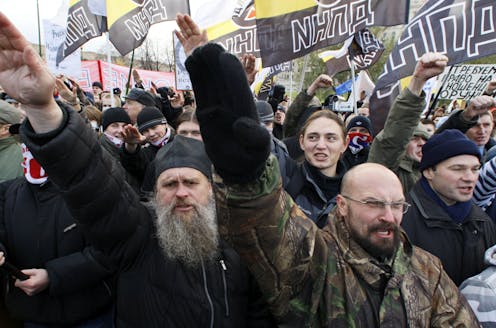
What has received less coverage is the Putin regime’s own record of collaboration with far-right extremists. Even as Russian diplomats condemned “fascists” in the Baltic states and Kremlin propagandists railed against imaginary “Ukronazis” in power in Kyiv, the Russian state was cultivating its own homegrown Nazis.
Read more: Vladimir Putin points to history to justify his Ukraine invasion, regardless of reality
The roots of neo-Nazism in Putin’s Russia
The origins of this relationship date to the late 1990s, when Russia was shaken by a wave of racist violence committed by neo-Nazi skinhead gangs. After Putin’s accession to the presidency in 2000, his regime exploited this development in two ways.
First, it used the neo-Nazi threat to justify the adoption of anti-extremism legislation, a longstanding demand of some Russian liberals. Ultimately, this legislation would be used to prosecute Russian democrats.
Second, the Kremlin launched “managed nationalism”, an attempt to co-opt and mobilise radical nationalist militants, including neo-Nazis, as a counterweight to an emerging anti-Putin coalition of democrats and leftist radicals.
Moving Together, a pro-Putin youth organisation notorious for its campaign against postmodernist literature, made the first move by reaching out to OB88, the most powerful skinhead gang in Russia.
This cooperation expanded in the aftermath of Ukraine’s Orange Revolution of 2004. To insulate Russia against the contagion of pro-democracy protest, the Kremlin transformed Moving Together into a more ambitious project called “Nashi”, or “Ours”.
As part of its preparations to confront a potential democratic uprising in Russia, Nashi enlisted football gang members, whose subculture overlapped with the neo-Nazi underground.
During 2005, Nashi’s thugs staged a series of raids on anti-Putin youth groups. The most violent attack, which left four left-wing activists in hospital, led to the arrest of the assailants. They were released after a visit to the police station from Nikita Ivanov, the Kremlin functionary who supervised the regime’s loyalist youth organisations.
The resulting scandal provoked a reconfiguration of “managed nationalism”. While Nashi distanced itself from football gangs, its radical militants migrated to two rival Kremlin proxies, the nationalist “Young Russia” group and the anti-immigration “Locals” group. These organisations became bridges between the neo-Nazi subculture and the Kremlin.
Neo-Nazi leaders implicated in killings
As I demonstrated in a recent study of the Kremlin’s relationship with Russian fascists, these linkages made possible a bold experiment to create a pro-Putin neo-Nazi movement.
In 2008-09, the Kremlin was threatened by Russian opposition activist Alexei Navalny’s efforts to build an anti-Putin coalition of democrats and radical nationalists in Russia. In response, the Kremlin began to work with Russkii Obraz (“Russian Image”, or “RO” for short), a hardcore neo-Nazi group best known for its slick journal and its band, Hook from the Right.
With the assistance of Kremlin supervisors, RO attacked nationalists who were abandoning the skinhead subculture for Navalny’s anti-Putin coalition. In return, RO was granted privileged access to public space and the media.
Its leaders held televised public discussions with state functionaries and collaborated openly with Maksim Mishchenko, a member of parliament from the ruling party. Perhaps most shockingly, RO also hosted a concert by the infamous neo-Nazi band Kolovrat in Moscow’s Bolotnaya Square, within earshot of the Kremlin.
The problem for the Kremlin was that RO’s leader, Ilya Goryachev, was a fervent supporter of the neo-Nazi underground, the skinheads who committed hundreds of racist murders in the second half of the 2000s. The authorities turned a blind eye to RO’s production of a two-hour internet “documentary” titled Russian Resistance, which celebrated these killers as patriotic heroes and called for armed struggle against the regime.
But they could not ignore the arrest on murder charges of Nikita Tikhonov, an ex-skinhead and cofounder of RO. Tikhonov was the leader of BORN (“Fighting Organisation of Russian Nationalists”), a terrorist group that committed a string of murders of public figures and antifa militants.
The victims included the renowned human rights lawyer Stanislav Markelov and journalist Anastasia Baburova. Tikhonov was convicted of their murders in 2011.
The police investigation revealed that Goryachev regarded BORN and RO as the armed and political platforms of a neo-Nazi insurgency, on the model of the IRA and Sinn Féin in Ireland and Northern Ireland.
The court materials show that as Goryachev was reporting to his Kremlin supervisors, he was also advising Tikhonov about the choice of murder victims. Goryachev was found guilty in 2015 of ordering the murders of numerous people, including Markelov.
The adverse publicity wrecked the careers of some of the Kremlin’s Nazi promoters, but veterans of RO flourished in the propaganda institutions of Putin’s increasingly autocratic regime.
One of them is Anna Trigga, who worked for the Internet Research Agency, the trolling factory that interfered in the 2016 US presidential election and tried to foment anti-Muslim hatred in Australia. Another is Andrei Gulyutin, editor of the website Ridus, an important platform of pro-Putin Russian nationalism.
Promoting neo-Nazis overseas
No less important is the role of neo-Nazis and other right-wing figures in Russia’s onslaught against Ukraine.
In 2014, RO’s Aleksandr Matyushin helped to terrorise supporters of the Ukrainian state in Donetsk on the eve of Russia’s proxy war in eastern Ukraine. He went on to become a major field commander.
Today, RO’s Dmitrii Steshin, a celebrated war correspondent for a mass circulation tabloid, disseminates lies blaming Ukrainian false-flag operations for atrocities committed by Russian forces.
The Kremlin’s cultivation of domestic neo-Nazis is matched by its promotion of neo-Nazis in the West. Some have amplified anti-Western conspiracy theories as “experts” on RT, the Kremlin’s cable TV propaganda channel.
Others have served the Kremlin as “monitors” who applaud the conduct of fraudulent elections. Meanwhile, Rinaldo Nazzaro, an American, has been quietly running The Base, the international neo-Nazi terrorist organisation, from an apartment in St Petersburg.
Putin’s weaponisation of neo-Nazis was always a risky strategy, but it was not irrational. Unlike mainstream nationalists, who tend to support the idea of free elections, neo-Nazis reject democratic institutions and the very idea of human equality. For a dictator dismantling democracy and constructing an authoritarian regime, they were ideal accomplices.
Read more: How Russians have helped fuel the rise of Germany's far right
Authors: Robert Horvath, Senior lecturer, La Trobe University

















