

Immanuel Kant’s Toward Perpetual Peace and its relevance to the war in Ukraine
- Written by: Paul Formosa, Associate Professor in Philosophy and Director of the Centre for Agency, Values and Ethics (CAVE), Macquarie University
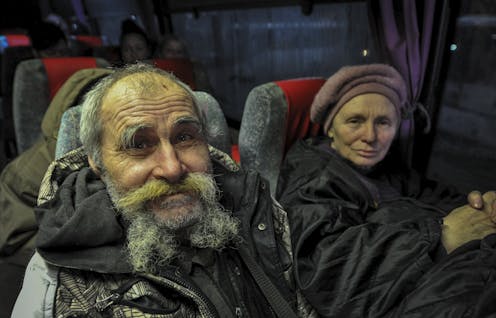
A powerful European country invades a less powerful one. This is a story that German philosopher Immanuel Kant, while writing his essay Toward Perpetual Peace in 1795 in Prussian Königsberg (now a Russian territory on the Baltic Sea called Kaliningrad), was all too familiar with.
Unfortunately, it is a story repeating itself today as Ukraine is invaded by Russia. But what can we still learn from Kant’s essay?
At the time of writing, Kant was 71-years-old. He was reflecting on the bloody aftermath of the French Revolution of 1789 and the numerous Revolutionary wars between France and various European powers, including Austria and Kant’s Prussia. Indeed, Prussia had been engaged in wars for most of Kant’s life.
Kant’s essay takes the form of a philosophical project aimed at achieving perpetual peace. To be perpetual, a peace must not merely be temporary, like a ceasefire, but lasting.
To be lasting, it must have a solid foundation. To this end, Kant drafts six preliminary articles aimed at reducing the chance of war.

 Portrait of Immanuel Kant.
Wikimedia Commons
While various aspects of this theory have been strongly contested, such as the claim that democratic states are less likely to go to war (for example, compare the higher number of recent wars involving the US versus those involving China), elements of this theory remain plausible.
For example, it is unimaginable that democratic France and Germany would go to war with one another today, whereas we have clear evidence of Putin’s despotic regime invading a neighbouring democratic country. But to see how this theory works, we need to look at Kant’s three articles in turn.
Kant’s first article is that the constitution of every state shall be “republican” or what we would now call a representative democracy. Such a state is based on the idea of each citizen as a free, equal and independent co-legislator of the state’s legislative functions through their elected representatives.
Separation of institutional powers, the role of a free press and critical discussion, and the need of representatives to be responsive to the views of the broader public all help to limit the ability and desire of democratic (or “republican”) states to go to war.
 Armed men and barricades in the Maidan Square in Kyiv.
Miguel A. Lopes
Kant’s second article concerns the right of nations to be protected through a “federalism of free states”. Kant argues that before a state is formed, citizens exist in a state of nature. To secure their rights, individuals may coerce one another to leave the state of nature and enter a constitutional state that can protect the rights of all.
Likewise, in the international sphere, states exist in a state of nature, as there is no greater power to secure their rights and adjudicate disagreements between them with the coercive force of law. Thus, states are also obligated to leave the international state of nature and enter a union of states. But what form that union should take is unclear.
Kant considers several models, including a global monarchy achieved through coercive means, a pacific league of states which lacks all coercive powers, and a freely entered federation of states (or world republic) with coercive powers. While Kant clearly rejects a global monarchy obtained through force, it is less clear which of the other two options he endorses.
One plausible reading is that Kant thinks a pacific league is a first step, and that over time states within it will form greater ties, and more states will join it, until eventually it morphs into a stronger federation that (ideally) encompasses all states.
Kant’s idea is that formal alliances between nations, as well as more federative organisations such as the European Union, help to ensure peace between its members. The danger is that those outside these alliances or federated unions can feel threatened by them, which typifies Russia’s view of the expanding NATO alliance.
This is why Kant envisages the need for all states to become republican and for any pacific alliance to eventually encompass all nations if perpetual peace is to be secured.
Read more:
Ukraine war follows decades of warnings that NATO expansion into Eastern Europe could provoke Russia
Universal hospitality
Kant’s third article is the cosmopolitan right of universal hospitality. This requires states not to treat those individuals arriving from other states with hostility or turn them away if this would put them in harm’s way. With estimates of ten million Ukrainian civilians having fled their homes, a cosmopolitan right that supports the millions of Ukrainians seeking refuge in other nations, such as demonstrated by Poland, can help to limit civilian casualties during war.
 A refugee who fled the war from Ukraine carries a child at the Medyka border crossing in Poland, on March 12.
Petros Giannakouris/AP
Kant was not unrealistic about the prospects of perpetual peace. Indeed, he warns against the other form of perpetual peace, that of the silence in the graveyards created by war. But he did identify two key drivers for progress: self-interest and publicity.
Just as it is in the self-interest of individuals to leave the state of nature to secure their rights, it is in the interests of states to join expanding pacific alliances to secure their own international rights and to defend their ability to engage in international trade and commerce. Kant also emphasises the important role of a free press and academic freedom in holding politicians in republican states to account.
This leads to Kant’s principle of publicity, which is that the policies of states that cannot be publicly pronounced if they are to succeed at achieving their aims are unjust. Here Kant exposes three common maxims of cynical politicians and despots: 1) act first and make excuses later; 2) do it, then deny having done it; and 3) divide and conquer your opponents.
While widely used, Kant notes that even the most cynical politician does not publicly espouse acting on these principles, since to do so would arouse such opposition as to make it impossible for them to achieve their aims. This is why even the most despotic leader tends to pay lip service to justice by giving it “all the honor due it, even if they should think up a hundred pretexts and subterfuges to evade it in practice”.
For example, Putin was unable to make public his preparations for war, instead peddling the transparent falsity of military exercises to justify the pre-invasion build-up of troops on the Ukrainian border, and he has felt the need to invent flawed historical narratives to try and justify his unjust invasion of another nation.
The influence of Kant’s short essay has been enormous. His ideas have given rise to democratic peace theory, which has influenced the foreign policies of many liberal states; his idea of a world union formed part of the intellectual foundation for founding the League of Nations and later the United Nations; and his focus on the cosmopolitan right of hospitality, or what we know call refugee rights, has been of increasing global importance.
While more than 200 years old, Kant’s Toward Perpetual Peace continues to be a rich resource for not only diagnosing contemporary injustices, but also for setting out a project for perpetual peace we can still aspire to achieve.
Authors: Paul Formosa, Associate Professor in Philosophy and Director of the Centre for Agency, Values and Ethics (CAVE), Macquarie University


















