

the quantum tech arms race is heating up
- Written by: Stuart Rollo, Postdoctoral Research Fellow, University of Sydney
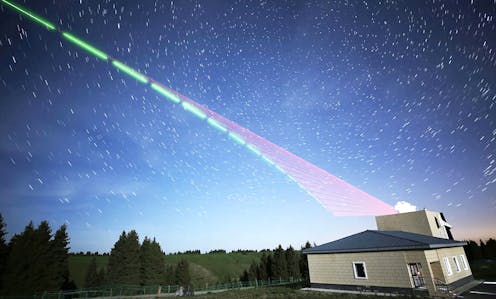
Quantum technology, which makes use of the surprising and often counterintuitive properties of the subatomic universe, is revolutionising the way information is gathered, stored, shared and analysed.
The commercial and scientific potential of the quantum revolution is vast, but it is in national security that quantum technology is making the biggest waves. National governments are by far the heaviest investors in quantum research and development.
Read more: Explainer: quantum computation and communication technology
Quantum technology promises breakthroughs in weapons, communications, sensing and computing technology that could change the world’s balance of military power. The potential for strategic advantage has spurred a major increase in funding and research and development in recent years.
The three key areas of quantum technology are computing, communications and sensing. Particularly in the United States and China, all three are now seen as crucial parts of the struggle for economic and military supremacy.
The race is on
Developing quantum technology isn’t cheap. Only a small number of states have the organisational capacity and technological know-how to compete.
Russia, India, Japan, the European Union and Australia have established significant quantum research and development programs. But China and the US hold a substantial lead in the new quantum race.
And the race is heating up. In 2015 the US was the world’s largest investor in quantum technology, having spent around US$500 million dollars. By 2021 this investment had grown to almost US$2.1 billion.
However, Chinese investment in quantum technology in the same period expanded from US$300 million to an estimated US$13 billion.
The leaders of the two nations, Joe Biden and Xi Jinping, have both emphasised the importance of quantum technology as a critical national security tool in recent years.
The US federal government has established a “three pillars model” of quantum research, under which federal investment is split between civilian, defence and intelligence agencies.
In China, information on quantum security programs is more opaque, but the People’s Liberation Army is known to be supporting quantum research through its own military science academies as well as extensive funding programs into the broader scientific community.
Artificial intelligence and machine learning
Advances in quantum computing could result in a leap in artificial intelligence and machine learning.
This could improve the performance of lethal autonomous weapons systems (which can select and engage targets without human oversight). It would also make it easier to analyse the large data sets used in defence intelligence and cyber security.
Improved machine learning may also confer a major advantage in carrying out (and defending against) cyber attacks on both civilian and military infrastructure.
The most powerful current quantum computer (as far as we know) is made by the US company IBM, which works closely with US defence and intelligence.
Unhackable communication
Quantum communication systems can be completely secure and unhackable. Quantum communication is also required for networking quantum computers, which is expected to enhance quantum computational power exponentially.
China is the clear global leader here. A quantum communication network using ground and satellite connections already links Beijing, Shanghai, Jinan and Heifei.
Read more: China's quantum satellite enables first totally secure long-range messages
China’s prioritisation of secure quantum communications is likely linked to revelations of US covert global surveillance operations. The US has been by far the most advanced and effective communications, surveillance and intelligence power for the past 70 years – but that could change with a successful Chinese effort.
More powerful sensors
Quantum computing and communications hold out the promise of future advantage, but the quantum technology closest to military deployment today is quantum sensing.
New quantum sensing systems offer more sensitive detection and measurement of the physical environment. Existing stealth systems, including the latest generation of warplanes and ultra-quiet nuclear submarines, may no longer be so hard to spot.
Superconducting quantum interference devices (or SQUIDs), which can make extremely sensitive measurements of magnetic fields, are expected to make it easier to detect submarines underwater in the near future.
At present, undetectable submarines armed with nuclear missiles are regarded as an essential deterrent against nuclear war because they could survive an attack on their home country and retaliate against the attacker. Networks of more advanced SQUIDs could make these submarines more detectable (and vulnerable) in the future, upsetting the balance of nuclear deterrence and the logic of mutually assured destruction.
New technologies, new arrangements
The US is integrating quantum cooperation agreements into existing alliances such as NATO, as well as into more recent strategic arrangements such as the Australia–UK–US AUKUS security pact and the Quadrilateral Security Dialogue (“the Quad”) between Australia, India, Japan, and the US.
China already cooperates with Russia in many areas of technology, and events may well propel closer quantum cooperation.
Read more: China's quest for techno-military supremacy
In the Cold War between the US and the USSR, nuclear weapons were the transformative technology. International standards and agreements were developed to regulate them and ensure some measure of safety and predictability.
In much the same way, new accords and arrangements will be needed as the quantum arms race heats up.
Authors: Stuart Rollo, Postdoctoral Research Fellow, University of Sydney


















