

Google AI


Modern Australian

Josh Frydenberg’s budget is an extraordinary turnaround – but leaves a $40 billion problem

  • Written by: Richard Holden, Professor of Economics, UNSW Sydney

Made with Flourish

It’s often said in business circles that good companies manage their balance sheet, and bad companies manage their P&L (profit and loss account). That same aphorism applies to governments.

And by that standard, Josh Frydenberg’s fourth budget is a triumph. Net debt is forecast to peak at 33.1% of GDP in 2024-25, compared to 40.9% in last year’s budget. Net interest payments stay below 1% of GDP—a better result than every year from 1984 to 2000.

This is an extraordinary turnaround, and much of it comes in the year to the end of June this year. Rather than net debt of A$729 billion by June 2022 (as forecast in last year’s budget), it is expected to be $632 billion. This reflects the stronger economy.

Unemployment is lower so welfare payments are, too. High commodity prices have helped the budget bottom line, but so too have the tax receipts from increased employment and consumer spending.

At the start of the coronavirus pandemic in 2020, the government outlined a clear fiscal strategy: spend big to support the economy, and shrink away the debt involved through higher economic growth.

It worked. Australian GDP is 3.4% higher than it was pre-pandemic. Only the United States, at 3.2%, is close to that performance among the world’s seven largest economies. France is up just 0.9%, Canada 0.1%, while Germany, Japan, the United Kingdom and Italy have all shrunk.

Amid this good news is a lingering concern. By 2025-26, the budget deficit is still estimated to be 1.6% of GDP. That’s a $43.1 billion gap between government revenues and expenses.

It is a reminder that while two governments — one Liberal and one Labor — have steered the nation through the global financial crisis and the coronavirus pandemic, they have not repaired our structural deficit.

The next government — whichever party that is — faces a difficult task. It needs to close that $40 billion structural gap without a turn to austerity that would damage the economic growth engine that’s put us in this enviable position.

It’s something of a high-wire act. And it is the litmus test of good economic management.

Some big spending

It’s not hard to see why. Defence spending will grow from $35.8 billion this year to $44.5 billion by 2025-26. Given the global security outlook, it could easily go higher.

And spending on the National Disability Insurance Scheme (NDIS) will grow from $30.8 billion this year to $46.1 billion over the same time frame.

That’s growth of 10.6% per annum. In fact, by 2033 the NDIS is forecast to represent more than $70 billion in government spending.

Commonwealth budget papers That spending is life changing for half a million Australians. But those figures tell us such spending is only sustainable with a strong economy. If unemployment doesn’t stay low, and economic growth comparatively high, then spending growth in areas like the NDIS and defence will become unsustainable. The fuel excise holiday One hotly anticipated measure in the budget is a 50% cut in the fuel excise from 44.2 cents to 22.1 per litre, for six months. Let’s be clear: this is great politics. The treasurer said in his speech: “Whether you’re dropping the kids at school, driving to and from work or visiting family and friends, it will cost less”. This is a beautiful rendition of the time-honoured political tradition of feeling the voters’ pain. In one way this makes perfect economic sense, too. Why should households bear the risk of petrol prices bouncing around based on global conflict and decisions by the OPEC cartel? As the Australian Competition Consumer Commission has demonstrated, prices at the pump basically move one-for-one with the Singapore price of the Mogas 95 unleaded petrol sold to Australia.
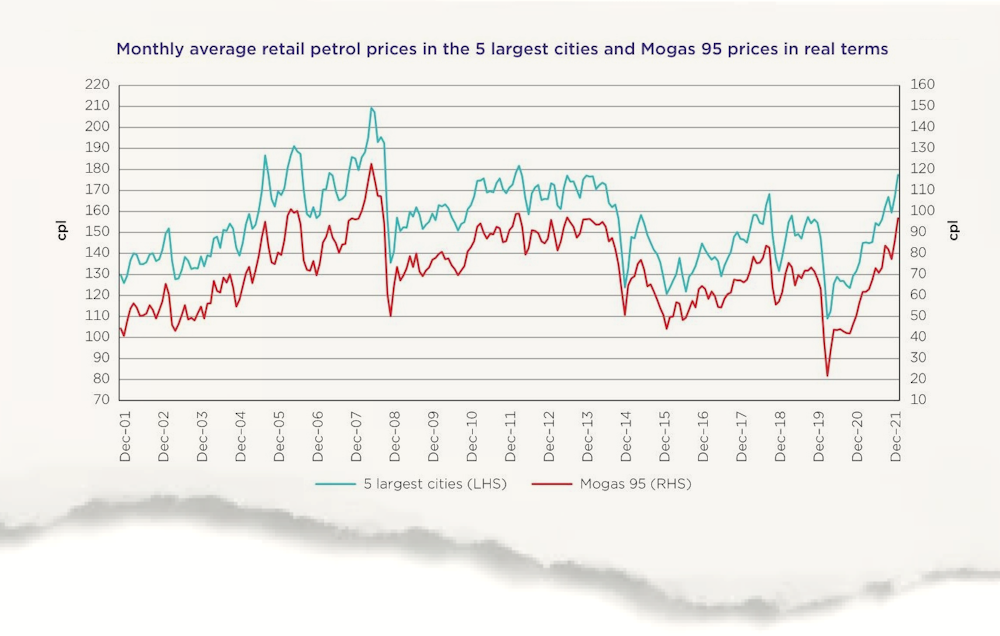
Australian Competition and Consumer Commission By setting the fuel excise lower when oil prices and high, and higher when oil prices are low, the government is acting like a big social insurance company. That’s part of their job (see Medicare, NDIS, unemployment benefits). But there’s a wrinkle to this. According to figures from the Bureau of Statistics’ Household Expenditure Survey, the bottom fifth of households by income spend $27 a week or 3.5% of their income on petrol. Read more: Budget 2022: Frydenberg has spent big – but on the whole, responsibly By contrast, the top fifth of households spend $42 a week or 1.8% of their income on petrol. So, a per litre cut in petrol benefits higher-income households more in dollar terms. It also doesn’t discourage people from driving less. It would be more progressive (and better for the environment) to just give all households a flat rebate. A good plan, well executed The tone at the budget press conference this year was in striking contrast to that at the announcement of the pandemic fiscal strategy in early 2020. Back then there were sharp questions about fiscal irresponsibility, leading then-Finance Minister Matthias Cormann to exclaim: “What would you have us do?” Made with Flourish This time, there were a series of relatively minor questions about whether Victoria was getting enough GST revenue or if medical students who studied in regional Australia would stay there. That is the consequence of a government that jettisoned decades of political branding in March 2022, laid out a compelling plan to get Australia through the pandemic, and delivered on it. Read more: Cheaper petrol, cash handouts in Morrison government's vote-buying budget Authors: Richard Holden, Professor of Economics, UNSW Sydney

Read more https://theconversation.com/josh-frydenbergs-budget-is-an-extraordinary-turnaround-but-leaves-a-40-billion-problem-180123

What to Do When an Older Car Is No Longer Worth Keeping in Melbourne

Ever looked at another repair quote and wondered whether your old car is still worth the trouble? It is a common turning point for Melbourne motoris...

Your Baby's First Year: A Local Guide to Feeding, Sleep, and When to Get Extra Support

Ask ten parents in a Brisbane mothers' group how their baby is feeding or sleeping, and expect ten different answers.  Someone's baby sleeps throug...

Kitchen and Laundry Makeover Ideas That Don't Require a Full Renovation

Full kitchen renos are expensive — and most people don't actually need one.  They need the kitchen to stop looking like it's stuck in 2009, or they...

How Technology Is Reshaping the Modern Australian Commercial Kitchen

The commercial kitchen has always been shaped by technology. Refrigeration changed how ingredients could be stored, modern ventilation transformed k...

The Number on a Roller Blind Fabric That Nobody Explains

Somewhere in the fabric book, next to the colour name, there is a percentage. Three per cent. Five per cent. Ten per cent. Nobody explains it, most c...

What’s Trending in Men’s Jewellery This Father’s Day!

Finding a Father’s Day gift that feels personal, stylish and genuinely wearable is not always easy. While socks and novelty mugs have traditionally ...

Road Signs: Understanding Their Role in Clear and Effective Signage

Effective signage and display hardware can help businesses communicate information, promote products and organise customer or visitor movement. Road...

Bottle Label Printing: Key Factors to Consider Before Your Next Packaging Run

Effective packaging begins with understanding the product, bottle material, artwork and production requirements when planning bottle label printing. H...

Planning a Long-Distance Move With Interstate Movers Melbourne

Moving between states involves more planning than a typical local relocation. Along with packing and transporting household belongings, you need to...

Understanding the Role of an I/O Controller in Industrial Automation

Modern industrial systems depend on accurate communication between sensors, machines and control systems. An I/O controller can help manage this commu...

How the Right Mining Hose Supports Demanding Operations

Mining environments place considerable demands on equipment used for material transfer, water management and processing. Hoses operating in these co...

Simple Ideas for Making Social Gatherings More Memorable

We have all been to those parties where everyone just stands around the kitchen island, staring at their phones, waiting for someone else to make a mo...

Outdoor Wall Lights: Improving Exterior Lighting Around Your Home

Lighting can influence how a room looks, feels and functions, so the right fitting should be selected according to both appearance and practical req...

Commercial Office Cleaning: Combining Routine Office Cleaning With Melbourne Service

Keeping a workplace clean requires a service that can accommodate everyday tasks as well as the particular needs of the business. Professional comme...

Caravan Sales in Queensland: How to Find the Right Caravan for Sale QLD

Caravan ownership is about more than having somewhere to sleep while travelling. For many Queenslanders, it is one of the best ways to explore regio...

What Sir Walter Buffalo Turf Actually Costs in 2026 (And Why Quotes Vary So Much)

Two quotes landed on a Hills District homeowner's kitchen table last spring for the exact same 80-square-metre backyard. One said $12 a metre. The o...

Nearly 1,300 NSW Hospital Beds Are Occupied By People Who Are Ready To Go Home

1,276 people in NSW hospitals have been medically cleared for discharge but remain in hospital because they're still waiting for NDIS or aged care sup...

National Survey Launched to Measure Operational Impacts of Federal NDIS Policy Reforms

The effects of recent NDIS reforms are beginning to move beyond policy papers and into day to day service delivery. A new national survey is asking ...
















