

Diplomacy is essential to a peaceful world, so why did DFAT's funding go backwards in the budget?
- Written by: Melissa Conley Tyler, Honorary Fellow, Asia Institute, The University of Melbourne
Earlier this month, Prime Minister Scott Morrison said Australia faces “its most difficult and dangerous security environment” since the second world war. Labor leader Anthony Albanese has made similar comments.
In 1949, shortly after the war, Australia invested 9% of the federal budget in development and diplomacy. If you applied that proportion today, the Department of Foreign Affairs and Trade would be more than seven times its current size.
In this week’s budget DFAT’s resourcing has gone backwards, with a small increase of A$124 million or 1.6% that is less than indexation. Funding for aid has increased but this is balanced by cuts to other parts of the portfolio, including diplomacy.
This is disappointing if you understand what diplomacy can do.
Read more: A cost-of-living budget: cuts, spends, and everything you need to know at a glance
‘Total war’ and Ukraine
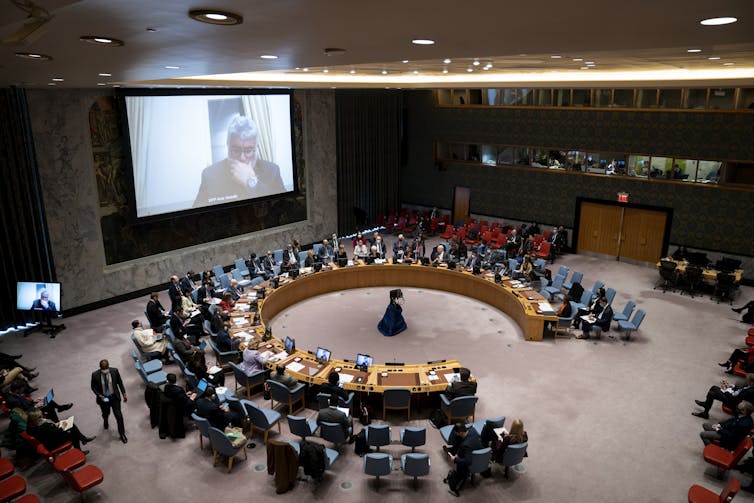
Let’s look at a situation we have watched play out over the last month: the coordinated international response to Russia’s invasion of Ukraine. This is a an example of diplomacy at work.
How did sanctions happen? Concerned countries spoke to other like-minded countries to agree an approach, then convinced others to come on board.
They persuaded countries like the United Kingdom and Italy they could live without Russian oligarchs, and even persuaded Switzerland to break its long-term practice of neutrality and impose sanctions.
They worked with the international banking system on cutting Russia off and shared information across countries to identify targets for individual sanctions.
Then came the snowball effect as other companies began to voluntarily exit Russia. The combined effect has been significant, described by a Russian spokesperson as akin to “total war”. Then we have the international condemnation of the invasion, including the overwhelming support for a UN Resolution demanding Russian withdrawal.
This is the work of diplomacy, an area Australian Institute of International Affairs National President Allan Gyngell recently described as being
as difficult, hard-edged and hard-headed as any dimension of government.
Compare the spend
We shouldn’t underestimate the importance of diplomacy to a country’s national interests, but we often do. If you look at the federal budget you get a sense of how little Australia invests in diplomacy and development.
For example, the government has announced an additional 18,000 people for the defence workforce. This increase alone is more than three times the entire staff responsible for diplomacy and development.
To put this in context, if this week’s federal budget was $100, we’d be spending $6 on defence, 72 cents on development and a copper coin on the practice of diplomacy.
Former ambassador James Wise has calculated that of the DFAT budget, only 10% is spent on its policy function after you take out the development program, passports, consular work and infrastructure.
The aid budget has grown
One good news story from the budget is that the international development program did get some love, after years of cuts. This includes:
A real increase in the development budget. This is via re-introduction of annual indexation, this year at 2.5%
Near-record funding to the Pacific, including a package of $324 million to deal with the social and economic costs of COVID-19
A $300 million program focused on women in Southeast Asia
Loans to Papua New Guinea and Indonesia for budget support
Increased humanitarian funding to the World Food Programme and Red Cross
Doubling Australia’s climate finance to $2 billion
It is heartening to see the development budget stabilising. This reflects a recognition that development programs have a huge role to play in shaping the world around us, from infrastructure to public health to climate to emergencies. It also suggests it is seen as a key part of Australia’s engagement with Southeast Asia and the Pacific.
But Australia is still way off the international target for developed countries of 0.7% of gross national income. Even with this week’s increases, Australia is at a low of 0.2%. A decade ago, it was 0.33%.
What is the bigger picture?
While there are positive signs in this budget, it’s important to see the bigger picture. Neither development nor diplomacy are being funded in a way that suggests they are viewed as vital tools for shaping a difficult and dangerous world. This puts Australia out of line with international trends.
The Lowy Institute and many others have long documented Australia’s diplomatic deficit and disrepair. Defence experts also now openly criticise the “woeful neglect of DFAT”, while the Australian Strategic Policy Institute has outlined the costs of this underinvestment:
Australia will be safer, richer, better regarded and more self-respecting if our diplomatic influence is enlarged, not if it remains stunted.
But this advocacy has not yet had an effect, leading former DFAT officer Mercedes Page to call in her post-budget analysis for an end to the “the familiar round of recriminations and calls for more funding”.
Instead of giving up, we should widen the debate so diplomacy and development are not seen as a niche issue, but one that affects all Australians. We all have a stake in not running down key planks in the way Australia interacts with the world.
In these difficult times, Australia needs to respect and resource all the elements of statecraft.
Authors: Melissa Conley Tyler, Honorary Fellow, Asia Institute, The University of Melbourne


















