

Modern Australian
The Times

More permanent skilled visas are a big deal. The government is heading in the right direction

  • Written by Henry Sherrell, Deputy Program Director (Migration), Grattan Institute

More permanent skilled visas are a big deal. The government is heading in the right direction

Migration didn’t rate a mention in Treasurer Josh Frydenberg’s budget speech. But the increase in Australia’s permanent skilled intake that Home Affairs Minister Alex Hawke announced on budget night is a big deal, and one that will leave Australians better off.

The government is shifting the composition of Australia’s permanent skilled migrant intake for 2022-23, moving back towards visas with a track record of selecting younger, skilled migrants best placed to succeed in Australia. At the same time, the total number of skilled visas on offer will rise to 109,900 – about 30,000 more than 2021-22 planning levels.

As the Grattan Institute’s 2021 report Rethinking permanent skilled migration showed, people who gain a permanent skilled visa to Australia typically live and work here for many decades. This means policy decisions affecting who gains a visa in the first place can have compounding effects over many years.

But there are still more changes needed to fix Australia’s migration program – including abolishing some visas programs that don’t make any economic sense, and simplifying the sponsorship process for businesses and migrants.
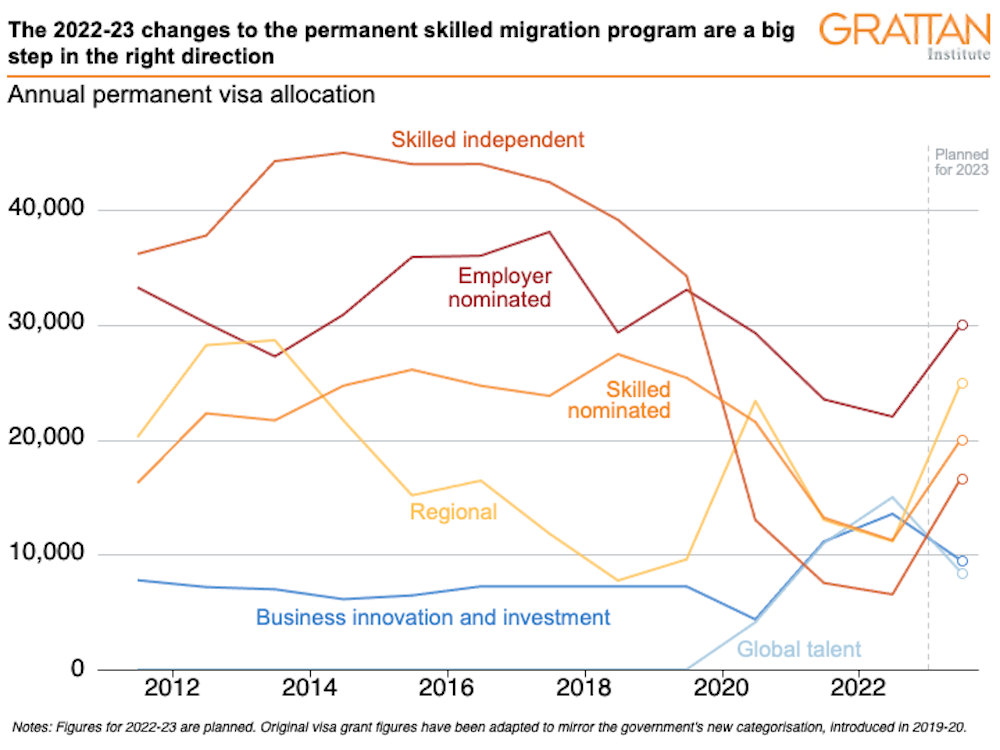
Australia migration intake by program, 2011 to 2023.
CC BY There’s a big increase in skilled worker visas The number of skilled worker visas – allocated via employer sponsorship or the points test – rises to 91,652 in 2022-23, up from 50,900 this financial year. This comes from both the increase in the number of visas and the composition shift described above. Employer sponsorship will increase 8,000 to a total of 30,000 permanent skilled visas, and the points-tested Skilled Independent category has been tripled to 16,652 visas. Migrants selected through these programs are highly skilled, and typically earn higher incomes than Australians of similar ages. They also generate a much larger economic benefit to the Australian community. For instance, Treasury estimates primary holders of permanent employer-sponsored visas pay $557,000 more in taxes than they receive in public services and benefits over their lifetimes. Primary holders of Skilled Independent visas pay $386,000 more in taxes than they can expect to receive in return. Business investment visas scaled back Australia’s “buy a visa” scheme, the poorly functioning Business Innovation and Investment Program (BIIP), has been cut from 13,500 visas to 9,500. It should be abolished. Few investors are financing projects that would not otherwise occur. Few are providing entrepreneurial acumen that will benefit the Australian community, because they are typically less skilled and speak little English. Grattan Institute research shows people who get this visa are older and earn significantly less than other skilled migrants. Treasury research published in December 2021 showed each primary visa holder costs Australian taxpayers an average of $117,000 over their life in Australia, due to paying less in tax than their draw on government services and benefits. The government’s decision to shrink the Business Innovation and Investment Program and reallocate places elsewhere will eventually save taxpayers about $1 billion from this year’s intake alone. That’s a valuable gain for a government grappling with the long-term costs of the pandemic and an ageing population. Global talent program shrunk The Global Talent visa program for highly skilled professionals has also been scaled back, from 15,000 to 8,448 places. Attracting global talent is a worthy goal, but the mechanisms used to select migrants for the program remain unproven. There are few rules – applicants don’t require a sponsoring employer or a firm salary offer – and the rules that do exist are often arbitrary and hard to administer. We don’t know who is being selected or what their incomes are. Until a more robust evaluation is conducted, scaling back this visa is a good idea. What the government should do next The federal government has committed to reviewing the occupation lists that dictate what jobs are eligible for skilled migration visas. It should just scrap them. These occupation lists are cumbersome, vulnerable to lobbying and ineffective. Instead, employers should be subject to a wage threshold of $70,000 to sponsor workers on a temporary visa and $80,000 to sponsor workers on a permanent visa. Sponsored workers should be paid the equivalent of what Australian workers are paid, to prevent wages being undermined. Read more: It's time Australia dumped its bureaucratic list-based approach to temporary work visas These changes would better target visas to people with the most valuable skills, and simplify the sponsorship process for firms and migrants. Points-tested visas, which assess prospective migrants based on their age, qualifications, skills and English proficiency, should be independently reviewed to ensure they give priority to younger, higher skilled workers. Points should be allocated only for characteristics that suggest an applicant will succeed in Australia. While state-nominated and regional visa holders do better than investors, they still earn substantially lower incomes than employer-sponsored or independent points-tested visa holders. Australia’s debates about migration policy tend to focus too much on the size of the intake, and not enough on who we choose. But even though it might not have made huge headlines on budget night, our skilled migration program has just taken a big turn for the better. Authors: Henry Sherrell, Deputy Program Director (Migration), Grattan Institute

Read more https://theconversation.com/more-permanent-skilled-visas-are-a-big-deal-the-government-is-heading-in-the-right-direction-180324

Celebration of Life vs Traditional Funeral: What's the Difference?

When saying goodbye to someone you love, there is no single way to honour their life. Every family has different traditions, beliefs, and preference...

Building Approval for Roofing Projects: What Homeowners Need to Know

Roofing projects are an important part of maintaining and protecting your home. Whether you're repairing storm damage, replacing an ageing roof, or ...

Chatswood Tutoring And Its Role In Academic Achievement

Academic success often requires more than classroom attendance alone. Students face increasing expectations as they progress through school, particu...

Why Laser Hair Removal Treatments Continue Growing In Popularity

Managing unwanted hair can become time-consuming and frustrating for many people, especially when shaving, waxing, and other temporary methods requi...

Choosing the Right Devices for a Flexible Workplace

For IT leaders managing large fleets, the device layer is where workforce productivity and security policy meet. The shift towards flexible and hybrid...

How Business Advisory Services Help Companies Achieve Sustainable Growth

Every business owner aims to build a profitable and sustainable organisation. While dedication, innovation, and hard work are important, achieving l...

Why Body Contouring Has Become A Popular Cosmetic Treatment

Many people maintain healthy lifestyles through regular exercise and balanced eating habits but still struggle with stubborn areas of fat that are d...

How to Choose the Right POS Hardware for Your Business in Australia

A lot of Australian business owners spend weeks researching POS software but buy hardware almost as an afterthought. That's a mistake. The wrong har...

Why Material Handling Hose Is Critical for Industrial Efficiency

A high-performance material handling hose is an essential component in industries that transport abrasive, dry, or bulk materials on a daily basis...

How to Choose the Right Lawyer in Melbourne for Your Situation

Choosing legal support can feel difficult, especially when the stakes are personal or business-related. The right lawyer in Melbourne should underst...

Hoteliers Look to Clever Value Adds to Increase Revenue

The Australian hospitality industry is still in recovery mode after a notoriously rough patch in recent years. While there has been a post-COVID tra...

Moving to Queensland? Here’s How to Prep Your Car for the Big Move North

There’s no sign of the northern migration slowing down, with thousands of southerners fleeing from chaotic lifestyles and cooler climates for a brig...

Diesel Shortage to Impact Trades and Contractors

Strait of Hormuz blockage affecting all major parts of trades and construction Trades and construction across residential, commercial and industria...

Why Holiday Home Owners Turn to Rental Management Agents

The Allure — and the Reality — of Renting Out Your Property Owning a holiday home is a dream for many Australians. Whether it's a beachside sha...

Why Finding Reliable Doctors In Bundoora Is Important For Long-Term Health

Access to quality healthcare plays an important role in maintaining overall wellbeing and managing health concerns early. Trusted Doctors in Bundoor...

Understanding the Different Types of Car Services: Minor vs Major

When it comes to car maintenance, one of the most important things every vehicle owner should understand is the difference between a minor and a maj...

How Superannuation and TPD Insurance Work Together

Superannuation is an essential part of financial planning in Australia. It is designed to provide individuals with income during retirement, helping...

Tiny Towns funding granted for Mt Hotham and Mt Buller upgrades

Alpine Resorts Victoria (ARV) has welcomed funding support from the Victorian Government’s  Tiny Towns Fund, with both Mt Hotham and Mt Buller se...

















