

Six months after marriage equality there's much to celebrate – and still much to do
- Written by: Paula Gerber, Professor of Human Rights Law, Monash University
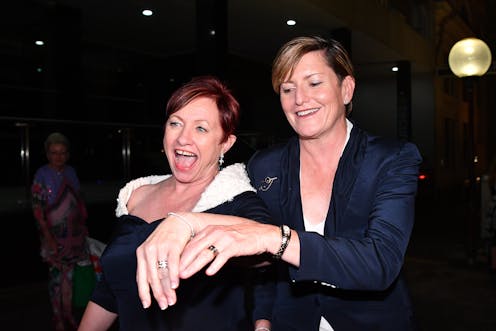
It has been six months since Australia declared that marriage is no longer an exclusively heterosexual institution. In that time, approximately 2,500 same-sex couples have been married, with NSW having the most weddings, closely followed by Victoria and Queensland. Many more couples, who married overseas before marriage equality was achieved here, have finally had their marriages recognised under Australian law.
The 2016 Census revealed that there are 46,800 same-sex couples living together in Australia. Of these couples, 3,142 reported they were the husband or wife of someone of the same sex (presumably because they were married overseas). If we combine this figure with the number of same-sex marriages registered in the last six months, it appears that over 10% of same-sex couples who live together are now married.
What’s changed?
During the postal survey, the “No” campaign warned of dire consequences if the institution of marriage was opened up to non-heterosexual couples. There was a stream of ads asserting that boys would start wearing dresses to school, students would role-play being in same-sex relationships, and radical LGBT sex and gender education would become mandatory. Safe Schools – a national program to combat bullying of LGBT students – came under particularly heavy and sustained attack.
Read more: How the Anglican Church has hardened its stance against same-sex marriage
So have any of these fears been realised? The answer seems to be a resounding “no”. If anything, education about sexual orientation and gender identity within schools is becoming more restricted.
For example, the South Australian government has ceased to fund the Safe Schools program, two years before the service provider’s contract was due to expire. As a result, that program will end in secondary schools on July 13. The government has indicated that it will be replaced with a general anti-bullying program, but this fails to recognise that LGBTI people have significantly poorer mental health and higher rates of suicide than other Australians because of the discrimination and bullying they are subjected.
In Victoria, Opposition Leader Matthew Guy has vowed to scrap the Safe Schools program if the Coalition wins the next election. So rather than marriage equality being the catalyst for more inclusive education, the opposite may be true.
The campaign around the marriage equality survey also saw opponents assert that allowing same-sex couples to marry would lead to a significant infringement on religious freedom. To allay these concerns, the Turnbull government initiated an inquiry into whether Australian law adequately protects religious freedom. The panel delivered its report last month, but the government has not yet released it to the public.
There is concern among human rights advocates that rather than limiting the exemptions that religious organisations currently enjoy from anti-discrimination laws, the government will expand the extent to which people can legitimately be discriminated against on the basis of sexual orientation or gender identity.
Such concerns are not baseless, if the American experience is anything to go by. In the US, once opponents of marriage equality had lost that battle, they shifted their focus to arguing that service providers who have religious beliefs that reject homosexuality should be allowed to treat LGBTIQ people less favourably. This was the argument run in the US Supreme Court case of Masterpiece Cakeshop, in which a Colorado baker refused to make a wedding cake for a same-sex couple.
Although the Supreme Court upheld the claim of the baker, it did so on the narrow ground that the Colorado Civil Rights Commission handled the original discrimination complaint against Masterpiece Cakeshop in a biased and unfair manner. The judges were very clear in stating that service providers should not be entitled to refuse to provide goods or services for same-sex weddings. Justice Kennedy noted that allowing discrimination against same-sex couples would cause:
a community-wide stigma inconsistent with the history and dynamics of civil rights laws that ensure equal access to goods, services, and public accommodations.
The Australian Christian Lobby has already suggested that this decision lends support to their argument that bakers, florists, motels and even lawyers should be able to refuse to provide goods and services in connection with same-sex weddings.
However, as my colleague Luke Beck observed, there is nothing in the Masterpiece Cakeshop decision to support that position. On the contrary, “The Masterpiece case says that people who are accused of discrimination are entitled to a fair hearing and that gay people are entitled to dignified treatment.”
More to be done
Amending the Marriage Act to allow same-sex couples to wed was a significant step forward. But it is not a panacea. Law reform alone will never lead to true equality. South Africa is a stark reminder of this. It has had constitutional protection against discrimination on the basis of sexual orientation and gender identity since 1996, but it is still an extremely dangerous place for LGBT people, with high rates of violent hate-based crimes. A 2017 report found four out of ten LGBT South Africans knew someone who had been murdered “for being or suspected of being” lesbian, gay, bisexual or transgender.
Read more: On marriage equality, Australia's progressive instincts have been crushed by political failure
In Australia, the reform of marriage laws that we witnessed six months ago is just one piece of the jigsaw puzzle, albeit an important one. But equally important is changing the hearts and minds of individuals who continue to oppose equal rights for LGBT people.
Amending laws contributes to transforming public opinion, but achieving long term change requires a more holistic approach. The elimination of discrimination against LGBT people won’t be achieved until we have increased positive representation of sexual and gender diversity in films], education, the media and from religious leaders.
We will know we have achieved true equality for LGBT people when we not only have laws that prevent a person being fired from their job or denied a service because of their sexual orientation or gender identity, but we also no longer have people arguing that they should be entitled to do so.
Authors: Paula Gerber, Professor of Human Rights Law, Monash University


















