

Modern Australian
The Times

What would it take to get Australians to buy electric cars? Canberra provides a guide

  • Written by Yogi Vidyattama, Associate Professor, National Centre for Social and Economic Modelling, University of Canberra
What would it take to get Australians to buy electric cars? Canberra provides a guide

Only 5,532 of the 101,233 new cars sold in Australia last month were all-electric.

While that number is an improvement on previous months, it is tiny compared to the 25% to 85% of new cars sold that are all-electric in European nations such as Germany, the Netherlands, Denmark and Norway.

A lot has been written about why that is, but less about what an individual state or territory can do to improve it, in the absence of help from the federal government.

Our team at the National Centre for Social and Economic Modelling, University of Canberra has examined what the Australian Capital Territory (ACT) is doing, and what effect this is having on electric vehicle take-up by price and type of household.

The ACT offers three incentives

  • a full exemption from stamp duty on purchase

  • two years free registration

  • a zero-interest loan of up to A$15,000 for eligible households

We used Australian Bureau of Statistics census and household expenditure data as well as microsimulations based on a survey of vehicle preferences to examine behaviour before and after the changes.

We simulated the decision to buy electric based on a total cost of ownership, which included the value of the vehicle as well as operational costs including petrol, service and repair.

Incentives matter

Our modelling found that with a stamp duty exemption, at an electric vehicle price of A$50,000, around 9% of new vehicles sold would be electric in five years.

The proportion climbs to 11% with zero-interest loan and free registration added.

But even after five years, the proportion of total cars on ACT roads that were electric would be small: just 1.6% with just the stamp duty exemption, and 2.0% with the other measures as well.

This result is much higher than the latest-known proportion of electric vehicles in the ACT, which in 2019 was 0.1%. Nationally, only 23,000 (0.011%) of the 20.1 million vehicles registered are electric.

Prices matter

At a much-lower electric vehicle price of $25,000, an extraordinary 23% of new vehicles sold after five years would be electric, provided they were stamp duty exempt.

If there was also a zero-interest loan of $15,000, the proportion would increase to 27%, and with two years free registration as well, to $30%.

As a proportion of the entire car fleet in the ACT, the figures would be 4.1%, 4.8% and 5.3% respectively, depending on those price, loan and registration factors. That would mean much larger demand than at present, but still small enough to mean the infrastructure for maintaining conventional vehicles would be needed for some time.

Income matters

We found that high income households are far more likely to replace their cars within five years and far more likely to switch electric even without incentives – and that for them, the incentives didn’t make much difference.
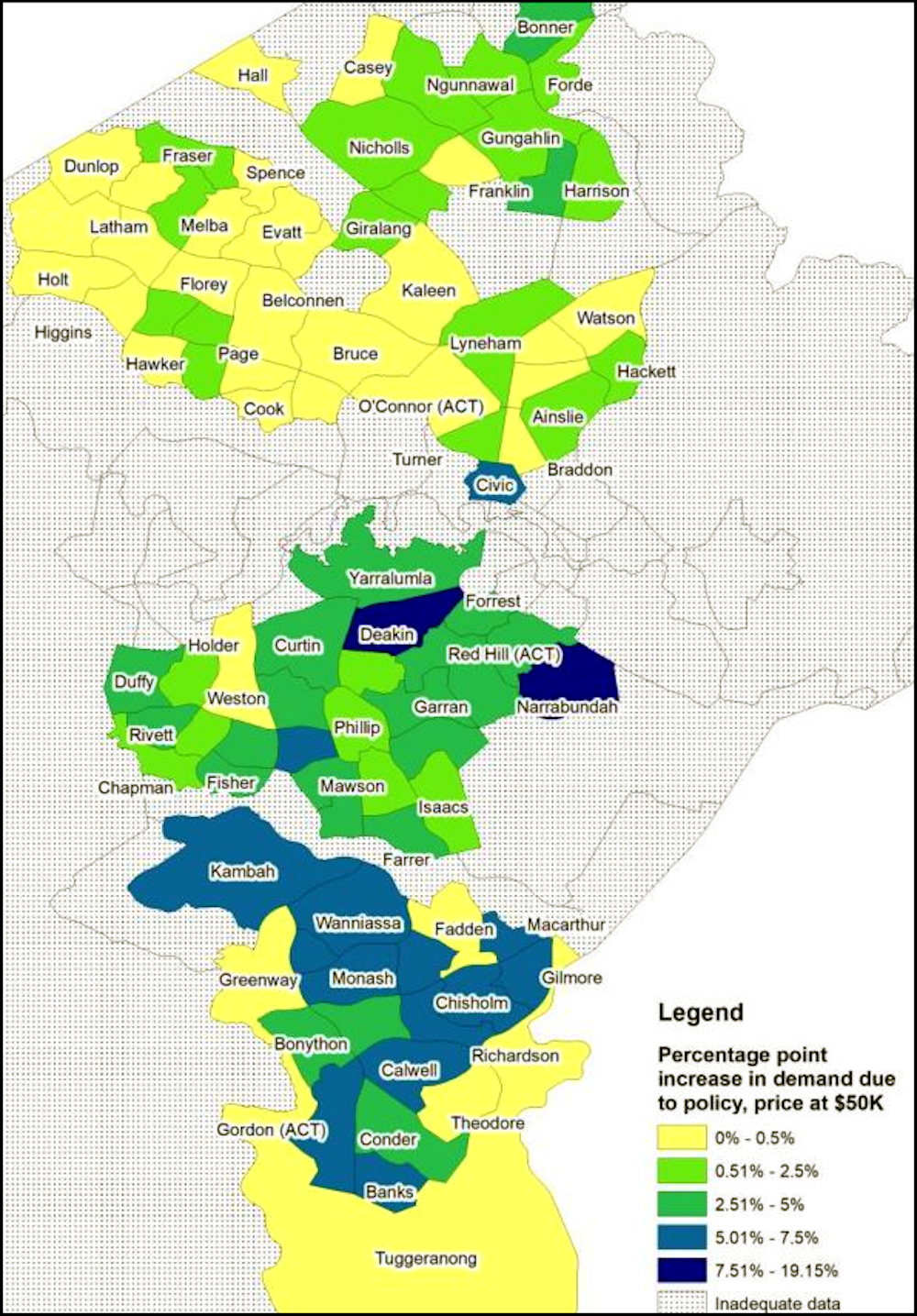
NATSEM, Impact simulation of ACT EV policy The incentives had their biggest impact, not among the highest earning three-fifths of households, or among the bottom fifth, but in the second-bottom fifth. For that group, the interest-free loan was found to be more important than the free registration, whereas for higher income households it was the other way around. In terms of geography, the highest take up is set to be in Canberra’s inner north and south where incomes are high. Nevertheless, our modelling also suggests a high take up in the south of Canberra. Petrol matters And the take-up rate depends on the price of petrol. The price used in our modelling was the 2018-19 price of around $1.45 per litre for unleaded and diesel. Our modelling suggests that the recent increase in price to around $2 a litre would lift the purchase of electric vehicles by 0.5 percentage points, while an increase to $3 would increase take-up by around 2.5 percentage points. Different states are experimenting with different incentives. Victoria, NSW and Queensland are offering $3,000 rebates on the purchase price, along with a registration discounts in Victoria offset by a road user charge. Read more: The embarrassingly easy, tax-free way for Australia to cut the cost of electric cars What applies to the ACT might not apply elsewhere, especially as average incomes in Canberra are higher than in other cities. But our modelling provides a guide as to how incentive-based policies can work. Policies that increase the electric vehicle take-up in lower income households are likely to have the greatest effect, and also likely to benefit these households by freeing them from the need to pay for fuel. Authors: Yogi Vidyattama, Associate Professor, National Centre for Social and Economic Modelling, University of Canberra

Read more https://theconversation.com/what-would-it-take-to-get-australians-to-buy-electric-cars-canberra-provides-a-guide-178778

Why Regular Skills Updates Are Essential for Licensed Security Officers

A guard at a Brisbane shopping centre gets a call about a shoplifter who's turned aggressive.  They’ve done the job for six years. But their de-...

10 Benefits of Choosing Professional Tutoring Penrith Services

Every student has unique learning strengths, challenges, and academic goals. While classroom teaching provides essential knowledge and structure, so...

Sunshine Coast Baby Classes Prove Big Hit Among First-Time Mums

There's a movement gaining traction on the Sunshine Coast, providing a village of support, socialisation and relief for first-time mothers and babie...

Father's Day Gift Ideas for Men Who Are Hard to Buy For

Some dads are easy to buy for. Others do not want anything, already have everything, or give you the classic "don't worry about me" answer every yea...

Top 5 Mistakes That Wear Out Your Brakes Faster

Brakes don't need frequent replacements like oil changes do.   But a lot of the wear happens quietly, over months, because of habits most drivers...

Plantation Shutters vs Curtains: Which Is Better for Your New Home?

Moving into a new home is an exciting opportunity to personalise your space and make it your own. While many homeowners focus on furniture, flooring...

Celebration of Life vs Traditional Funeral: What's the Difference?

When saying goodbye to someone you love, there is no single way to honour their life. Every family has different traditions, beliefs, and preference...

Building Approval for Roofing Projects: What Homeowners Need to Know

Roofing projects are an important part of maintaining and protecting your home. Whether you're repairing storm damage, replacing an ageing roof, or ...

Chatswood Tutoring And Its Role In Academic Achievement

Academic success often requires more than classroom attendance alone. Students face increasing expectations as they progress through school, particu...

Why Laser Hair Removal Treatments Continue Growing In Popularity

Managing unwanted hair can become time-consuming and frustrating for many people, especially when shaving, waxing, and other temporary methods requi...

Choosing the Right Devices for a Flexible Workplace

For IT leaders managing large fleets, the device layer is where workforce productivity and security policy meet. The shift towards flexible and hybrid...

How Business Advisory Services Help Companies Achieve Sustainable Growth

Every business owner aims to build a profitable and sustainable organisation. While dedication, innovation, and hard work are important, achieving l...

Why Body Contouring Has Become A Popular Cosmetic Treatment

Many people maintain healthy lifestyles through regular exercise and balanced eating habits but still struggle with stubborn areas of fat that are d...

How to Choose the Right POS Hardware for Your Business in Australia

A lot of Australian business owners spend weeks researching POS software but buy hardware almost as an afterthought. That's a mistake. The wrong har...

Why Material Handling Hose Is Critical for Industrial Efficiency

A high-performance material handling hose is an essential component in industries that transport abrasive, dry, or bulk materials on a daily basis...

How to Choose the Right Lawyer in Melbourne for Your Situation

Choosing legal support can feel difficult, especially when the stakes are personal or business-related. The right lawyer in Melbourne should underst...

Hoteliers Look to Clever Value Adds to Increase Revenue

The Australian hospitality industry is still in recovery mode after a notoriously rough patch in recent years. While there has been a post-COVID tra...

Moving to Queensland? Here’s How to Prep Your Car for the Big Move North

There’s no sign of the northern migration slowing down, with thousands of southerners fleeing from chaotic lifestyles and cooler climates for a brig...

















