Google AI


Modern Australian

Colonial and nationalist myths are recast in Yumna Kassab's Australiana

  • Written by: Clare Archer-Lean, Senior Lecturer, English, University of the Sunshine Coast
Colonial and nationalist myths are recast in Yumna Kassab's Australiana

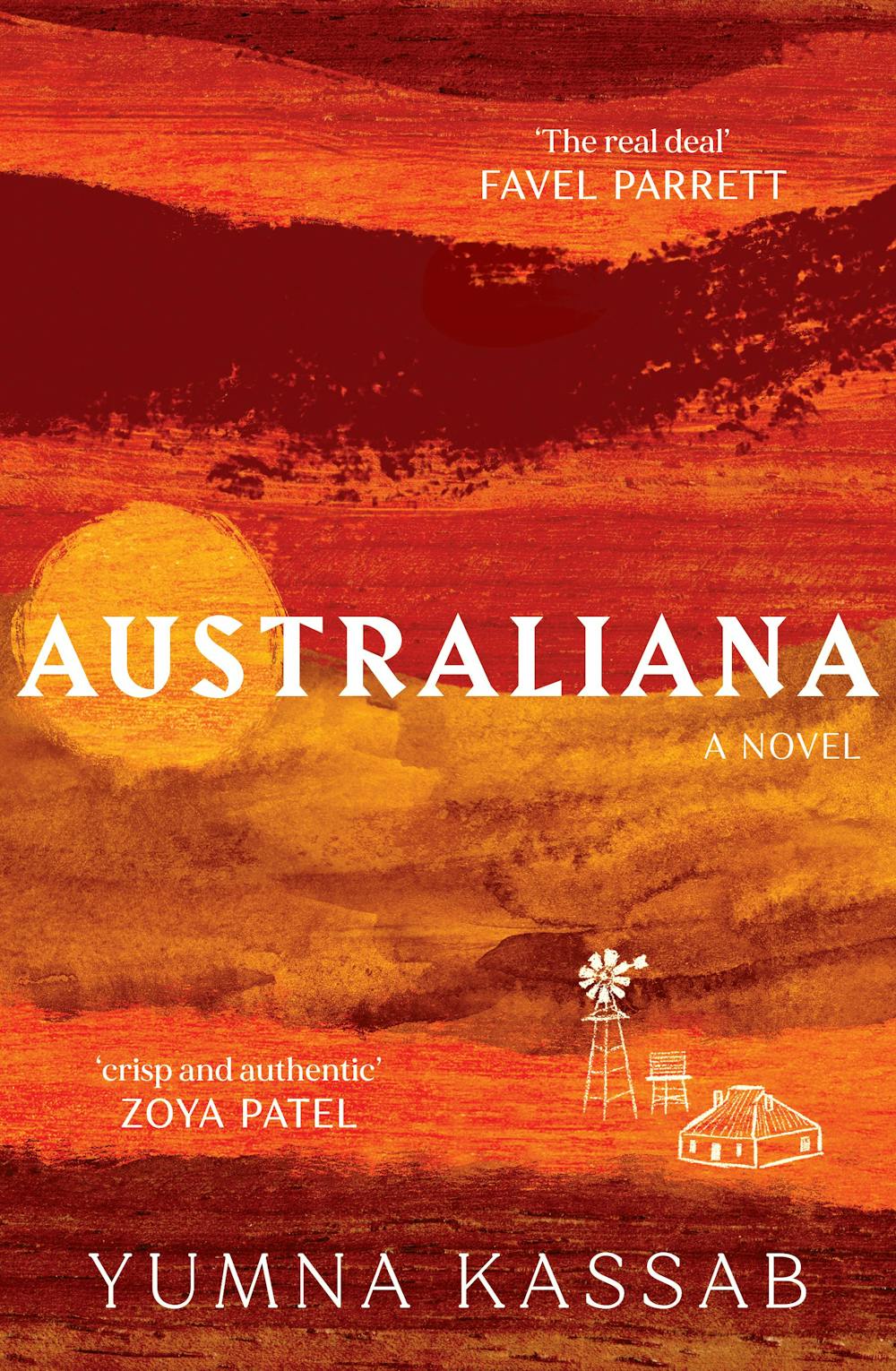
Yumna Kassab’s Australiana: A Novel is mostly set in an unnamed regional town, likely Tamworth, in northern NSW and in other nearby locations like Barraba, Uralla and the Pilliga. It tells of the lives of ordinary people, their relationships with the land and homes in which they dwell, the objects in which they seek solace, their hopes and losses.

Review: Australiana: A Novel – Yumna Kassab (Ultimo Press)

My parents migrated to this region when I was a few weeks old, and I spent my formative years in close vicinity to Australiana’s setting. I opened the book with trepidation. Would I recognise this rendering of the place in which I was raised? A place I left, like other rural and regional Australians, and indeed characters in the book. A community that has, arguably, become peripheral to the contemporary Australian cultural imagination, which has sought to replace the cultural cringe with an insistence on the richness of metropolitan life and the freedoms of the beach. Kassab is not a regional NSW “local”. She primarily grew up in in western Sydney and wrote the novel during a three-year stint teaching secondary-school science in Tamworth. Australiana is her second book, following her debut collection The House of Youssef (2019), which depicts the lives of several generations of Lebanese immigrants in a sparse, minimalist realism. In Australiana, Kassab continues her austere representation of the connections and unspoken traumas of the communities in which she resides. The book consists of five sections, each with a series of thematically interconnected vignettes. Many are only a few pages long, some just a few lines. The mix of genres is arresting, including understated realist tales of quotidian regional lives, mock fairy tale, simulations of a school-reader style, gothic horror, poetry, and moments when the conventions of syntax and grammar are jettisoned completely. There are tales of a stolen spoon, op-shopping, a couch, car accidents, monuments, murals and the memorialised, hauntings, roadkill, suicide and murder. Read more: Trauma and loss define Mandy Beaumont's unapologetically feminist debut novel An ecosystem of stories Australiana is subtitled “a novel”, but, while unified by region and tropes, there is no linear narrative or cohesive narrator. Stories are variously told omnisciently, in the first-person, and occasionally in the second-person. They assume the perspectives of the very old, the very young, the middle-aged, and the long dead. Kassab has cited Arab storytelling traditions and One Thousand and One Nights as influences on this evocative interweaving of discrete stories. She prefers the term “ecosystem”, deploying her scientist’s understanding of a cyclical and mutually dependent world of living and nonliving entities. Yumna Kassab Photo: Tiger Webb. Many of the stories pick up an object or character from the previous tale, shifting perspective to reveal the connections within the community and, ironically, the judgements and feelings of isolation that can obfuscate a deep connectedness. They invariably open mid-occurrence, giving the impression of individuals already overcome by events: “He’d been counting on a light day”; “Her surgery had been yesterday”; “The truck got stuck under the bridge and they all agreed they should have known better”; “Outside there is glass breaking”. Australiana’s style is economical. This is true of even Kassab’s more radical departures from realism. The vignettes have a fable-like succinctness, but there is no clear moral, beyond the compulsion to witness. Kassab’s rendering of life in rural NSW is empathetic and canny, and the precision of the prose recalls the expertly executed short fiction of Australian authors like Laura Elvery and Nam Le. “Mob Justice” tells of a town taken over by kangaroos, koalas and echidnas deprived of water, shade and nourishment by reckless council irrigation policy. It is a story that reflects the increasingly meaningless distinction between town and wilderness in an age of escalating development and depleted resources. The action is conveyed in controlled minimalist tones, until a succinct denouement where animal guerrilla tactics dispossess the townsfolk. “Speed Dating”, just four anaphoric lines, is breathtaking in its tragic familiarity: a memorial to the senselessness of young lives lost in small communities to road accidents, and more fundamentally to boredom and desire. The longest continuous narrative is “The Pilliga”, a series of 50 vignettes, narrated by a guileless unnamed protagonist who is lost with fellow sojourners in the barren Pilliga. Space, time and morality collapse in this waterless landscape, where the haunting, privation and violence are reminiscent of Cormac McCarthy’s apocalyptic visions. The more realist tales – some quotidian, some horrifying – are also unsettling. They recount a child-murderer’s disturbingly philosophical justifications, bored teens’ petty crime, a child’s interpretation of adult conflict, the burning of books, marital micro- and macro-aggressions. Read more: Ambiguity and amorality: is Douglas Stewart's Ned Kelly one of Australia's great forgotten plays? Playing with national myths “Australiana”, the term, conventionally conjures a kitsch (and marketable) Australianness. It evokes icons for tea towels that reflect a colonialist and nationalist imaginary: the bushranger, the drover, the swagman, meat pies, boomerangs, koalas, lamingtons and gum leaves. Kassab divests these archetypes of their original mythos. Animals are not decorative; they are named, feel pain and revolt. Contemporary descendants of the iconic Australian bushman are not defined by a sure masculinity; they are complex, sensitive, railing against a new order, consumed by private suffering and caught in a climate crisis. When famed Uralla bushranger Captain Thunderbolt appears, he is no larrikin hero. He despairs at living in Ned Kelly’s shadow. The Death of Captain Thunderbolt - Samuel Calvert (1870) Public domain Australiana’s title is a homage to Don DeLillo’s Americana (1971). Like her American influence, Kassab aims to make the nation her “canvas”. Given this broad intent, Australiana is strangely lacking in cultural diversity. The strength of First Nations’ communities is fundamental to Australian life, and on this Country, the Kamilaroi and Anaiwan presence is vital. Regional areas are shaped by non-Anglo influences and multicultural community activity. Such considerations are mostly absent from Australiana, neutralised by the detached minimalism of the narration. Characters are often nameless and interiorised. I am not convinced that Kassab ever reconciles the tension between speaking to all things Australian and the silences that result from such minimalism, which both debunk and enact a unifying assemblage of types. But Australiana, importantly, does restore attention to aspects of regional Australian life. The drought has had a devastating effect on regional areas. Water, when it comes, wreaks havoc on land parched by extreme drought and soil erosion. Prosperity is precarious. Like Jane Harper’s The Dry (2016) – a novel quite different in form – Australiana demonstrates that such an existence can result in despair, but also community bonding. Australiana plays with myths of Australian bush life while simultaneously restoring focus on the stories of those who live their lives in the regions. I recognise my young self and those I lived among in its pages. Many of us appear in Australiana, along with warnings of what we might become. Kassab’s book is unnerving, but as a distillation of regional life it is both eerily resonant and innovative. Authors: Clare Archer-Lean, Senior Lecturer, English, University of the Sunshine Coast

Read more https://theconversation.com/colonial-and-nationalist-myths-are-recast-in-yumna-kassabs-australiana-178881

What to Do When an Older Car Is No Longer Worth Keeping in Melbourne

Ever looked at another repair quote and wondered whether your old car is still worth the trouble? It is a common turning point for Melbourne motoris...

Your Baby's First Year: A Local Guide to Feeding, Sleep, and When to Get Extra Support

Ask ten parents in a Brisbane mothers' group how their baby is feeding or sleeping, and expect ten different answers.  Someone's baby sleeps throug...

Kitchen and Laundry Makeover Ideas That Don't Require a Full Renovation

Full kitchen renos are expensive — and most people don't actually need one.  They need the kitchen to stop looking like it's stuck in 2009, or they...

How Technology Is Reshaping the Modern Australian Commercial Kitchen

The commercial kitchen has always been shaped by technology. Refrigeration changed how ingredients could be stored, modern ventilation transformed k...

The Number on a Roller Blind Fabric That Nobody Explains

Somewhere in the fabric book, next to the colour name, there is a percentage. Three per cent. Five per cent. Ten per cent. Nobody explains it, most c...

What’s Trending in Men’s Jewellery This Father’s Day!

Finding a Father’s Day gift that feels personal, stylish and genuinely wearable is not always easy. While socks and novelty mugs have traditionally ...

Road Signs: Understanding Their Role in Clear and Effective Signage

Effective signage and display hardware can help businesses communicate information, promote products and organise customer or visitor movement. Road...

Bottle Label Printing: Key Factors to Consider Before Your Next Packaging Run

Effective packaging begins with understanding the product, bottle material, artwork and production requirements when planning bottle label printing. H...

Planning a Long-Distance Move With Interstate Movers Melbourne

Moving between states involves more planning than a typical local relocation. Along with packing and transporting household belongings, you need to...

Understanding the Role of an I/O Controller in Industrial Automation

Modern industrial systems depend on accurate communication between sensors, machines and control systems. An I/O controller can help manage this commu...

How the Right Mining Hose Supports Demanding Operations

Mining environments place considerable demands on equipment used for material transfer, water management and processing. Hoses operating in these co...

Simple Ideas for Making Social Gatherings More Memorable

We have all been to those parties where everyone just stands around the kitchen island, staring at their phones, waiting for someone else to make a mo...

Outdoor Wall Lights: Improving Exterior Lighting Around Your Home

Lighting can influence how a room looks, feels and functions, so the right fitting should be selected according to both appearance and practical req...

Commercial Office Cleaning: Combining Routine Office Cleaning With Melbourne Service

Keeping a workplace clean requires a service that can accommodate everyday tasks as well as the particular needs of the business. Professional comme...

Caravan Sales in Queensland: How to Find the Right Caravan for Sale QLD

Caravan ownership is about more than having somewhere to sleep while travelling. For many Queenslanders, it is one of the best ways to explore regio...

What Sir Walter Buffalo Turf Actually Costs in 2026 (And Why Quotes Vary So Much)

Two quotes landed on a Hills District homeowner's kitchen table last spring for the exact same 80-square-metre backyard. One said $12 a metre. The o...

Nearly 1,300 NSW Hospital Beds Are Occupied By People Who Are Ready To Go Home

1,276 people in NSW hospitals have been medically cleared for discharge but remain in hospital because they're still waiting for NDIS or aged care sup...

National Survey Launched to Measure Operational Impacts of Federal NDIS Policy Reforms

The effects of recent NDIS reforms are beginning to move beyond policy papers and into day to day service delivery. A new national survey is asking ...