

'Is this really fair?' How high school students feel about being streamed into different classes based on 'ability'
- Written by: Olivia Johnston, Lecturer, Edith Cowan University
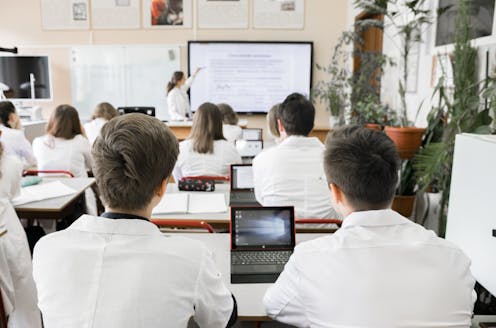
Many Australian schools still use “streaming”, where students are separated into classes based on ability. However, not all students see streaming as beneficial.
My research, published in the journal Research Papers in Education, found streaming caused some students to feel unduly pressured, privileged, disempowered, and misunderstood.
Some students in higher-ability classes said they felt more confident and motivated, but students in lower streams reported conforming to teachers’ low expectations for achievement.
Read more: Selective schools mainly 'select' advantage, so another one won't ease Sydney's growing pains
Students see less opportunity in lower streams
In Australia, there is no official educational policy on streaming (also known as tracking, setting, or “between-class ability grouping”). Schools make local decisions about if and how to stream students.
My recent research in Western Australia shows students themselves can experience the inequity embedded in streaming. I followed 25 year 10 students across their school days for one week of school. I did more than 100 interviews with the students and conducted 175 classroom observations.
The research revealed some students in lower streams found their learning opportunities were limited. Student in the higher streams had different exams, assignments, grading, and excursions than students in lower streams.
Ryan* discussed how in the higher stream, they “got to build roller coasters” while students in the lower stream were “just building bridges.”
Students also expressed frustration their capacity to succeed was limited by streaming.
Jerome said that in a lower streamed class
The highest mark you can get in that class is a C!
Moving up between streams highlighted the difference for students too. Curt remembered it was like he “skipped a year.”
Krissy said “there is a big gap of knowledge” when you “move up” to a higher stream.
Some students in higher streams welcomed the challenge of more difficult learning and extra opportunities. They felt motivated by the additional opportunities and, as Jenny put it, “wanted to be pushed” because it made them “feel good about themselves.”
For other students, streaming felt restrictive. These students felt their teachers saw them in a way that didn’t match how they saw themselves.
Not seen as individuals
Many students felt their teachers had conceptualised their ability because of the streamed class they were in, rather than seeing them as individuals.
Being expected to perform at a higher level academically felt constrictive and unwelcome for some students.
Jessica, for instance, resisted being told to do more difficult work in higher streams. When her teacher told her the work she was doing was Year 11 work she responded by thinking
Why can’t we do Year 10 work? What happened to the Year 10 work?
Other higher stream students also felt unmotivated by being assigned work they found too difficult. Rochelle avoided her maths teacher and the learning, saying:
Some of the math, she’s like doing stuff on the board and I’m just like [wide eyes] oh my God. This is too hard […] If I don’t get it, I’m like, I lose motivation.
Students in lower streams complied with their teachers’ low expectations for learning. Jerome said his teacher
[…] understands what class we’re in, like everyone’s just, no one really cares. So she does understand if I don’t really focus that much.
Many of these students felt they didn’t fit in with the teachers’ homogeneous expectations for streamed classes.
 Students in lower streams complied with their teachers’ low expectations for learning, the research found.
Shutterstock
Students in lower streams complied with their teachers’ low expectations for learning, the research found.
Shutterstock
Calling out inequity
Not all students accepted streaming. Some felt undue pressure and privilege in higher streamed classes.
Jessica noticed she and her classmates in higher streamed classes sometimes had to do extra tests her friends in different classes got to skip.
It’s really like, ‘is this really fair?’ Because I’m getting all this extra stress, and like, it’s helping me, but it’s not like 100%.
Sarah noticed students in the higher streams “had the privilege to go on a lot of excursions” while students in lower steams didn’t. She said she thought it’d be better if there was no streaming.
I don’t think there should be a (higher streamed) class […] I think it’s better with everyone fair, and everyone should do the same.
These students questioned the fairness of streaming, even while acknowledging the privileges of being in the higher streamed class.
Poor behaviour in lower streams makes learning harder
Poor behaviour in lower streams made it difficult for students already struggling at school.
Asher, who was in a lower streamed class, said:
They’re not learning because they’re always mucking around, and it takes away from everyone else’s ability to learn because the teacher’s preoccupied dealing with them […] And we’re behind a whole assessment because of the people in our class.
Other students described their peers in lower streams as “naughty”, “noisy”, “rowdy” or “messing around.”
Students in higher streamed classes noticed and appreciated how being streamed protected them from poor behaviour of students in the lower streams. Rochelle said she’d felt “distracted” in the lower streams, but since moving the higher stream found “things have changed […] my class is pretty good.”
Since moving to the higher streamed class, Curt noticed “everyone focuses.” This had not been his experience in the lower streamed classes.
Clustering students who have difficulty achieving at school can lead to more behaviour problems in lower streamed groups.
Streaming can perpetuate disadvantage
A growing body of research has identified a link between streaming and equity issues.
Critics of streaming say it is an ineffective way to cater to the varied needs of students and that it can perpetuate social inequality (because students from lower socio-economic backgrounds and minorities are often placed in “bottom” groups, where their opportunities to learn are limited).
Education researcher John Hattie has said streaming (or “tracking”) says to kids that “this is where you perform” and it presents equity issues.
Yet, teachers in Australia often believe streaming is beneficial because it allows them to meet students’ learning needs more effectively.
So what should educators do?
Schools, educators and policymakers making decisions about streaming should consider students’ experiences and take into account how streaming helps perpetuate cycles of disadvantage. Policymakers could look to guidelines aimed at reducing the inequality associated with it.
All students deserve the opportunity to learn well and to confront limiting expectations and prove them wrong. My research shows students want to be taught and seen as individuals – unconstrained by labels and assumptions.
We should take care adults’ socially-contrived notions of student “ability” don’t place limits on their capacity to succeed at school.
* All names have been changed to protect the students’ identities.
Read more: More stress, unclear gains: are selective schools really worth it?
Authors: Olivia Johnston, Lecturer, Edith Cowan University


















