

Want to cut your chance of catching COVID on a plane? Wear a mask and avoid business class
- Written by: Thea van de Mortel, Professor, Nursing and Deputy Head (Learning & Teaching), School of Nursing and Midwifery, Griffith University
A Florida court recently overturned mask mandates on planes in the United States, saying the directive was unlawful. That decision is now under appeal.
Before that, Australian comedian Celeste Barber told her social media followers a passenger sitting next to her on a recent flight took off her mask to sneeze.
So wearing masks on planes to limit the spread of COVID is clearly a hot-button issue.
As we return to the skies more than two years into the pandemic, what is the risk of catching COVID on a plane? And does it really matter where on the plane you are?
So many variables
It’s impossible to give a precise answer about your risk of catching COVID on a plane as there are so many variables.
For instance, not all countries and airlines require passengers to wear masks or be vaccinated.
Some countries and airlines require a negative COVID test within a certain timeframe before flying, others have scrapped that requirement entirely.
Then there are different rules that may apply if you’re flying domestically or internationally, or leaving or entering a country.
That’s before we start talking about the virus itself. We know more recent variants have emerged (Omicron and the sub-variant BA.2, for example), that are much more easily transmitted than the original virus or the Delta variant. We don’t know how transmissible future variants or sub-variants will be.
So we can only talk in general terms about the risk of catching COVID on a plane. All up, your risk is very low, but the measures airlines put in place help achieve that. You can also reduce your personal risk further in a number of ways.
Read more: The next COVID wave is here. Why for some of us it's OMG and for others it's meh
Air flow and HEPA filters
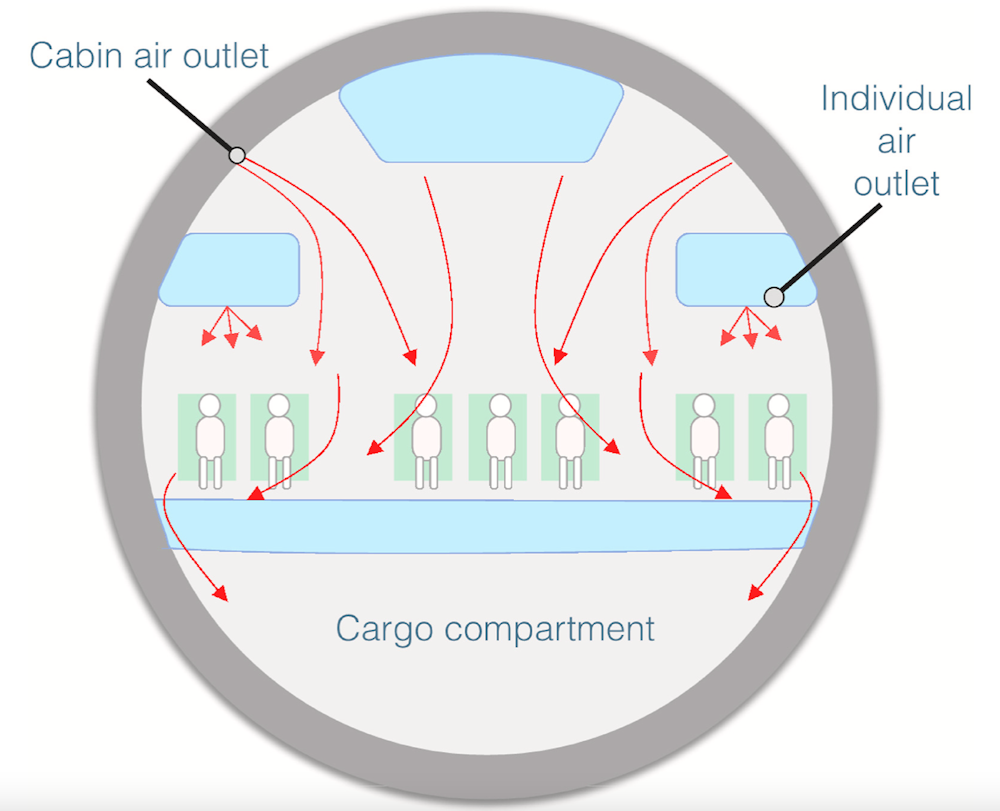
Air flow is designed to largely travel vertically, from the ceiling to the floor, to reduce the potential spread of contaminated air through the plane.
The height of the seats acts as a partial barrier to air movement from rows in front and behind you.
Cabin air is also replaced every two to three minutes with a half-half mix of recycled and fresh air.
To see how this works in real life, researchers looked at how the virus spread on a long-haul flight when an infected person (the index case) sat in business class.
Twelve of 16 people who were infected on the plane sat within a few rows of this person; another was a flight attendant. This suggests limited spread of contaminated air through the rest of the plane.
Recycled air is also filtered through high-efficiency particulate air (or HEPA) filters. These remove more than 99% of viral particles, further reducing the risk of droplet or airborne transmission.
Masks
Well fitted masks or respirators (worn properly) can reduce your risk of contracting COVID on a flight. That’s why many airlines say wearing a mask is a condition of flying.
For example, modelling of several known transmission events on planes demonstrates an advantage if both the infected person and others around them wear masks.
Vaccination
Some countries, such as Australia, require entering travellers to be fully vaccinated. This lowers the risk of someone becoming sick with COVID.
Read more: Your unvaccinated friend is roughly 20 times more likely to give you COVID
Pre-flight COVID testing
Not all flights require a negative COVID test before boarding. For those that do, the time frame before a flight varies, as does the type of test required.
However, we know tests do not detect every single COVID case. A range of factors can influence test sensitivity (ability to detect COVID). These include the type and brand of test you take, whether you have symptoms, your age, and the viral variant.
You can also still test negative two days before a flight and catch COVID in the meantime.
Read more: 15 things not to do when using a rapid antigen test, from storing in the freezer to sampling snot
Sanitisation
Airlines may do additional cleaning of high-touch areas, and overnight disinfection, to reduce the spread of COVID through touching contaminated surfaces.
However, the risk of transmission by this route is low compared to the risk of catching COVID through breathing in infectious droplets and aerosols.
When and where are you most at risk?
The closer you are to the infected person
Most transmission occurs within two to three rows of an infected person. If you sit next to someone who is coughing or has other symptoms you might ask to move seats if spare seats are available.
Distance yourself from others if you can, particularly when getting on and off the plane.
You might also avoid sitting close to the toilets as passengers will hang about in the aisles waiting to use them, particularly on long flights.
The longer the flight
The risk increases with long- versus short- or medium-haul flights. During long-haul flights passengers are also more likely to recline their seats. This somewhat reduces the protection upright seats provide in reducing air movement between rows.
If you or others are not wearing a mask or wearing it properly
You can breathe infectious particles in and out via your nose as well as your mouth, so don’t wear your mask under your chin or nose.
The risk also increases when everyone takes off their masks during food service. You might choose not to eat or drink on short flights to avoid this. Alternatively you might bring a snack to eat before food service begins, or eat after those around you.
If you contaminate your food or your face
You can catch COVID through touching your food or face with contaminated fingers. Sanitise your hands regularly and train yourself to not touch your face.
If you are in business class
Based on limited reports, the transmission risk appears higher in business class. This is possibly because of more interruptions to mask wearing due to greater service of food and drinks.
Authors: Thea van de Mortel, Professor, Nursing and Deputy Head (Learning & Teaching), School of Nursing and Midwifery, Griffith University


















