

Understanding Ukraine’s symbolic fight to return to Europe, as the EU marks 18 years since its 'big bang’ enlargement
- Written by: Mathew Doidge, Senior Research Fellow, University of Canterbury
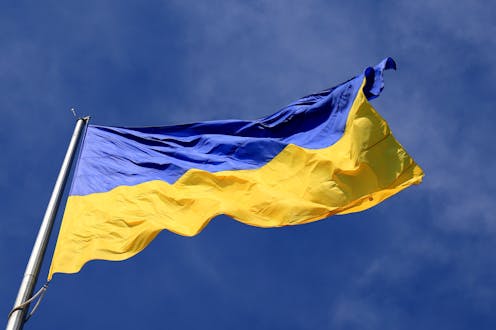
With the weight of Russian military might bearing down on it, Ukraine applied to join the European Union (EU) on February 28. While the Russian invasion provided the immediate pretext, membership had been on the Ukrainian political agenda since the Orange Revolution of 2004–2005.
President Volodymyr Zelenskyy’s request was a symbolic act. It was a claim for Ukraine’s European identity to be acknowledged, and a turning away from Russia towards the West. It recognised the EU as representing a set of values and ideals which Ukraine claimed to share, in contrast to the regime of Vladimir Putin.
Zelenskyy also wanted to set Ukraine on a path taken by eight Central and Eastern European countries (CEECs) almost two decades earlier. May 1 is the 18th anniversary of the “big bang” enlargement of the EU, when Czechia (also known as the Czech Republic), Estonia, Hungary, Latvia, Lithuania, Poland, Slovakia and Slovenia, alongside Cyprus and Malta, were welcomed into the Union.
The stabilisation and transformation of the CEECs through the 2004 enlargement has been one of the most significant successes of European integration. The underlying intention has always been to promote peace and stability on the European continent, preventing a return to the conflict that produced two world wars.
Reflecting on the first eastern enlargement on its 18th anniversary can help us understand Ukraine’s desire for membership.
The return to Europe
When the Iron Curtain fell, an air of celebration spread across Europe. For Eastern states, the physical barrier denying them their European identity was gone. In the words of former Czech president Václav Havel:
[W]hat has triumphed is the realistic hope that together we can return to Europe as free, independent and democratic nations.
As that early elation began to subside, however, the challenges became clear. By the early 1990s, tentative transitions toward democracy and market economics were taking place, but the CEECs were experiencing increasingly severe economic hardship. There were concerns that public support for the reform process would waiver, risking instability and conflict.
With increasing uncertainty surrounding the future of the CEECs, Western states – chiefly Western Europe – saw a need to reinforce the transition process. Initial arms-length solutions, with the Eastern states seen as external EU partners, soon fell by the wayside. Pressure mounted to fulfil the promise enshrined at the launching of European integration: that membership was open to all European states.
For the CEECs, the symbolic attraction of being part of the EU was immense: accession provided a practical expression of the aspiration expressed by Havel and others for a return to Europe, an aspiration from which they would not resile.
Read more: West must beware the language of appeasement and see Russia's war on Ukraine for what it is
The result in 1993 was a commitment to accession from EU leaders, and the outlining of membership criteria which would frame the transition process. Enlargement became the primary tool through which principles of democracy, the rule of law and free market economics were established in the CEECs. Convergence with their European partners was fostered, peace and stability were pursued.
This entailed a significant commitment on the part of the EU. Enlargement required addressing changes to the delicate balance between member states that defines the way the Union operates.
It also involved significant financial costs to facilitate the political and economic convergence of the eastern states. By 2003, the CEECs had received more than €16 billion in pre-accession support, and by 2020 more than €200 billion under a range of instruments designed to reduce EU regional disparities.
Stabilisation and transformation
In the three decades since 1993, and the 18 years since their accession, the CEECs have converged significantly with their western counterparts, a process that has led from uncertainty to stability.
Sustained economic growth has seen CEEC economies collectively expand almost sixfold since 1990, accompanied by improvements in life expectancy at birth (now between five and eight years greater compared to 1990) and infant mortality (declining on average from almost 13 per 1000 live births to fewer than three).
Read more: How Russia's fixation on the Second World War helps explain its Ukraine invasion
Politically, democratisation was largely consolidated and stabilised, notwithstanding recent backsliding in Poland and Hungary. The transition to full democracy remains incomplete – all eight CEECs were listed in the 2021 Democracy Index as “flawed democracies” (as was the US).
But compared to other former Eastern Bloc states, they have performed well, ranking in the Democracy Index’s top seven (with Hungary 10th) out of 28 states in the central and eastern European region.
EU membership has established democracy as a baseline expectation against which the CEECs may be held to account by fellow member states (as with Poland and Hungary) and, more importantly, by their own people.
Symbolic value
The EU’s values and ideals (including democracy, human rights and the rule of law), and its perception as a region of peace, prosperity and stability, have made it a major pole of attraction for the former Eastern Bloc states, including Ukraine.
This pull has arguably been strengthened by the successful integration of the eight CEECs. They have since been followed by Bulgaria and Romania in 2007, and Croatia in 2013, with five more states at various stages along the same path: Albania, Bosnia and Herzegovina, Montenegro, North Macedonia and Serbia.
That the EU has been able to turn this attraction into the (albeit imperfect) consolidation of democracy and economic transformation in Eastern Europe – and in doing so building towards the underlying goal of regional peace and stability – must be acknowledged.
More than that, after the war of 1939–1945 that gave rise to European integration, and remembering more recent conflicts just beyond the Union’s borders – and now in Ukraine – the EU’s contribution to peaceful transformation, recognising the aspirations of the people of eastern Europe, should be celebrated.
Understanding the successful integration of the CEECs into the Union also helps us understand Ukraine’s motivation for membership. It is about placing a stake in the ground, claiming an identity and a heritage, and building toward a peaceful and prosperous future.
Authors: Mathew Doidge, Senior Research Fellow, University of Canterbury


















