

Judith Wright, an activist poet who was ahead of her time
- Written by: Tony Hughes-d'Aeth, Professor, The University of Western Australia
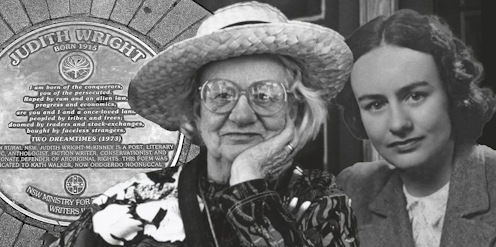
Judith Wright is a giant of Australian letters. Though most famous as a poet, she was also a very fine writer in prose, and it is this dimension of her writing that is brought to life in a new selection of her non-fiction.
Review: Judith Wright: Selected Writings, edited by Georgina Arnott (La Trobe University Press).
The works have been selected and introduced by Georgina Arnott, author of The Unknown Judith Wright (2016). Arnott draws on essays published by Wright during her lifetime in the collections Because I Was Invited (1975), Going on Talking (1991) and Born of the Conquerors (1991).

A master of devastating understatement
It is important to emphasise the sheer pleasure of reading Wright’s work. She is a gifted prose writer. Never showy, she is instead a master of devastating understatement. She writes aphoristically, but often you do not notice the aphorisms, because they spill out gently and without the showman’s characteristic pause for effect.
Her irritation almost never comes to the surface, but on occasion she takes the briefest moment to set certain presumptions back in their place. “To sentimentalise women is to despise them,” she writes in “Women Writers in Society”.
In a later essay, “Transcending Womanliness”, she begins by quoting the words of Vincent Buckley from the 1950s:
When [Wright] is content to be a woman, enduring the profound incident of woman’s life, she is able, paradoxically enough, to transcend her womanliness and be a very fine poet. When she attempts to be not a woman, but a bard, commentator or prophet, she becomes a bit of a shrew – which is the worst and most unwomanly of things that a woman may become.
That Buckley, a not insensitive poet, could blithely call someone of Wright’s stature a shrew is a reminder of what it was like for women who dared to write. The deep dignity of Wright makes this easy to forget, but she did not have the luxury of setting this matter aside entirely.
One sees traces of the stultifying sense of “culture” in the immediate post-war years in Wright’s earliest literary criticism. She was not averse to a certain Olympian coolness that was the keynote of mid 20th century Anglo-American literary criticism. Her review of Verse in Australia (1960) affects bemusement at the new speaking registers appearing in contemporary poetry. She finds in the work of younger poets, a poetry that “was conducted on an oddly conversational level”.
What is significant, though, is not this cultural moment, but what happens to Wright in the years just after this. Many of her contemporaries, including Buckley, doubled down on Leavisite prescriptions grounded in a Great Tradition, but Wright opened herself to the world. As a publisher’s reader at Jacaranda Press, she promoted the manuscript of a book of poems that would become We Are Going (1964) by Kath Walker (later Oodgeroo Noonuccal).
Oodgeroo’s volume was the first published book of poetry by an Indigenous Australian. It was dismissed by literary critics, who had their standards, but remained deaf to the call of history.
Wright, however, immediately grasped the significance of Oodgeroo’s work, and if one looks at Wright’s life – which is what this collection affords – one sees moments like this time and again: moments that show Wright to be often decades ahead of her fellows.
Her essay, “The Koori Voice: A New Literature” (1973), is startlingly early in its appreciation of Indigenous writing in Australia. It shows how laggard others were to see what was staring them in the face. While other critics could only grimace at what they deemed a childlike earnestness in the poems of Oodgeroo and Jack Davis, Wright was able to calmly see the radical significance of the new Aboriginal writing.
Read more: A thousand yarns and snapshots – why poetry matters during a pandemic
Environmental activism
It is a similar story with Wright’s apprehension of the environment.
Certainly, there were environmental voices prior to Wright. Elyne Mitchell’s Soil and Civilisation (1946), an impassioned plea for improved soil conservation, appeared in the same year as Wright’s The Moving Image. Yet Wright was one of the first to mobilise the newly globalised sense of the environment that reached a point of inflexion with the publication of Rachel Carson’s Silent Spring (1962).
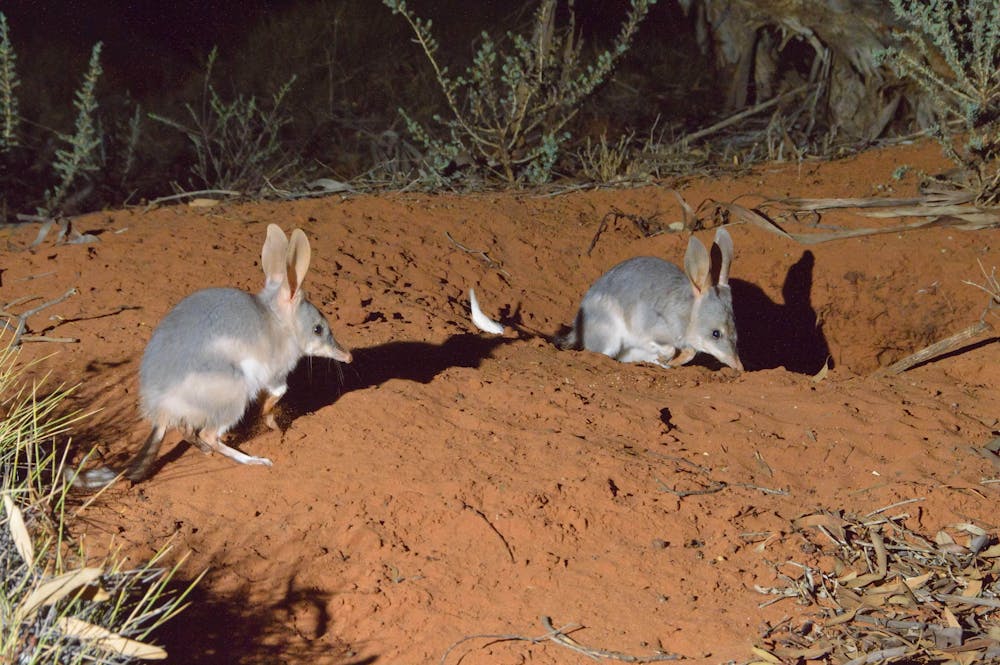 A pair of bilbies in the Scotia Wildlife Sanctuary, NSW. Wright was at the front line of some of Australia’s first major conservation campaigns.
AAP Image/Supplied by the Australian Wildlife Conservancy, Wayne Lawler
A pair of bilbies in the Scotia Wildlife Sanctuary, NSW. Wright was at the front line of some of Australia’s first major conservation campaigns.
AAP Image/Supplied by the Australian Wildlife Conservancy, Wayne Lawler
In 1962, Wright was one of the founders of The Wildlife Preservation Society of Queensland. In 1964, the same year that Oodgeroo’s We Are Going was published, Wright became its president, a role she would serve until 1976. It was this role that took her to the front line of some of Australia’s first major conservation campaigns.
Read more: Hidden women of history: Kathleen McArthur, the wildflower woman who took on Joh Bjelke-Petersen
With this collection of Wright’s work, one is able to watch her thought moving with persistent acuity through moments of epiphany and revolution. The steadiness of her voice can sometimes disguise the radical shifts in her thinking as she reconceives the basic coordinates of literature, environment, settler history and Indigenous reconciliation.
As well as being an activist, Wright was a crucial witness to the actions she undertook. Some years ago, I had occasion to read her book We Call for a Treaty (1985), which traced the work of the Aboriginal Treaty Committee, on which she served from 1979 to 1984. Expecting a fairly dry account of the committee’s work, I was struck by how crisply the tale was told, how deftly it set the scene, how lucidly the problems were rendered. In fact, I found the book utterly riveting.
 Editor Georgina Arnott has provided a fuller picture of Judith Wright’s prose writing than previously existed.
Black Inc.
Editor Georgina Arnott has provided a fuller picture of Judith Wright’s prose writing than previously existed.
Black Inc.
Among her other virtues, Wright’s expository prowess deserves more than a passing mention. On every page of this new collection, and across a multitude of topics, Wright’s writing voice never falters – the clarifying poise of her phrasing, her unerring eye for the telling detail and the timeliness of her counterpoints.
For me, though, and this may well be a matter of personal taste, I was most won over by Wright’s environmental writing. In particular, the triumvirate of essays that follow in quick succession in this collection, “Conservation as a Concept” (1968), “Our Vanishing Chances” (1972) and “Conservation: Choice or Compulsion” (1975) left me breathless with their scope and clarity of vision.
What these essays carry is not only Wright’s trademark erudition, and her acute sense of the fatal interplay of historical forces, but the grain of life lived in the service of environmental struggle – the day-to-day praxis of fighting to save things.
Read more: Friday essay: Judith Wright in a new light
A path of repair
And by things, we must say without hyperbole, the world. For what is Fraser Island, what is the Great Barrier Reef, if not the world in its substance?
Wright’s vision seemed to directly repudiate the instrumental logic that relentlessly removed life from the world under the euphemism of selective appropriation. Mining the sand from Fraser Island is not just the selective removal of a resource: it destroys the world.
Wright begins “Conservation: Choice or Compulsion” with these remarks:
Until very recently, most Australians felt that they were in possession of a virtually unlimited country whose only problems were those of “development”, “progress” and population. This unexamined attitude has coloured the whole of Australian settlement, and still rules the thinking of many people. The older generation, brought up in times when it seemed true, still thinks and acts in such terms; and our whole legislative, economic system is based on it. It might be called the Australian Myth, and an accepted social mythology is very hard to change even when facts emerge to contradict it.
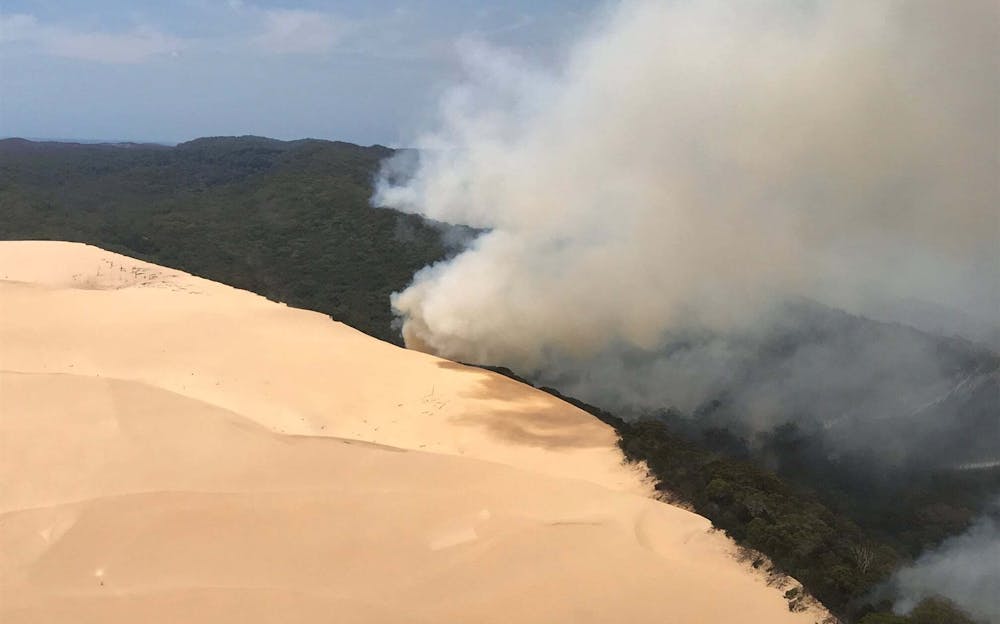 An aerial image of a fire on K'gari (Fraser Island) captured on Monday 30 November 2020.
QFES/AAP
An aerial image of a fire on K'gari (Fraser Island) captured on Monday 30 November 2020.
QFES/AAP
This essay goes on to provide an unblinking account of Australian environmental failure, and how ecological destruction is wired into the basic circuitry of the nation. She is under no illusion about the difficulty of change:
The sweeping changes needed to cope with such a radically new position [i.e. “that we are coming hard up against certain limits”] are difficult enough to make any planning and implementation of them both unpopular and highly delicate from a political point of view.
Though I knew many of the more famous essays in this collection, there were many I had never seen. One of the essays that had slipped beneath my notice was “Australia – Landscape Ancient and Modern”, which was published in the collection Australia Fair? (1984).
In this essay, Wright takes the reader around the continent of Australia, effortlessly offering up its geological and environmental history, floating like a kind of spirit through the diverse biomes of this unique land.
Under her pen, Australia, not as nationalist unity, but as an assemblage of lifeworlds, starts to pulse and come alive. At such moments, this collection brings this great writer back to us.
The collection ends with more intimate writings, including examples from Wright’s letters. A central part of her genius is that she never forgets where she comes from. Her most important thinking can be traced to her upbringing within her family’s pastoral empire.
Raised in the bosom of New England squattocracy, Wright was able to see firmly what everyone else was trying desperately and constantly to forget. Prising herself from the self-exculpatory myths of a pioneering family set her on a path to see the world for what it is.
The recognition that she was “born of the conquerors” was something Wright met with decisive courage. Her instinct was never to wring her hands or offer empty platitudes, but to set out a path of repair.
Authors: Tony Hughes-d'Aeth, Professor, The University of Western Australia
Read more https://theconversation.com/judith-wright-an-activist-poet-who-was-ahead-of-her-time-178422


















