

Centre-left parties worldwide have struggled to reinvent themselves – what kind of ALP is fighting this election?
- Written by: Rob Manwaring, Associate Professor, Politics and Public Policy, Flinders University
With due caution about the (in)accuracy of opinion polls, Australian voters may bring in a Labor government on May 21. If so, what kind of government would they get?
One obstacle to answering this is that the Australian Labor Party (ALP) has been out of office for so long, having lost three elections since 2013. And it’s difficult to find comparable case studies, as the social-democratic left has generally not performed well in various elections over the past decade or more.
British Labour, for example, has lost four elections since 2010, although it’s showing signs of revival with Keir Starmer at the helm.
And the tide may be turning in the left’s favour. New Zealand Labour formed a coalition government after the 2017 election and then, following an election dominated by COVID-19 in 2020, hit a record high of 50% and won a single-party majority (virtually unheard of under the proportional MMP system).
And in Germany, social democrat Olaf Scholz now leads a coalition as federal chancellor following last year’s election.
Three brands of labour
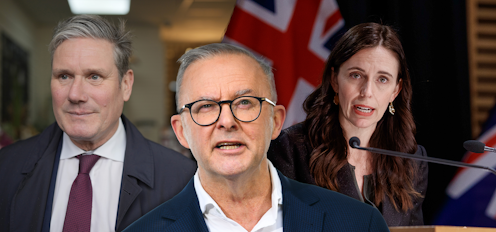
The three labour parties (British, Australian and New Zealand) have converged around some key values and ideas, indicating how the ALP might govern. There’s always likely to be a gap between rhetoric and actual policy implementation, but examination of leaders’ speeches gives some evidence about where they’re heading.
Our comparative analysis of speeches by the three party leaders indicates a “thin” labourism in relation to the parties’ social-democratic traditions.
ALP leader Anthony Albanese’s key speeches since becoming leader in 2019 show he’s big on economic growth, with an emphasis on social mobility (“aspiration”), fairness and security.
Along with talk of jobs and wages – essential themes for any politician wishing to appeal to working people – there’s reference to nation-building and infrastructure. These themes are reflected in the approach being taken by shadow treasurer Jim Chalmers.
Albanese, Starmer and New Zealand’s Jacinda Ardern are alike in that their speeches use the words “economy”, “growth” and “jobs” more than any others – although Ardern refers to the environment noticeably more frequently than the other two.
Like Starmer and Ardern, Albanese downplays traditional social-democratic vocabulary like “progressive”, “dignity”, “solidarity” and “equality”. These leaders also lack the enthusiasm of the third-way “soft neoliberals” who governed during an era of deregulation and downsizing and yet claimed they could “modernise” social democracy, as popularised by the UK’s former prime minister Tony Blair.
Safe centrism
Today’s labour leaders do, however, steer a “safe” centrist path between being pro-growth (or at least not anti-business) and seeking gains for low- and middle-income earners.
They normally avoid explicit talk of class, redistribution and trade unions. None of them critiques the market economy – they just want it to be fairer. Once in office, the gains for workers from a labour government will be incremental, not transformational.
Read more: How much do mainstream media matter in an election campaign? (Spoiler: more than you might think)
One can see this in New Zealand. The pandemic has meant a major detour, but Ardern hasn’t made great progress towards her avowed social goals: getting everyone into an affordable home and reducing child poverty. The gains she can cite are incremental at best.
Under Albanese, the ALP removed some politically troublesome tax policies which had originally been intended to deliver greater fairness. Labor reversed its 2019 policy positions on negative gearing, capital gains tax and franking credits. Further, Albanese announced no lift in the unemployment benefit under Labor, and also signed up to the Coalition’s stage three tax cuts – in effect removing an entire income tax bracket.
In the campaign he presents himself as professional, “reasonable” and a safe pair of hands – but above all, not radical. There have been some “gaffes and stumbles” and then a positive COVID test, but the latest polls will be reassuring.
A thin ideological platform
One impact of the pandemic has been a return of strong governmental action backed by borrowing. At the state level, premiers (notably Labor premiers) have gained credit for taking more decisive (or less indecisive) actions to prevent spread of the disease, reduce pressures on hospitals and save lives.
New Zealand Labour’s exemplary performance in disease control showed how a government can be rewarded electorally for this – although recent opinion polls show Ardern’s government could be beaten by a centre-right coalition next year.
Read more: If Labor wins the election, he is set to become the next federal treasurer. So who is Jim Chalmers?
Ardern’s commitment to lift the minimum wage, and Starmer’s and Albanese’s focus on job security exemplify the incremental approach that’s focused on workers but doesn’t want to “frighten the horses” of capitalism.
Labour leaders have to work harder than their centre-right opponents to convince voters they’re not anti-business, that they understand macroeconomic policy and that they won’t get too tax-hungry – and yet also appeal to those for whom “economy” might mean how the next paycheck will cover rent and groceries.
Labour parties now find themselves on a thin ideological platform, anxious not to be an easy target for their pro-business opponents, especially during an election campaign.
An attenuated social-democratic value base is all that’s left now.
Authors: Rob Manwaring, Associate Professor, Politics and Public Policy, Flinders University


















