

Over the last 30 years, a fifth of polls have called the wrong winner. Here are 3 things poll-watchers need to understand
- Written by: Murray Goot, Emeritus Professor of Politics and International Relations, Macquarie University
With voting already underway, and the sausage sizzle less than two weeks away, there are three things worth knowing if you are trying to work out which side is most likely to win:
- the likely result in terms of the two-party preferred vote
- the record of the electoral pendulum, based on the two-party preferred vote, in predicting election outcomes, and
- the record of the opinion polls in predicting how far the electoral pendulum is likely to swing.
Here’s how are they used together to predict a result.
Read more: As the election campaign begins, what do the polls say, and can we trust them this time?
The two-party preferred
The two-party preferred vote (which compares Labor and the Coalition) combines the first preferences with second or other preferences.
If Labor wins 51%, the Coalition wins 49%, and vice versa; the numbers always add up to 100.
But the two-party preferred, on its own, is not enough to predict the outcome of the election. You also need to get your head around the electoral pendulum.
The electoral pendulum
Devised by psephologist Malcolm Mackerras in 1972, the pendulum lists the seats held by Labor and the Coalition in ascending order of their two-party preferred results.
There are various versions of the electoral pendulum online, but the ABC’s is regarded as definitive.
The 2022 pendulum is based on the results of the 2019 election, adjusted for subsequent changes in electoral boundaries in Victoria and WA.
Nominate a national two-party preferred vote, and the pendulum promises to predict each side’s share of the seats.
True, this promise has been fulfilled only twice in the 19 elections held since 1972.
But it’s usually quite close; at four elections it has fallen short by only one seat, and at eight by no more than two or three. Not a bad record.
More importantly, the pendulum has only twice failed to predict which side would form government:
- in 1998, when Labor won 51% of the two-party preferred result but got 12 fewer seats than the pendulum predicted, a result that allowed John Howard to survive; and
- in 2010, when the Coalition won 49.9% of the two-party preferred – enough, on the pendulum, for an Abbott victory – only to see Labor bag five more seats than the pendulum anticipated, allowing Julia Gillard to form a minority Labor government.
As 2010 illustrates, the side that gets more than half the votes won’t necessarily get more than half the seats. Rather, the pendulum works off the margins by which seats are held.
At this election, Labor needs substantially more than 50% of the two-party preferred vote – 51.8% according to the pendulum – to win the majority of seats, 76. This equates to a swing of 3.3 percentage points.
How big a challenge is that? Since the war, there have been 29 elections. Labor increased its share of the two-party preferred vote in 13.
But in only six did it do so by 3.3 percentage points or more, and in only four did it do so by 4.5 points or more (the swing required for it to pick up a two-party preferred result of 53%). Not Mount Everest, but not a stroll in park.
The last time there was a swing to Labor of this magnitude was in 2007.
A two-party vote of 54% suggested by recent polls – a 5.5-point swing – is something Labor has only achieved once since the war. That was in 1969, off a much lower base (a two-party vote of 43.1% not 48.5%, Labor’s two-party vote in 2019).
So, what to make of current polls?
Labor currently enjoys a two-party preferred vote of about 54% in the polls; this translates to a gain of 17 seats on the pendulum.
A two-party preferred result of 53% would, in theory, yield just 10 seats – three more than the seven it needs to form government.
A two-party preferred result of 57%, reported by the latest Ipsos poll, would produce a Labor gain of 30 seats.
According to Sportsbet on Monday morning, punters are expecting a Labor two-party preferred result of 51.6% and a gain of the seven seats it needs, with the Coalition expected to lose another three to independents.
Current doubts about the polls’ accuracy have focused on their 2019 failure, with all of them getting it wrong and by the similar margins.
But over the past 30 years, a fifth of all the polls have called the wrong winner.
More importantly, from 1993 to 2010, the polls median error in calculating the winner’s lead was almost two percentage points.
On a median error of this size, a 54-46 lead in the polls might really be a lead of six (53-47) or ten (55-45), if the polls were entirely accurate.
Similarly, if the polls narrow, a lead of 53-47 could turn out to be a lead of 52-48 or a lead of 54-46.
Errors of this size could make a big difference.
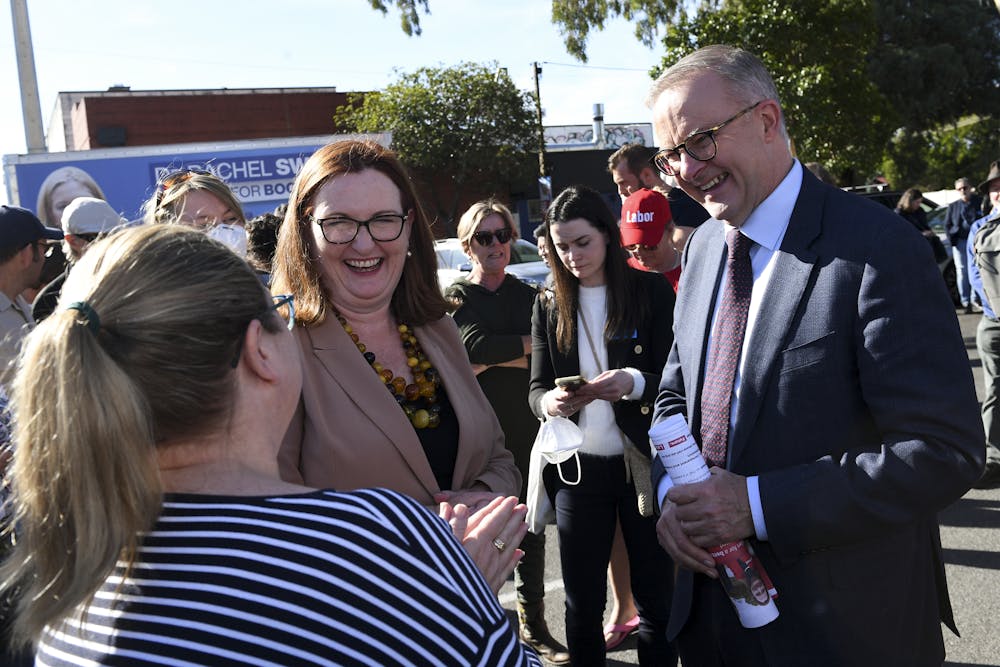
 Over the last 30 years, a fifth of all the polls have called the wrong winner.
AAP Image/Mick Tsikas
Over the last 30 years, a fifth of all the polls have called the wrong winner.
AAP Image/Mick Tsikas
An element of uncertainty
Before the votes are counted, the two-party preferred vote can only be a guesstimate.
In a close contest, even a smaller error could make the difference between:
- a hung parliament in which the Coalition formed government (unlikely this time)
- a hung parliament in which Labor formed government (a more likely outcome)
- a parliament in which Labor commanded a majority in its own right (the outcome to which all the polls are pointing).
History suggests the polls could easily be over-estimating Labor’s two-party preferred; the chances that they are underestimating it are low.
While each of these considerations are important, as we try to work out what’s likely to happen, each involves an element of uncertainty.
Of course, uncertainty is part of life. Maybe you’ll get a good sausage sandwich when you turn up to vote, and maybe you won’t.
Read more: View from The Hill: Labor widens leads in Newspoll and Ipsos, as pre-polling starts
Authors: Murray Goot, Emeritus Professor of Politics and International Relations, Macquarie University


















