

Morrison is hoping for an election surprise but 'uncommitted' voters rarely turn things around in the final week
- Written by: Murray Goot, Emeritus Professor of Politics and International Relations, Macquarie University
The number of voters the Coalition is attempting to sway in the final days of the campaign varies widely, depending on how the targeted voters are defined. But the historical precedent for success to which commentators refer isn’t persuasive.
The party leaders’ final policy announcements and campaign appearances are about shoring up support among voters not yet fully “committed”, pulling “softly committed” voters away from other parties, and persuading those with no clear party preference.
These are the voters pollsters more properly categorise as “don’t knows”, or perhaps “won’t says”, rather than “undecided” – a category that can apply to those who have indicated a choice but aren’t certain about it.
The media will puzzle endlessly over the effectiveness of the leaders’ appeals. Making sense of the evidence, based on varying notions of “commitment”, will be difficult.
The 2004 election is a key reference point. But evidence for a late swing, often said to have saved John Howard that year, needs to be examined carefully.
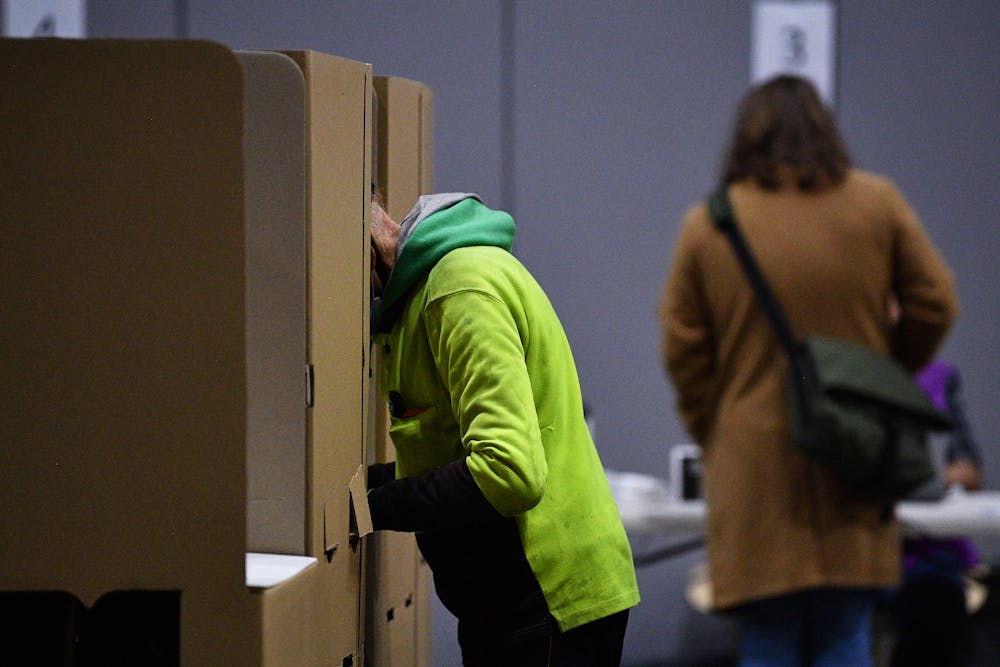
Opinion polls are designed to minimise the number of ‘don’t knows’
Opinion polls are designed to minimise the number of “don’t knows”. The greater the “don’t knows”, the greater the uncertainty about voting intentions and the more difficult it is to decide what to do with them.
Should pollsters ignore them on the grounds they will not vote or vote informal? Or find some other way of working out how they might vote?
Conveniently, pollsters also have a way of ensuring the number of “don’t knows” is small. Respondents who initially refuse to say how they intend to vote are usually asked to which party they are “leaning”. Thanks to this step, none of the polls report a “don’t know” figure of more than 7%.
None of the pollsters say how big the share of “don’t knows” is before the “leaning” question is asked. But the proportion is sure to be much greater than 7%.
The ultimate way of minimising the “don’t knows” is not to register them at all.
Jim Reed, who conducts the Resolve poll for the Sydney Morning Herald and the Age, insists respondents choose a party or independent: no “don’t knows” allowed.
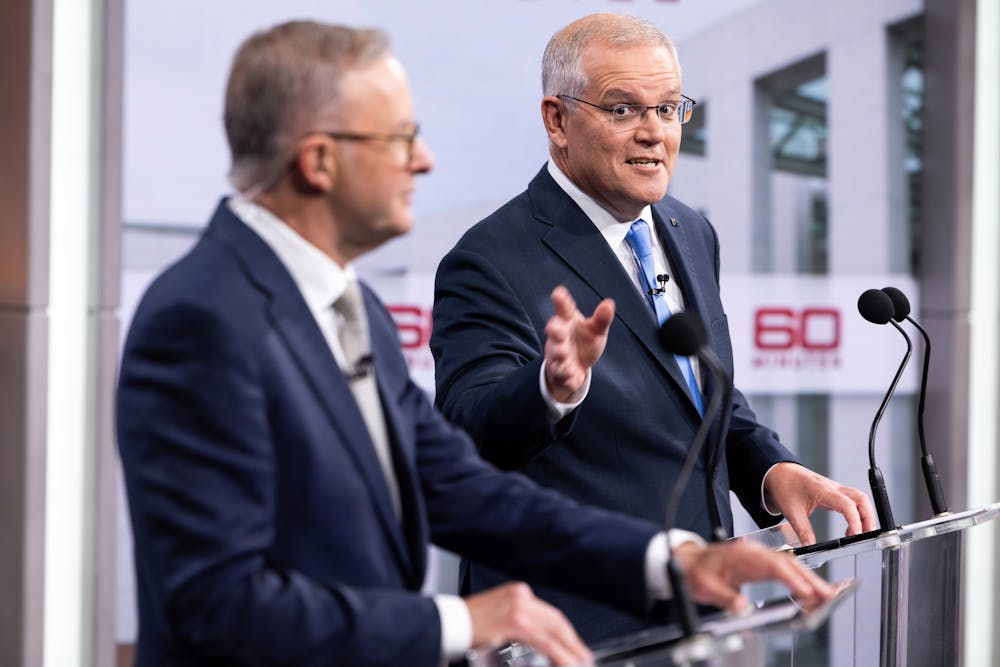 The party leaders’ final policy announcements and campaign appearances are about shoring up support among voters not yet fully ‘committed’.
AAP Image/Pool, Alex Ellinghausen
The party leaders’ final policy announcements and campaign appearances are about shoring up support among voters not yet fully ‘committed’.
AAP Image/Pool, Alex Ellinghausen
But what of respondents who appear ‘decided’ but are not ‘committed’?
However, having forced respondents to choose, Resolve asks respondents: “How firm are you with your vote?”
In its latest poll, recent 86% of respondents are “committed”, 14% are “uncommitted” – a much bigger number than the “don’t knows” reported by other polls.
Party pollsters have their own ways of defining those voters who might be still be “in play”. They ask, for example, about the “hesitations” voters have about Labor/Albanese or the Liberals/Morrison.
The major parties obviously think carefully about the voters they might be able to shift from a minor party or independent, or between Labor and Liberal.
But they also hope to persuade voters who are going to vote first for other parties or independents, to preference them so that they get their vote, two-party preferred.
The numbers the parties are looking to influence vary, but they are much higher than the conventional “don’t knows” or Resolve’s “uncommitted”.
Ahead of the Liberals’s policy speech, the prime minister put the number of voters “either undecided or opting for a minor party of independents” at about 25%.
In the Weekend Australian, Dennis Shanahan put the number even higher. In addition to those intending to vote for minor parties or independents, he says, are those who are “officially uncommitted”, totalling “at least one in three voters”.
There are not enough ‘undecideds’ to neutralise Labor’s lead
Where the proportion that “don’t know” is small, and the gap on the two-party preferred wide – as it is in some, though not all, of the polls – the chances of the “don’t knows” making a difference isn’t great.
In theory, Labor needs 51.8% of the two-party vote to win.
So, even if the “don’t knows” split 2:1 in favour of the Coalition, this would only reduce the the gap in the Morgan poll from six points (47-53) to four (48-52) – not enough to prevent a Labor majority. In the Newspoll, it would reduce it to six (47-53).
The “uncommitted” vote offers the Coalition much greater hope. But caution is called for.
It’s not clear the number of “uncommitted” voters now is much greater than it has been at other elections.
More to the point, there have been few if any elections when, in the last week, it has been the “uncommitted” voters who have turned things around.
Take 2004 with a grain of salt
For those contemplating a boil-over, the 2004 election looms large.
Behind in the polls with about a week to go, the story goes, Howard wrong-footed Labor with his forests’ policy; Labor then shot itself in the other foot when Mark Latham, with a day to go, appeared to grab Howard’s hand and pull Howard towards him.
According to then Liberal campaign director, Brian Loughnane, Latham’s handshake generated more feedback to Liberal Party headquarters than anything else during the six-week campaign, and “brought together all the doubts and hesitations that people had about Mark Latham”.
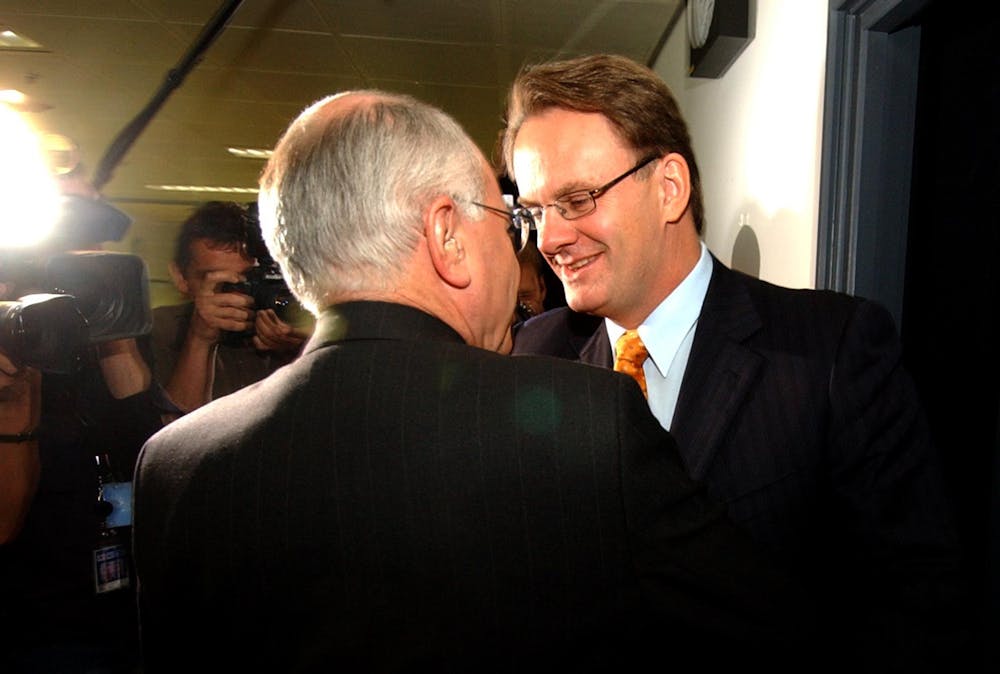 Late in the 2004 election campaign, Labor’s Mark Latham appeared to grab John Howard’s hand and pull it.
AAP Image/Mick Tsikas
Late in the 2004 election campaign, Labor’s Mark Latham appeared to grab John Howard’s hand and pull it.
AAP Image/Mick Tsikas
But the Coalition’s support peaked not at the end of the campaign but in the first few weeks.
It went on to win by a massive majority: 24 seats. Well before the final week, the Coalition already had it won.
Whether or not the “uncommitted” prevent Labor winning this time, the part they played in securing the 2004 win for Howard is more Liberal legend than political science.
Authors: Murray Goot, Emeritus Professor of Politics and International Relations, Macquarie University


















