

Climate change is killing trees in Queensland's tropical rainforests
- Written by: Lucas Cernusak, Associate professor, James Cook University
In recent years, the Great Barrier Reef off Australia’s northeast coast has seen multiple events of mass coral bleaching as human-caused global warming has driven sustained high temperatures in the ocean.
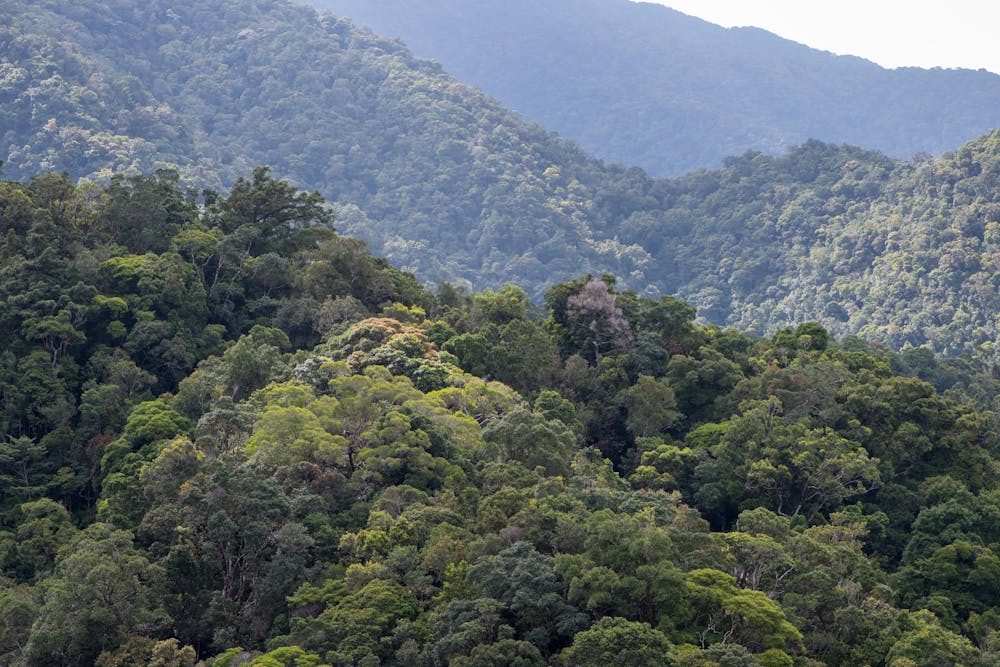
Alongside the Coral Sea is another spectacular natural wonder: the rainforests of the World Heritage-listed wet tropics of Queensland.
It turns out the same climate change forces contributing to coral bleaching have also taken a toll on the trees that inhabit these majestic tropical rainforests.
In new research, we and our co-authors found that mortality rates among these trees have doubled since the mid 1980s, most likely due to warmer air with greater drying power. Like coral reefs, these trees provide essential structure, energy and nutrients to their diverse and celebrated ecosystems.
A 50-year record
Our study was based on 20 plots of trees in rainforests in northeast Queensland, which were created and monitored in a project begun in 1971 by a forest scientist named Geoff Stocker.
These plots were later incorporated into the Wet Tropics of Queensland World Heritage Area, and the monitoring has been carried on by CSIRO scientists based in Atherton, Queensland.
The plots are typically half a hectare (5,000m²) in size. In each plot the species and diameter of all trees larger than 10cm diameter at breast height were recorded.
The plots were revisited at intervals ranging from two to about five years. Tree diameters were recorded again, along with any new trees that had grown into the 10+cm size class, and any trees that had died.
Over the years, a few additional plots were initiated and contributed to our analyses. But these 20 provided a uniquely long record and formed the core of the dataset.
The lifespan of trees
With many plots visited multiple times, and many tree species on each plot, we were able to estimate the average percentage of trees in each species that died in a given year (the “annual mortality rate”). We also examined how this rate has changed over time.
Until about the mid 1980s, the average annual mortality rate was around 1%. This means that any given year, each tree had about a one in 100 chance of dying.
This corresponds to an average tree lifespan of about 100 years.
However, beginning in the mid-1980s, the annual mortality rate began to increase. By the end of our dataset in 2019, the average annual mortality rate had doubled to 2%.
These results match a similar pattern in tree deaths in the Amazon rainforest at the same time, which suggests the increase in tropical tree mortality may be widespread.
A doubled annual mortality rate means that trees are only living half as long as they were, which means they are only storing carbon for half as long.
If the trend we observed is indicative of tropical forests in general, this could have big implications for the capacity of tropical forests to absorb and mitigate carbon dioxide emissions from human activity.
Thirsty air
What caused the increasing mortality rates of the tropical trees?
A first guess might be temperature stress: the average air temperature of the plots has increased in recent decades.
However, we did not find that temperature directly caused the increasing mortality rates. Instead the mortality rates correlated better with the drying power or “thirstiness” of the air, which scientists call the “air vapour pressure deficit”.
You’re probably familiar with the idea of relative humidity. It tells you how much water vapour there is in the air, as a percentage of the maximum amount the air can hold.
When temperatures rise, the air’s capacity to hold water vapour increases exponentially. Each degree of warming lets the air hold about 7% more water vapour.
So if the air temperature increases, and the relative humidity stays the same, the air will have a bigger capacity to take on more water vapour.
To a first approximation, this is what has happened with global warming. Air temperature has increased, relative humidity has remained approximately constant, and the air has become thirstier.
This means the drying power of the atmosphere (or “evaporative demand”) has increased. This is what we found best explained the increasing mortality rates in Australian tropical trees.
What’s next
If greenhouse gas emissions continue unabated, both the air temperature and the air vapour pressure deficit will continue to increase. Our results suggest that in all likelihood this will cause a further acceleration in the increasing mortality rates of tropical rainforest trees.
Like coral reefs, tropical rainforests may then experience relatively rapid changes in species composition, biodiversity, and three-dimensional structure, threatening these prized Australian ecosystems as we know them. The best way to mitigate this threat is to urgently reduce emissions of carbon dioxide and other greenhouse gases, in order to slow global warming and eventually stabilise the global climate system.
Read more: Friday essay: trees have many stories to tell. Is this our last chance to read them?
Authors: Lucas Cernusak, Associate professor, James Cook University


















